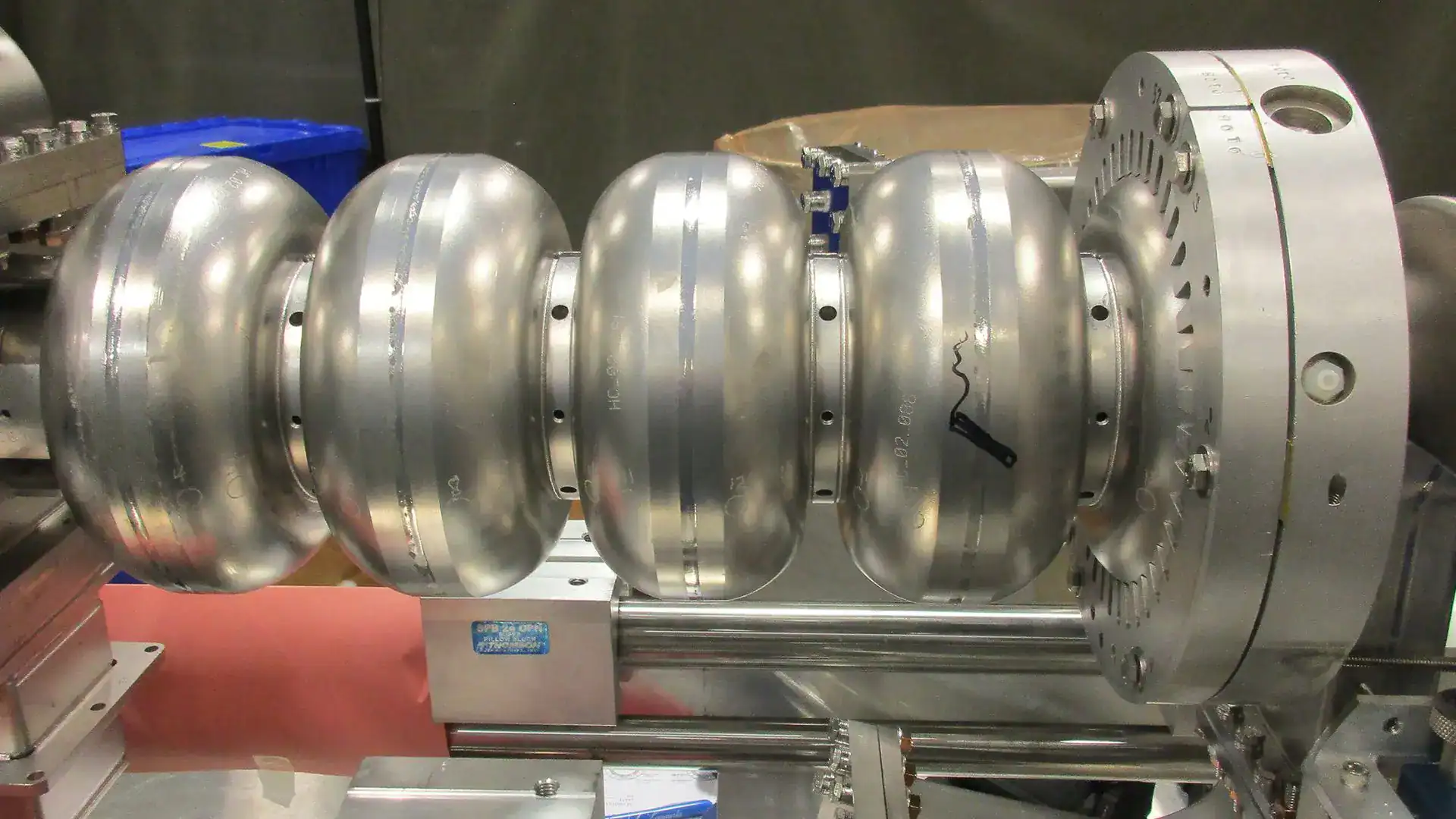
Transforming Nuclear Waste with Particle Accelerators
Background on Nuclear Waste Challenges
Used nuclear fuel poses significant challenges for nuclear energy, remaining highly radioactive for thousands of years and requiring secure, long-term storage solutions. Researchers are now exploring innovative physics tools to reduce the hazardous lifespan of nuclear waste.
Innovative Approach: Particle Accelerators and Subcritical Reactors
A promising methodology involves pairing a particle accelerator with a subcritical nuclear reactor. Traditional reactors create long-lived isotopes like Plutonium-239, which are difficult to manage safely. In contrast, subcritical reactors need an external energy source (the particle accelerator) to maintain their reactions, allowing for the more efficient handling of these isotopes.
Project Funding and Goals
The U.S. Department of Energy’s ARPA-E has provided $8.17 million to the Thomas Jefferson National Accelerator Facility to develop technologies aimed at reducing the longevity of nuclear waste and harnessing some of it for additional energy production.
Waste Management and Resource Recovery
Using accelerator-driven systems, researchers can convert long-lived isotopes into shorter-lived materials through a process called spallation, where high-energy protons collide with heavy targets (like liquid mercury) to release neutrons. This interaction can shorten the storage time for some isotopes from tens of thousands of years to roughly 300 years.
Technical Innovations to Enhance Accessibility
Addressing the cost challenges associated with particle accelerators, researchers are experimenting with niobium-tin surfaces to allow operation at higher temperatures and reduce the complexity of cooling systems. This change could make accelerators more cost-effective and easier to implement.
Collaborative Effort and Industry Partnerships
Working alongside industry partners and leveraging existing accelerator designs, the team aims to transition from laboratory success to real-world applications, furthering the potential of this technology for nuclear waste management.
This innovative use of technology presents a potential solution to one of the nuclear energy sector’s most pressing issues, promising a future where nuclear waste can be turned into a manageable resource.


