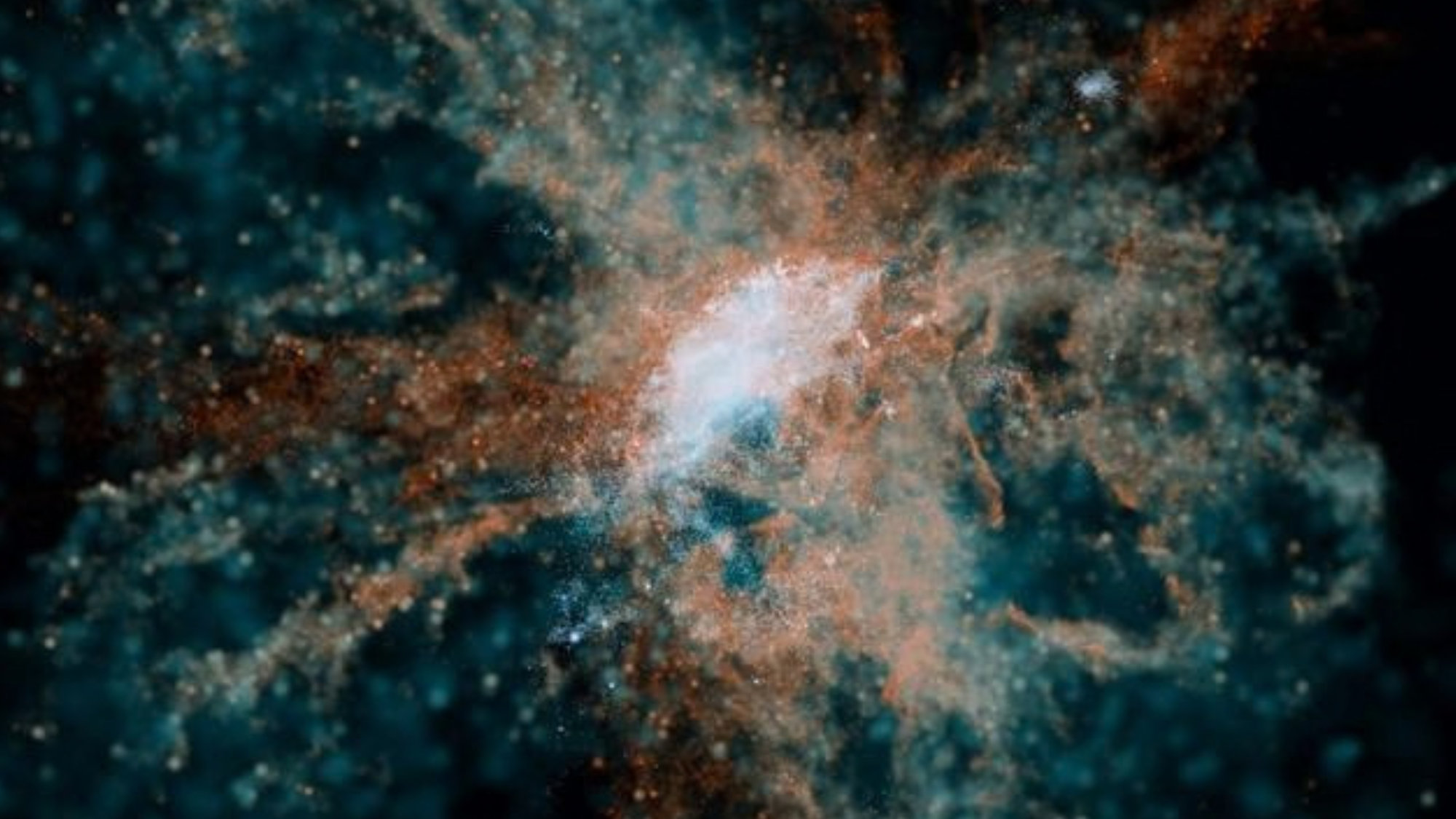
Early Universe Galaxies Enriched with Heavy Elements
Using data from the James Webb Space Telescope (JWST), astronomers have made a groundbreaking discovery: just 500 million years after the Big Bang, galaxies were already emitting heavy elements into the universe. This challenges previous assumptions that the early universe was largely pristine and devoid of such materials.
Formation of Early Stars and Metals
Initially, the universe primarily consisted of hydrogen and a small amount of helium. The first stars, known as POP III stars, formed from these elements. As these stars aged and eventually exploded, they produced and dispersed heavier elements, often referred to as “metals.” Subsequent generations of stars, namely POP II and POP I, became increasingly metal-rich.
New Findings from JWST Research
Recent research utilizing JWST suggests that the process of metal production and dispersion by galaxies occurred earlier than previously thought. The surrounding gas of these early galaxies was found to be rich in elements like oxygen and carbon, even when the universe was merely 3% of its current age.
As Yongda Zhu from the University of Arizona noted, this early distribution of heavy elements is comparable to adding sprinkles to vanilla ice cream—the pure base becomes harder to find as the sprinkles mix in.
Observations of Galactic Light
To investigate the early cosmos, Zhu and his team studied three galaxies as they appeared around 13.3 billion years ago, during the Epoch of Reionization. They analyzed light from these galaxies as it passed through surrounding gas, which absorbed specific wavelengths characteristic of various elements. This allowed them to identify the presence of gases rich in oxygen, carbon, and silicon.
The resulting chemical signatures indicated that these early galaxies were already enriching the surrounding intergalactic space with heavy elements, which resemble those found in contemporary galaxies.
Implications for Astronomical Research
These observations may explain the challenges astronomers have faced in finding POP III stars. Researchers have been searching for evidence of their existence in pristine hydrogen gas, which is believed to have dissipated much earlier than currently understood.
This important research was published in Nature Astronomy on September 24, 2023, furthering our understanding of cosmic evolution and the early universe’s complexity.


