Updates and Insights on New AI Models
Hello everyone, Keshav here. Today, I’m excited to share updates in Ben’s absence, as he is currently traveling.
Let’s dive into three noteworthy new models:
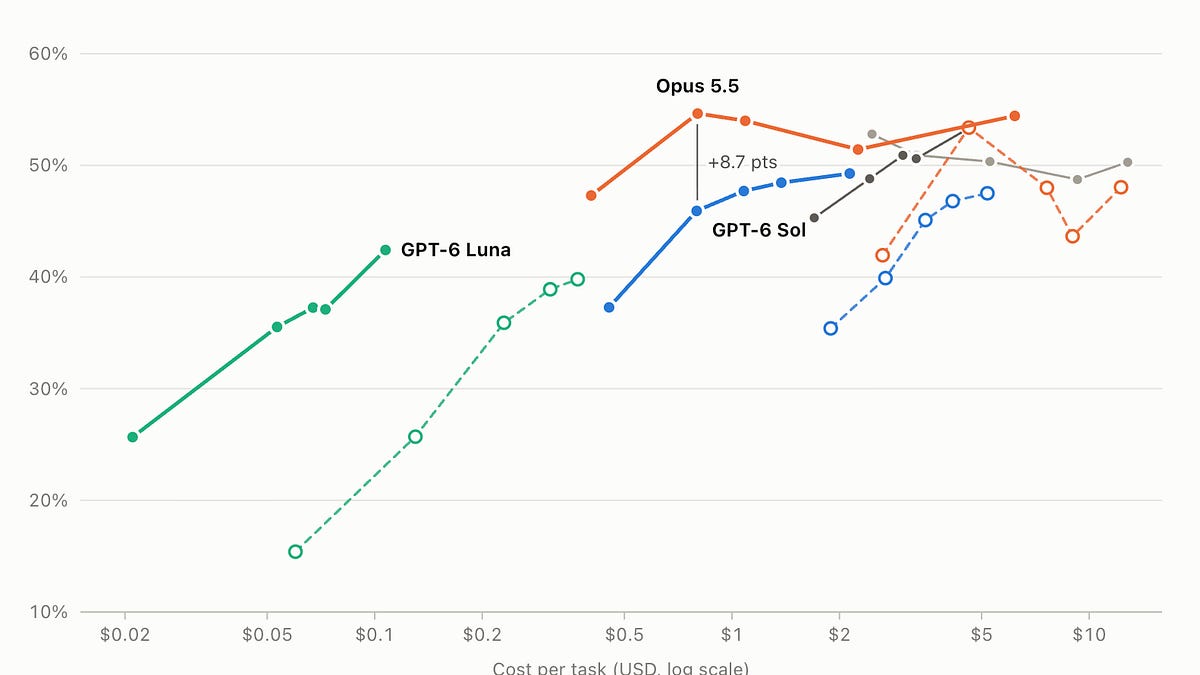
Claude Opus 5.5 – This model stands out as a top contender, outperforming Fable 5.1 in benchmarks, while being more cost-effective than Opus 5. It excels in writing tasks and proves reliable for various applications.
The introduction of Opus 5.5 has also led to a 20% extension of five-hour limits in Claude Code and a new banked rate limit reset.
The default setting for Opus 5.5 in the app is medium. I’ve been experimenting with high and x-high settings for the past two days and only hit the five-hour limit once.
I’ve tasked it with some side projects, which include:
-
ossean.com – “Update filtering to use jev instead of gemini and refresh the website’s design.”
-
shortandlongtail.com – “Rewrite essays using in-depth research.”
-
detroitbench – “Run the three new models and incorporate their findings into the results.”
Everyone seems to believe that it is luring Codex users back to Claude, and I share that sentiment. My preferred tool has shifted to Claude Code since this release.
GPT-6 Luna and Sol from OpenAI – Interestingly, there is no Terra this time around, likely because few were utilizing it. Currently, GPT-6 Luna and GPT-6 Sol are only available in Codex and ChatGPT Work (not in standard chat).
A key feature is that both models are priced at 50% lower than their predecessors, costing $0.10 and $0.50 for Luna, and $2 and $10 for Sol, respectively, per million input/output tokens. Both models feature only a minor improvement in intelligence, with GPT-6 Sol appearing to be a step behind the newly released Opus model.
To test the reduced pricing for Sol, I assigned it a comprehensive task: to develop a Duolingo-like marketing course.

Keshav Jindal@Keshavatearth
let’s see what comes out on the other end.


Ananyaa Gupta @Momosdo
Forget Spanish. I need @duolingo to drop a marketing course 🐦
2:35 PM · Sep 23, 2026 · 596 Views
3 Likes
It first stopped after 1.5 hours with a quite decent output, but I pushed it to work further. Within about four hours, it consumed 22% of my weekly limits on a $100 Codex plan. Here’s what it built.
GPT-6-Astra, on the other hand, uses up limits at an astonishing rate. I plan to experiment more with Astra managing Sol subagents, as it seems like a promising approach.
Ben’s Bites is supported by Adobe Acrobat
Adobe for Claude has just received a significant update: Acrobat tools can now join Adobe’s creative suite in a single plugin, offering access to over 80 advanced tools across imaging, design, video, and document management. New interactive editors enable direct editing of PDFs and Adobe Express designs right within Claude.
Muse at Meta Connect – Zuckerberg is going all-in on Muse, Meta’s personal AI assistant. It can now operate any app on your Mac, make purchases from Walmart, Best Buy, and Sephora, and is set to receive its own email address for threaded discussions. Muse will also be integrated into Meta’s glasses in the coming months.
Zuckerberg claims Muse will remain free for a “substantial number of tokens,” but a small fee may be applied to transactions. Upcoming features include a video-chat avatar for Muse and a Tamagotchi-like keychain to carry Muse around (welcome back, AI pendants).
Gemini 3.8 Flash and Flash-Lite TTS – a new set of speech generation models from Google, costing half as much as 3.1 Flash TTS. Offering 100+ languages and 2000+ voice options, it even includes the capability to clone your own voice. Steve, founder of Tldraw, is impressed with these models, which is a positive indicator.
ChatGPT Voice can now access your email, calendar, and Slack while syncing with Astra, Sol, or Luna models to maximize intelligence and cost efficiency.
Claude Code cloud sessions are now available – with this feature, you can run tasks on a cloud computer instead of keeping your Mac on. Cloud sessions utilize your Pro/Max plan limits as usual, but existing subscribers will receive a one-time credit to test them out – $100 for Pro and $250 for Max. Claim it by October 7.
Claude has discovered a new enzyme system in bacteriophage DNA (viruses that infect bacteria). Its function remains unknown, and previous searches missed it. This shows that we are indeed pushing the boundaries of knowledge.
-
Zapier’s Zaps can now self-repair when they break, and costs decrease the more they operate. (In Beta)
-
The Claude mobile app now supports multiple accounts.
-
MentalHealthBench – benchmark for assessing mental health conversations. GPT-6-Astra leads, followed closely by 6-Sol and Opus 5.5, with Fable 5.1 surprisingly underperforming.
-
Find out how to train your own Jev for just $17.
-
GoodVibes – filter X, Reddit, and YouTube by vibes, easily articulated. Powered by Jev.
-
Cursor has improved its system to save about 7% on token costs.
-
Jeffrey Katzenberg (of Shrek, Kung Fu Panda, and Madagascar) discusses AI in creative processes.
-
Cursor Rollouts – a tool that monitors your deployment and opens a revert PR if issues arise. (Teams and Enterprise)
-
Learn how Anthropic made Claude AI three times faster in two weeks. Prompts are included.
-
Claude Code may replace plan mode. This change seems necessary.
-
Vercel’s Sandbox can now save files with its new offering, Drives.
-
In the near future, your privacy will hinge on the social skills of your agent.
-
Drama 3 by Fish Audio – direct a voice in plain English, even mid-sentence.
-
Monologue has developed its own dictation model aimed at reducing post-transcription edits.
-
What if you could talk to a podcast and receive responses? (Research demo)
- The Open Frontier – discover which open model best fits your use case and the potential savings from switching.
-
OpenAI’s proposal for AI standards, and what external testers should have access to.

Rhys@RhysSullivan
I love prompting for a full walkthrough of a flow
i.e. here, I asked it to show me all the steps involved in OAuth and discovered redundant processes, layout shifts, and some odd UI states.
agents don’t just produce slop; they can also help create excellent software.


7:15 PM · Sep 22, 2026 · 7.46K Views
13 Replies · 2 Reposts · 137 Likes

Benji Taylor@benjitaylor
Your agent can handle significantly more than you are currently asking of it.
6:52 PM · Sep 23, 2026 · 86.6K Views
233 Replies · 115 Reposts · 2.52K Likes

Jake Eaton@jkeatn
For the past few months, I’ve been encouraging our models to create art. Opus 5.5 shows remarkable skills in emulating various styles.
Every image you see here was generated pixel by pixel by a Python program. We utilized neither an image model nor off-the-shelf art software; instead, it consisted of around 7,500 lines of code…

Claude @claudeai
Introducing Claude Opus 5.5, the first model in our new Claude 5.5 family.
It performs at the level of Claude Fable 5.1 for most tasks, and costs 40% less to run than Opus 5.
4:54 PM · Sep 22, 2026 · 704K Views
185 Replies · 318 Reposts · 4.76K Likes