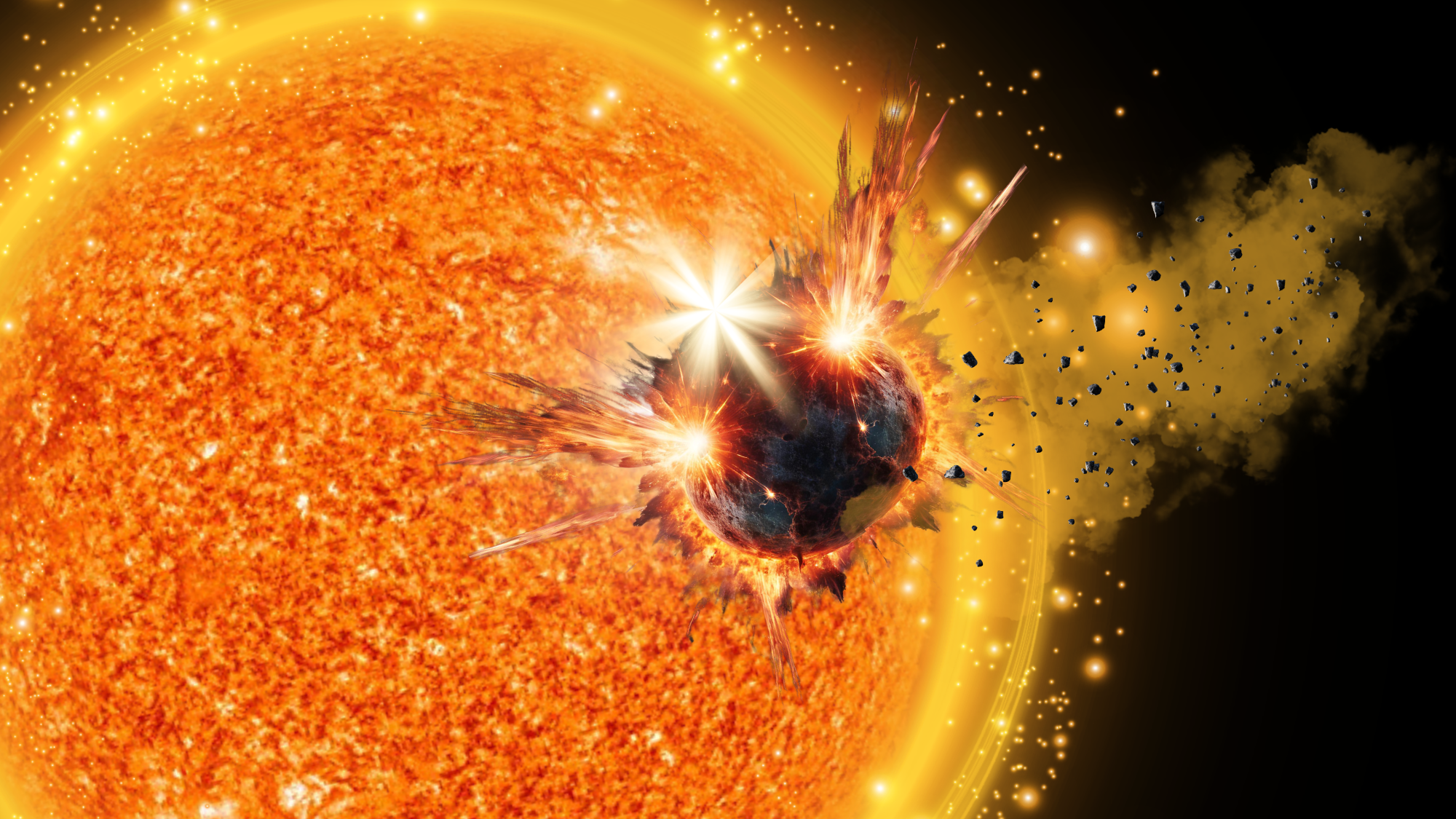
The Sun’s Cosmic Cannibalism: New Research Suggests It Might Have Swallowed a Super-Earth
Recent research indicates that the sun, our primary source of energy and life, may have consumed a super-Earth—an exoplanet several times more massive than our planet—billions of years ago during its early formation. This cosmic event could explain peculiarities in the sun’s current structure and chemical composition.
Evidence of Planetary Consumption
Scientists believe that remnants of this planetary ingestion might still be found within the sun’s interior. According to Mutlu Yildiz from Ege University, Turkey, the chemical imprint from such an event may help explain why our solar system lacks super-Earths, which are common in other planetary systems. Yildiz noted, “A planet several times more massive than Earth may have fallen into the young sun and left a lasting chemical imprint deep inside it.”
Implications for Solar Models
The study challenges existing models of stellar evolution by providing explanations for observed discrepancies, such as the sun’s convection zone depth and its unusual lithium-depleted surface. By comparing solar models with precise observations of the sun’s internal structure, Yildiz and his colleagues found that the ingestion of a super-Earth could clarify these inconsistencies.
The Role of Protoplanetary Disks
Young stars are enveloped by protoplanetary disks of gas and dust, which facilitate the movement of materials between the disk and the star. The research team hypothesized that chaotic interactions between these disks and the young sun might have allowed a super-Earth to meet its end in a violent collision, leaving behind a distinctive chemical signature.
Key Findings from Stellar Modeling
Using advanced modeling software, researchers investigated various scenarios in which the sun could have engulfed a planet. They concluded that the sun’s characteristics align best with the consumption of a super-Earth ranging from five to ten times Earth’s mass. This unexpected conclusion highlights a remarkable characteristic of the sun that was previously unpredicted.
Next Steps in Research
While this study provides potentially revolutionary insights, it also acknowledges that other explanations for the sun’s interior inconsistencies exist. Future research aims to identify the structural and chemical fingerprints left by the hypothesized planetary meal to substantiate the theory of consumption.
The findings were published in the journal Monthly Notices of the Royal Astronomical Society, paving the way for further exploration into the sun’s early history and the dynamics of planetary formation.
For those interested in space and astrophysical phenomena, this research opens up new avenues for understanding our solar system’s formation and what might have transpired in its distant past.


