Black Holes and Their “Burps”: New Insights
Black holes vary significantly in size, from stellar-mass black holes, which have a few times the mass of the sun, to supermassive black holes, boasting billions of solar masses at the centers of large galaxies. Recent research indicates that the “burps” — or jets — emitted by these black holes while consuming stars are surprisingly similar across sizes.
A Shared Mechanism
Scientists have long theorized that the fundamental physics governing black holes, regardless of their size, should be consistent. However, studying this concept has been challenging due to the lengthy evolution times of supermassive black holes.
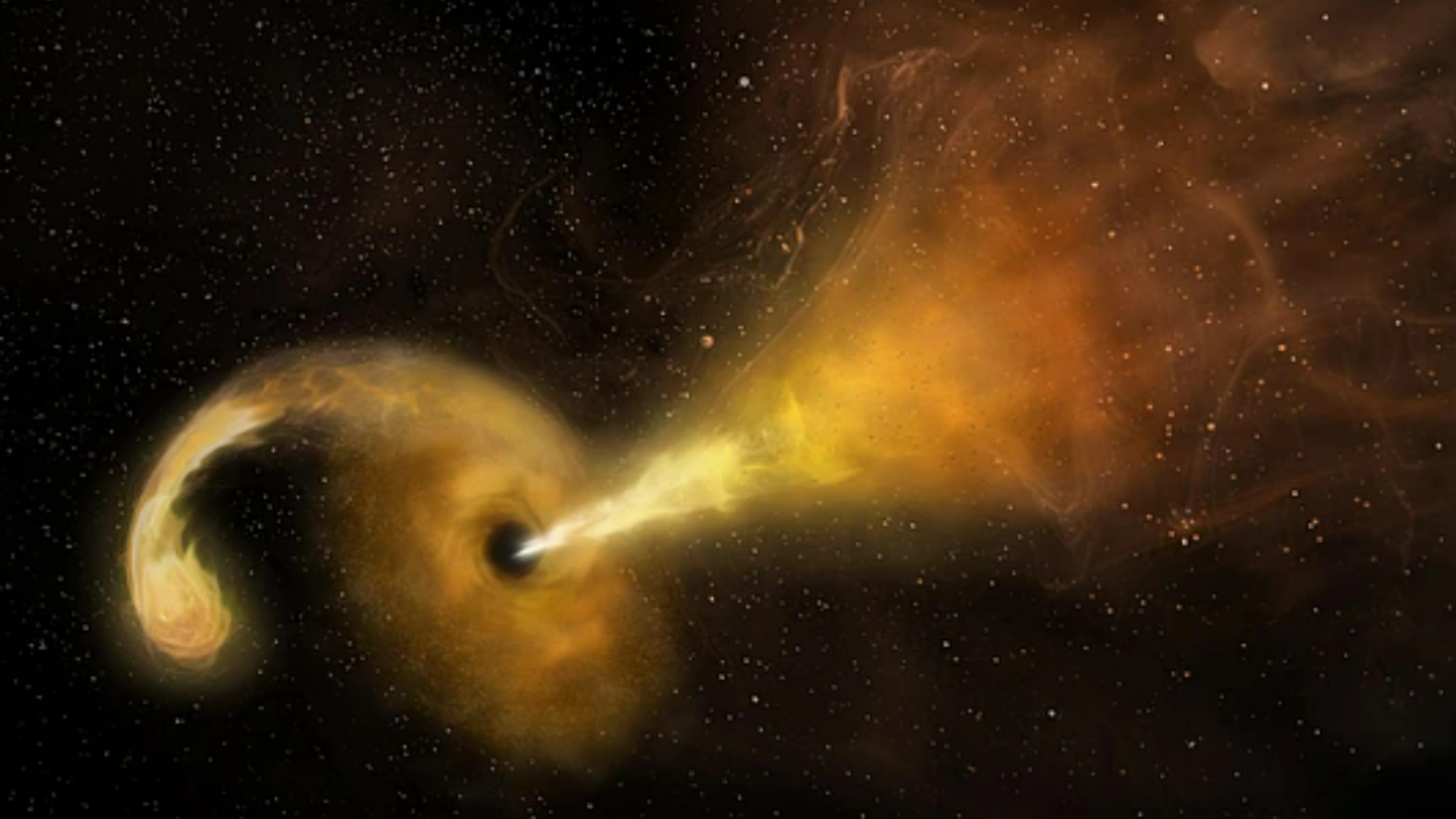
To tackle this, researchers turned their attention to tidal disruption events (TDEs), which occur when a star approaches a black hole too closely, resulting in the intense gravitational forces tearing the star apart — a phenomenon known as spaghettification. This destruction compresses the feeding process into a timescale observable within a human lifetime.
Findings from TDEs
During TDEs, the torn star’s material wraps around the black hole and is then ejected at near-light-speed as jets. However, the mechanics behind jet formation have been a mystery, especially regarding the varying timeframes between feeding and jet ejection.
Researcher Andrew Mummery from the Institute for Advanced Study observed that black holes exhibit two phases of jet-launching. The first occurs during extreme feeding; the second phase takes place potentially years later when the feeding rate has dramatically decreased, often to 2% of the Eddington limit — the threshold where radiation pressure prevents further accretion.
Implications of the Research
The significance of this discovery suggests that both stellar-mass and supermassive black holes create jets under similar conditions. This consistent behavior allows astronomers to potentially predict jet formation for future TDEs, opening the door to more profound discoveries about the universe.
This research was published in Nature Astronomy on September 17, providing exciting prospects for understanding the behavior of black holes and their influence on galaxy formation.


