Astronomers Detect First Radio Emission from Exoplanet Beta Pictoris b

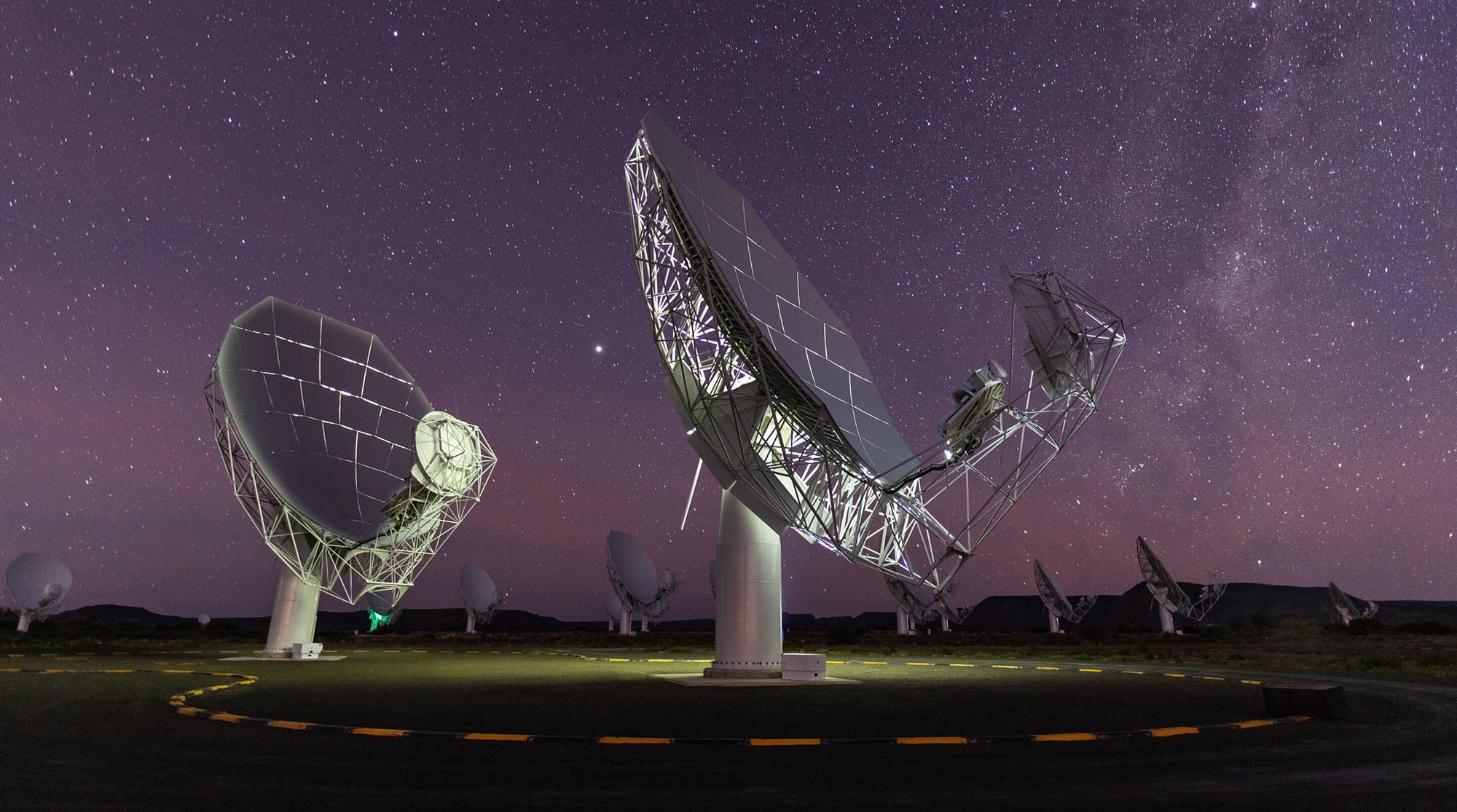
The South African MeerKAT radio telescope, a precursor to the Square Kilometre Array (SKA) telescope. Credit: MeerKAT
For years, astronomers have sought signals from planets beyond our Solar System. They may now have isolated one: the source is Beta Pictoris b, a young gas giant located around 64 light-years away. This discovery marks a significant milestone in exoplanet research but does not imply contact with extraterrestrial life; the signal emerges from natural auroras—a phenomenon similar to Earth’s northern and southern lights.
Discovery Highlights
-
Observational Techniques: Utilizing South Africa’s MeerKAT array, researchers conducted observations of the Beta Pictoris system multiple times between 2025 and 2026. They detected short bursts of radio emissions characterized by circular polarization, indicating a strong magnetosphere.
-
Electron Cyclotron Maser Instability (ECMI): This natural radio emission arises from energetic electrons in a magnetic field. The study published on September 15 claimed to be the first reliable detection of radio signals from an exoplanet, presenting a direct measurement of its magnetic field strength.
Pinning the Signal on a Planet

Image of Beta Pictoris d, orbiting its star. Credit: ESO/B. Sutlieff, M. Bonse et al.
Beta Pictoris b is an attractive target because it is about twelve times the mass of Jupiter and orbits roughly ten astronomical units from its star. This position allows MeerKAT to differentiate between the emissions from the planet and its star.
By referencing the positions of nine quasars and a radio calibrator, researchers successfully pinpointed the radio emissions to Beta Pictoris b, confirming that the observed signal was not from nearby celestial bodies.
Magnetic Field Insights
The radio waves act as a magnetometer. The highest frequency detected, 3.5 gigahertz, implies that the magnetic field at the emission site is at least 1,250 gauss, far stronger than Earth’s surface field of approximately 0.5 gauss.
Yvette Cendes noted the strength of this magnetic field as “incredibly, incredibly strong,” indicating potential for even higher emissions undetected in this study.
Challenges and Future Research
Previous searches for such emissions yielded no results. However, Beta Pictoris b’s robust magnetic field and rapid rotation (every 8-9 hours) distinguishes it from background noise, enabling clearer observations.
Astronomers are enthusiastic about the implications of this discovery for broader exoplanet study:
-
Understanding Atmospheric Interactions: Magnetic fields can shape how planetary atmospheres interact with stellar winds, providing insights into a planet’s internal processes.
-
Next Steps: The researchers identified several more exoplanets that could be investigated using similar techniques, emphasizing the need for telescopes more sensitive than current instruments.
The discovery of Beta Pictoris b’s radio emissions opens new avenues for exoplanet research, allowing researchers to gather valuable data about distant worlds and their characteristics.


