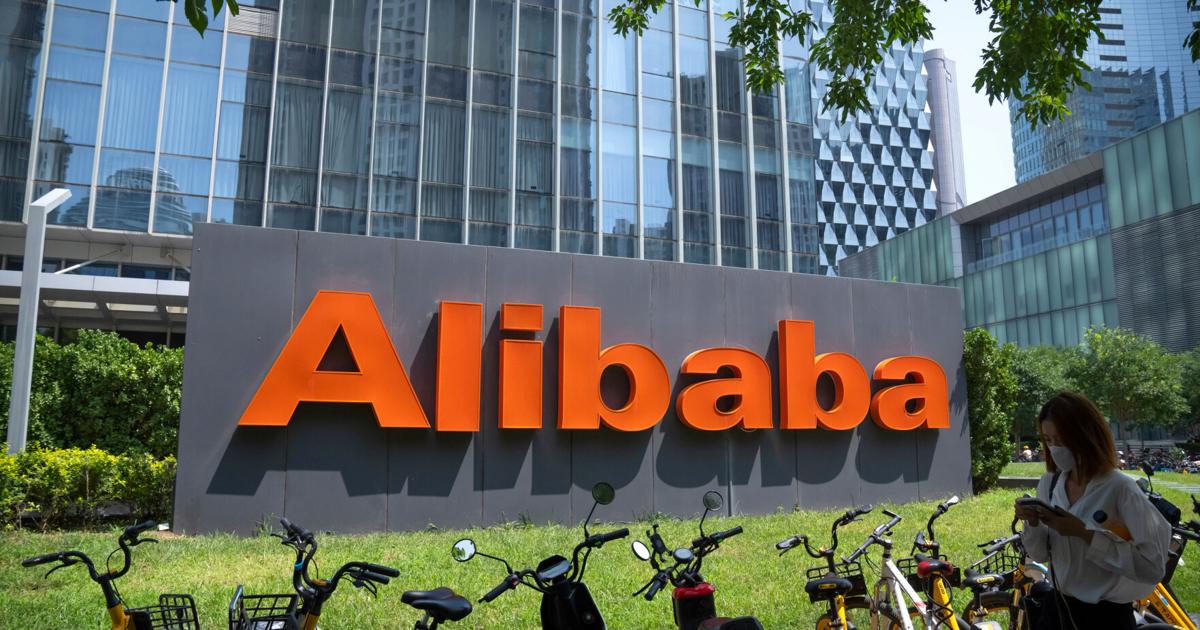
Alibaba Unveils New AI Chip Ahead of U.S.-China Talks
HONG KONG (AP) — China’s Alibaba announced new artificial intelligence chip technologies on Tuesday, including what it claims is China’s most powerful AI chip, just days before a pivotal meeting between Chinese and U.S. leaders where competition in AI technology is expected to be a major theme.
This announcement coincides with warnings from U.S. AI leaders, including Anthropic CEO Dario Amodei, about the potential threats posed by China’s rapid AI development. Concerns are rising over the need for an overall slowdown in AI technology development.
Chinese leader Xi Jinping is scheduled to arrive in Washington on Wednesday for a state visit to meet with U.S. President Donald Trump, where AI, trade, and tariffs are likely to be discussed.
During Alibaba’s annual flagship conference in Hangzhou, CEO Eddie Wu introduced the Zhenwu V900 chip, touted as the most powerful AI chip in China today, delivering three times the performance of its predecessor, the Zhenwu M890. These chips are essential for training and “inference” in AI, enabling computations that provide responses to users.
Additionally, Alibaba plans to train a new AI model with a scale of five to ten trillion parameters, nearing the size of the most advanced U.S. models. Its latest Qwen3.8-Max model, the most powerful in the Qwen AI series, has 2.4 trillion parameters.
The Chinese AI company Moonshot recently introduced the Kimi K3, noted as the world’s largest open model with 2.8 trillion parameters.
Alibaba also aims to enhance its data centers, driven by rapidly growing demand for AI computing, forecasting over 20 gigawatts of computing capacity by 2032. In comparison, SpaceX currently has 1.4 gigawatts, planning to reach over 10 gigawatts by 2027.
Recent advancements in Chinese AI are believed to give Beijing leverage in its discussions with Washington. While U.S. export restrictions have limited China’s access to cutting-edge technologies like AI chips and manufacturing equipment, more affordable open models from China are gaining traction globally, including in the U.S.
Last week, Huawei unveiled new chip technologies to compete with global leaders like Nvidia. As frontier AI training in China often relies on Nvidia chips, the local production of chips is becoming increasingly important due to the restrictions on Nvidia supplies to China.
Neil Shah, vice president of Counterpoint Research, noted that China’s approach to maximizing computing power locally helps maintain its strength, despite limitations. Counterpoint analyst Parv Sharma emphasized that the narrowing gap in AI and chipmaking capabilities will depend on China’s advancements in chip manufacturing facilities.
CEO Wu stated that Alibaba is “mobilizing every resource” to meet the surging demand for AI, despite global shortages in the AI data center supply chain, which restrict scaling efforts.
Wu compared AI growth to the industrial revolution, predicting that machines could one day exhibit more “thinking” capacity than humanity, projecting an increase from less than 3% currently to over 1,000 times more.
Copyright 2026 The Associated Press. All rights reserved. This material may not be published, broadcast, rewritten or redistributed without permission.


