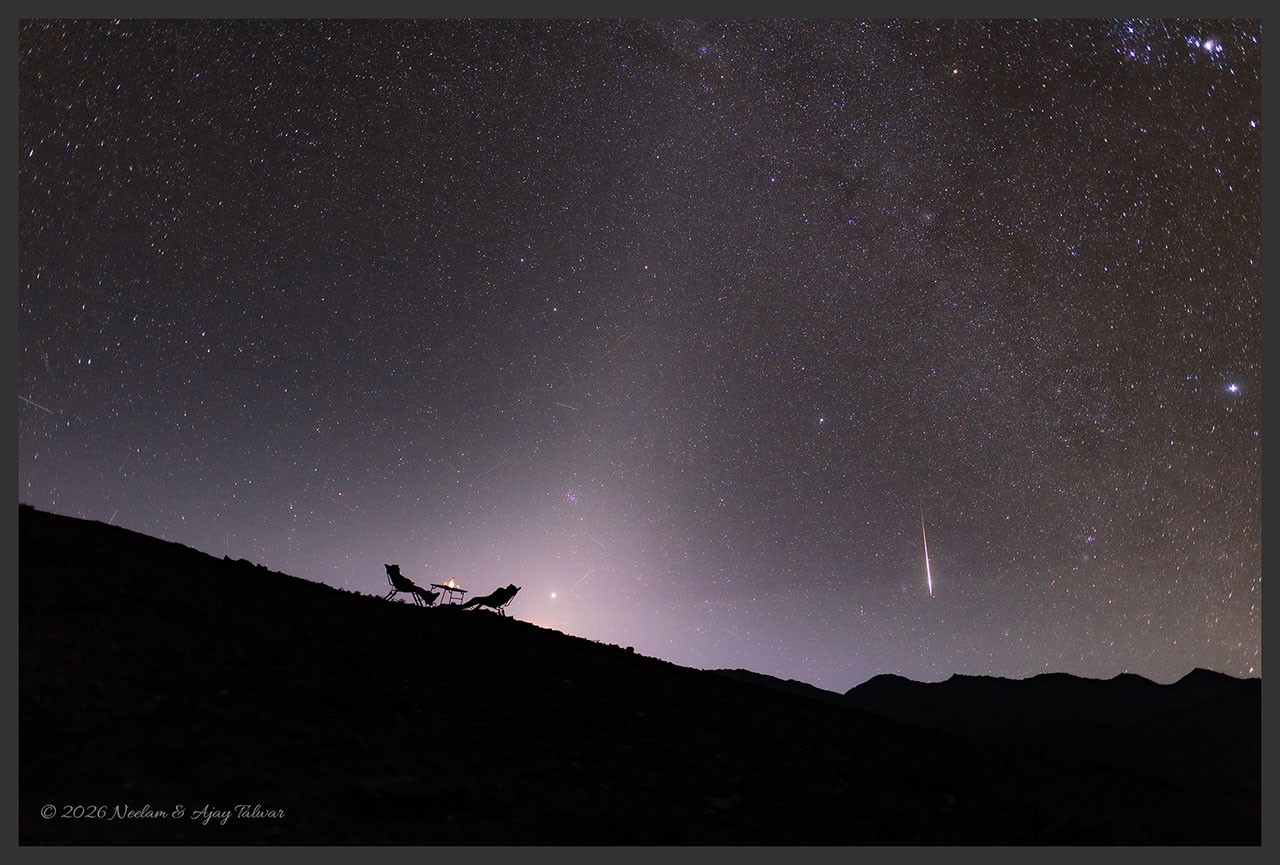
This text provides a detailed explanation of a phenomenon known as zodiacal light, described in the context of a photograph taken during a star party at the Hanle Dark Sky Reserve in Ladakh, India. Here are the key points distilled from the text:
-
Zodiacal Light: Also referred to as “false dawn,” it appears as a luminous band in the night sky, visible just before astronomical twilight.
-
Location: The image was captured at a high-altitude dark sky reserve, ideal for stargazing and astrophotography.
-
Notable Celestial Objects:
- Bright planet Jupiter can be seen near the eastern horizon within this zodiacal glow.
- The image captures open star cluster M44 and Mars, which has a yellowish tint, located towards the center of the frame.
-
Scientific Insight: NASA’s Juno spacecraft has provided evidence suggesting that Mars contributes to the dust responsible for the zodiacal light phenomenon.
-
Resources: Linked articles offer further details about zodiacal light, the observations from the Juno mission, and the transition of the APOD (Astronomy Picture of the Day) website.
This information is valuable for anyone interested in astronomy, astrophotography, or the specific phenomena occurring in the night sky.


