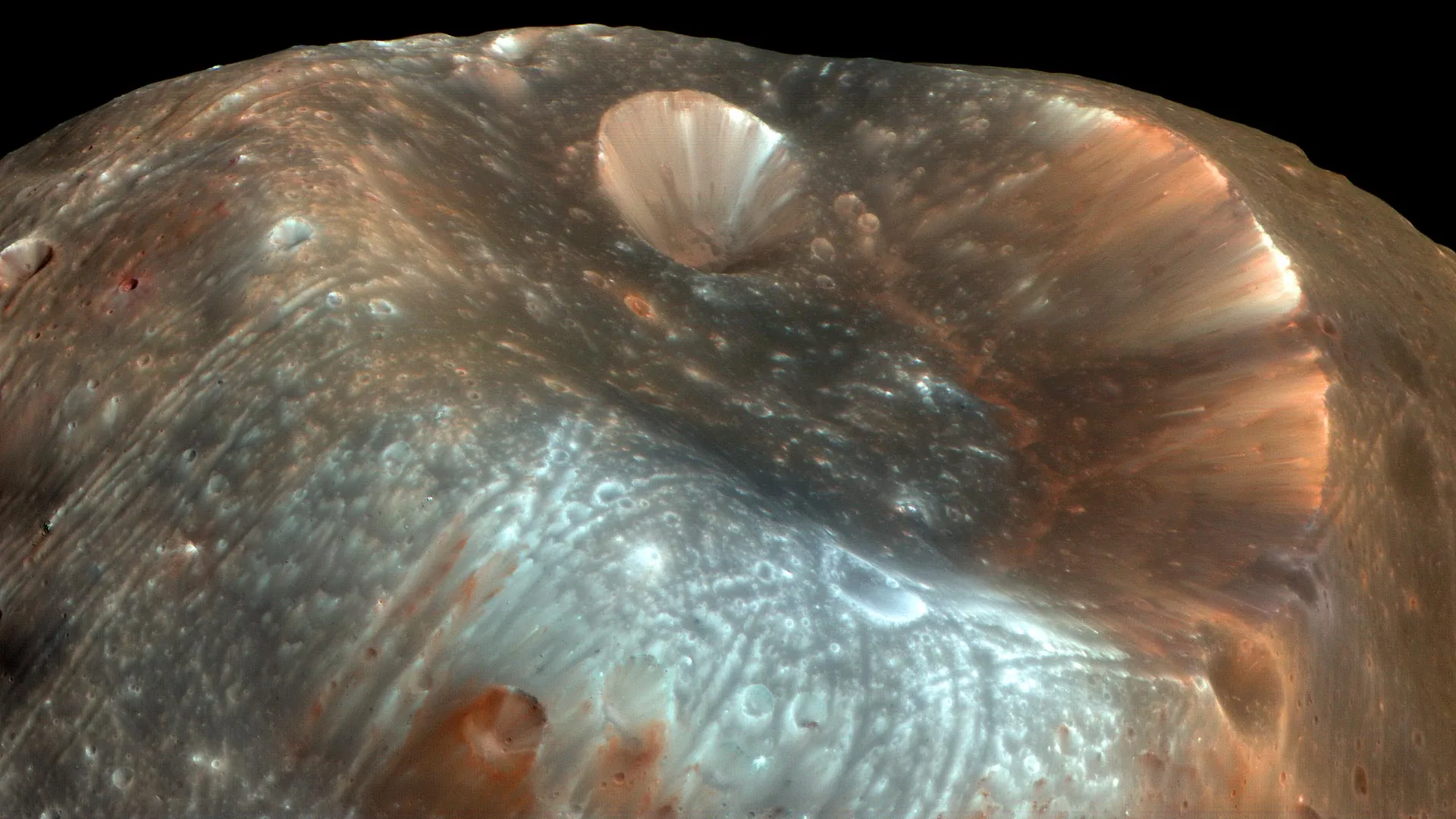
Phobos: The Unraveling Mystery of Mars’ Moon
Phobos, Mars’ innermost moon, has intrigued planetary scientists for years, primarily concerning its origin. The two leading theories posit that Phobos might either be a captured asteroid or the result of debris from a significant impact event on Mars.
Understanding Phobos’ Characteristics
Recent studies focus on Phobos’ internal structure through gravity and motion measurements, particularly around its notable feature, Stickney Crater. This enormous crater, with a diameter of 9 km (5.6 miles), plays a vital role in unraveling Phobos’ past, with estimates placing its formation at about 4.2 billion years ago if from an impact or around 2.6 billion years ago if captured.
Current insights suggest a porous interior possibly containing water ice, as proposed by researchers Benjamin Haser and Thomas Andert. They emphasize the importance of understanding the gravitational characteristics of Stickney, as a denser area beneath the crater may exist as a result of the impact.
Key Theories of Origin
Haser outlines two main hypotheses regarding Phobos’ formation:
-
Impact Theory: A massive object collided with Mars, sending debris into orbit that formed Phobos and its twin moon, Deimos.
-
Capture Theory: Phobos started as an asteroid before being captured by Mars’ gravity, supported by the moon’s irregular appearance similar to rubble pile asteroids.
Researching the gravitational field and internal mass distribution is crucial for confirming either theory, as Phobos’ gravity, shape, and orbit all pose challenges to clear interpretation.
Stickney Crater: More Than Meets the Eye
The impact that formed Stickney raises questions about how Phobos survived. Haser suggests that its unusually low density may allow it to absorb impacts like a sponge, protecting it from shattering. The intense heat generated by the collision may have compressed material beneath the crater, creating a denser region that could reveal information through gravitational signals.
The Evolving Nature of Phobos
Phobos is not just a historical relic; it is actively changing. Its orbit is gradually spiraling inward, which will eventually lead to its disruption or collision with Mars. Haser describes Phobos as both a preserved historical record and an evolving geophysical system.
Future Investigations: The MMX Mission
Upcoming missions, like Japan’s Martian Moons Exploration (MMX), aimed for a late 2026 launch, offer the promise of directly studying Phobos. The spacecraft will gather samples, which are expected to return to Earth by 2031, potentially answering longstanding questions about the moon’s composition and internal structure.
Conclusion: A Complicated Puzzle
The complexity of Phobos’ origin may require a nuanced understanding that incorporates elements of both theories. For Haser, the ultimate objective is to clarify what materials compose Phobos and how its internal structure aligns with its peculiar characteristics. Understanding these factors may finally illuminate the moon’s enigmatic history and future trajectory.


