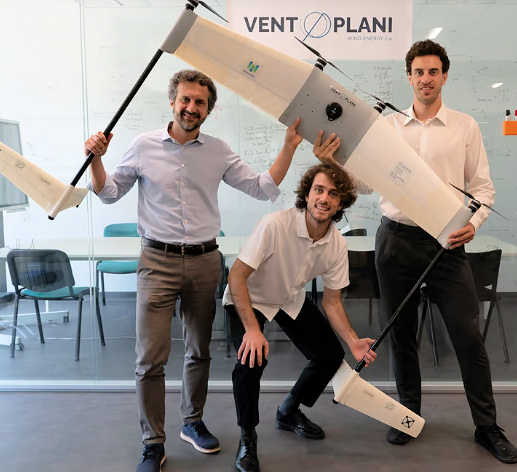
Overview of Windplanes
What are Windplanes?
Windplanes are innovative fixed-wing airborne wind energy systems that utilize small onboard turbines to harvest wind energy. These lightweight and autonomous devices are tethered to the ground, resembling kites, allowing them to operate efficiently.
How Do They Work?
Windplanes generate electricity by flying in fast crosswind loops, leveraging the onboard turbines to produce electric power. By operating at higher altitudes, they access stronger and more consistent winds compared to traditional small wind turbines. Their circular flight path allows them to sweep a larger area than a comparable rotor, significantly enhancing energy capture.
Advantages
- Material Efficiency: To generate the same power output, windplanes require less than 10% of the material needed by conventional tower-based turbines, making them a compact and scalable solution for clean energy.
- High Capacity Factor: Windplanes work effectively alongside solar and battery systems, reducing the storage needs for hybrid energy setups.
- Rapid Deployment: Their lightweight design allows for quick deployment, even via autonomous flights, making them suitable for temporary applications like disaster relief.
- Accessibility: Windplanes can power a variety of users—from farms and businesses to private households and communities—with clean, on-site electricity, thus lowering energy costs and reducing grid dependency.
Company Background
Ventoplani’s Founders
Ventoplani was established by:
- Filippo Trevisi (CEO): A PhD holder in Aerospace Engineering from Politecnico di Milano, Trevisi’s research led to significant breakthroughs in windplane technology, earning him several prestigious awards.
- Prof. Lorenzo Fagiano (CSO): With a PhD in Information and System Engineering from Politecnico di Torino, Fagiano has extensive experience in airborne wind energy research, having co-authored numerous patents and publications.
- Leonardo Cecchin (COO): A PhD in Microsystems Engineering from the University of Freiburg, Cecchin specializes in drone and glider prototyping and controls the experimental activities at SAS-Lab.
By harnessing the potential of airborne wind energy technology, Ventoplani aims to accelerate the transition to a net-zero future.


