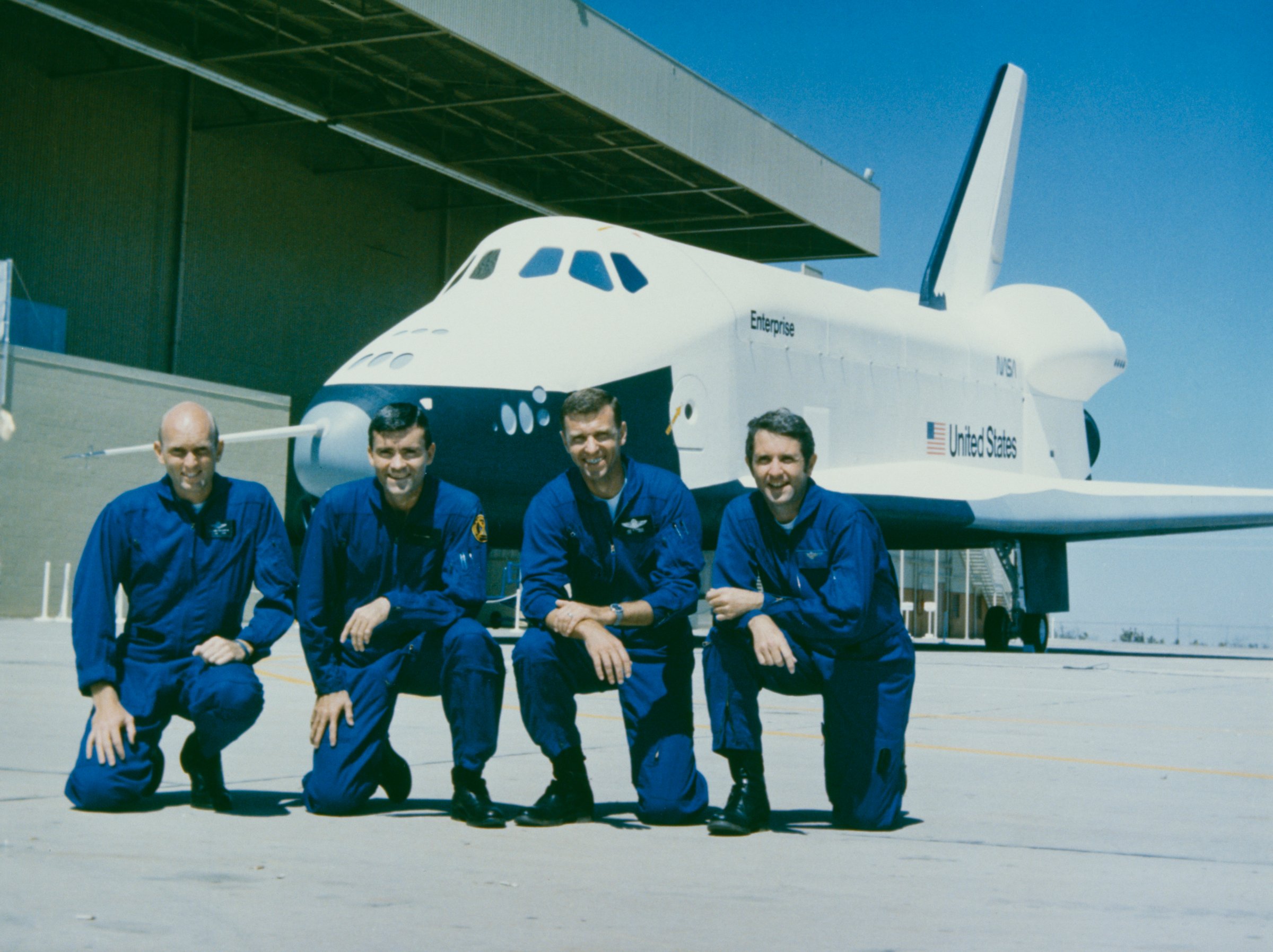
On September 17, 1976, NASA publicly unveiled its first space shuttle, the Enterprise, at a ceremony in Palmdale, California. This marked a significant moment in American space exploration, as the shuttle was designed to be reusable, unlike previous spacecraft from the Mercury, Gemini, and Apollo programs. The Enterprise combined rocket capabilities with an aircraft-like vehicle that could land on a runway.
The announcement came seven years after astronauts first walked on the moon, with the Apollo program winding down. NASA envisioned the shuttle as a new generation of human spaceflight that could regularly transport astronauts, satellites, and scientific equipment into orbit. The development of the shuttle took nearly a decade and cost around $10 billion.
Named after the fictional starship from Star Trek, the Enterprise was a result of a fan-led letter-writing campaign urging NASA to adopt the name. Notably, several Star Trek cast members were present at the unveiling.
While the Enterprise never ventured into space, it was crucial in validating the shuttle concept. In 1977, NASA conducted approach and landing tests, carrying the Enterprise atop a modified Boeing 747 before releasing it at around 25,000 feet. The shuttle then glided back to a landing at Edwards Air Force Base in California.
These tests set the stage for operational shuttle missions, starting with the launch of Columbia on April 12, 1981. Over three decades, NASA’s shuttle fleet accomplished numerous missions, including deploying and repairing satellites, conducting scientific experiments, and building the International Space Station. Astronauts also performed vital upgrades to the Hubble Space Telescope.
However, the program faced significant tragedies, including the Challenger disaster in 1986, which killed all seven crew members, and the Columbia disaster in 2003, which again resulted in seven fatalities. Despite these losses, the shuttle program continued until its retirement in 2011.
Today, the Enterprise is displayed at the Intrepid Museum in New York City, reminding us of the innovation and ambition that characterized the shuttle era. Its unveiling was more than just the introduction of a new spacecraft; it embodied America’s resolve to explore beyond Earth after the achievements of Apollo. Although the Enterprise never reached orbit, it played an essential role in shaping three decades of American spaceflight.


