In today’s update on the Iranian conflict, it appears that while Saudi Arabia has restored oil exports to around 70% of their previous levels, attacks from Ansar Allah are still causing significant disruptions. This has led Saudi Arabia to seek assistance from its new allies, comprising Turkey and Pakistan, to exert military pressure on the Houthis.
Despite the reliability issues associated with Reuters, a recent report indicated that Pakistan has communicated a warning to Iran regarding its Houthi allies, who have intensified their assaults on Saudi territory:
Pakistan has conveyed a message to Iran urging it to control the Houthis following their increased attacks, amid concerns about escalating tensions, according to sources from Saudi Arabia, Pakistan, and Iran.
Recent Houthi attacks included a strike on an airbase in Khamis Mushait and oil facilities in nearby cities, resulting in 73 injuries. This represents one of the most substantial offensives against Saudi Arabia since the onset of the U.S.-Israeli war on Iran.
Houthi military spokesman Yahya Saree asserted that Saudi airforces conducted 54 airstrikes across various Yemeni territories over the previous 12 hours, vowing that these actions “will not go unanswered.”
Given its defense pact with Saudi Arabia and Turkey, Pakistan’s warning to Iran is particularly significant.
Pakistani officials have clarified that any military involvement would be strictly limited to the defense of Saudi Arabia’s borders, though Defense Minister Khawaja Asif signaled that Houthi incursions could prompt a collaborative security effort involving Riyadh, Ankara, and Islamabad.
Interestingly, an article from the Jerusalem Post was published prior to the Reuters report, which noted:
There is much speculation regarding whether Pakistan or Turkey will take action in response to the Houthi threats. Historically, both nations have been cautious about entering into conflicts with Iran, while Saudi Arabia has openly criticized the Islamic Republic.
In recent months, the Houthi threat has escalated significantly. Despite this, there is a prevailing belief in Riyadh that Yemeni forces can counter the Houthis.
On September 8, Turkey’s Foreign Affairs Ministry condemned the Houthi attacks, calling for an end to their aggression. However, these statements do not indicate an intention for Turkey to engage militarily alongside Saudi Arabia.
Currently, Turkey maintains military assets in the region due to operations in Somalia, where it recently facilitated the release of sailors from Somali pirates.
According to reports from Turkiye Today, “Pakistan is likely to conduct airstrikes against Houthi forces at Saudi Arabia’s request,” with an expectation that these actions will be made public soon. A source familiar with the situation mentioned that the primary goal of potential Pakistani airstrikes would be to eliminate the Houthi presence in regions like Saadah, among others, although a final decision has yet to be reached.
Additional commentary highlights:
Pakistan is intervening on the side of Saudi-backed Yemeni gov’t forces against the Houthi?
At the same time Pakistan has cut off truck and rail shipments from China to Iran?
I wonder how big the US-Saudi bribe was for it to backstab the Mullah Regime of Iran? 🤔 https://t.co/qnRXhYXKxq
— Trent Telenko (@TrentTelenko) September 9, 2026
Many, including some Americans, have grown sympathetic towards Iran due to its resistance against U.S. imperialism and its stance on the ongoing humanitarian crisis in Gaza. It has become increasingly clear that Iran’s most significant leverage lies not in its potential nuclear capabilities but rather in its control over the Strait of Hormuz. Iran has openly suggested that raising oil prices serves to apply pressure on the U.S., aiming to force a retreat through various means, particularly through the destruction of U.S. military bases in the region.
It is intriguing to observe that despite Iran’s recent escalations targeting vessels, oil exports from the Persian Gulf have not significantly diminished. While it is possible that the impacts of Iran’s recent strikes have not been immediately felt within shipping decisions, current oil prices have surged above $100 a barrel, which may suffice as an initial pressure tactic for Iran.
In discussions with Samir Madani, co-head of Tanker Trackers, insights were shared concerning the irregularities in oil transit patterns. Although the administration reports high individual transit numbers on specific days, these figures can be misleading. A more accurate measurement emerges from average weekly volumes:
Madani delivered some surprising information regarding the increase in oil flows:
While these transits may occur in irregular bursts, they seem to have become much more pronounced lately. We currently estimate that the region has around 18.5 million barrels of crude oil exiting daily, a figure that had plummeted to around 6 million barrels per day in May and June, but has consistently climbed back up to approximately 11-12 million barrels per day now—39% shy of the baseline range. The past 28 days show an average of about 9.85 million barrels per day, demonstrating a positive trend from the previous 8.2 million.
Despite no Iranian crude leaving the Gulf since July, it has still managed to export refined products like liquefied petroleum gas using non-sanctioned vessels. So far, only one ship has reportedly sustained damage recently:
Oil Tanker H!t In Iraqi Waters | Asia One News #Asiaone #Asiaonenews #Iran #USA #USIran #OilTankers #KhargIsland #MiddleEast pic.twitter.com/jI2ueeY7at
— ASIA ONE NEWS (@AsiaOne_News) September 9, 2026
The U.S. has retaliated, reportedly targeting similar locations along the Iranian coast. According to Anadolu Agency:
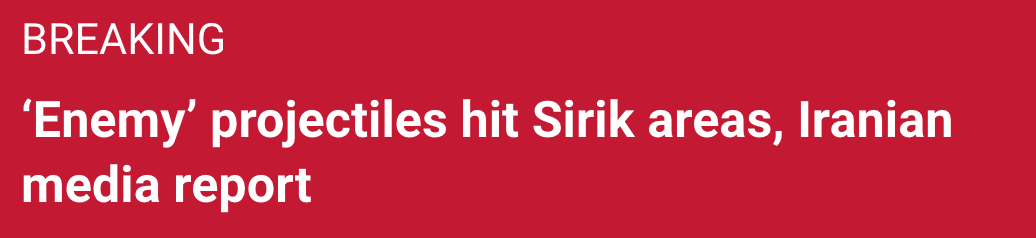
Multiple explosions were detected early Thursday in southern Iranian coastal regions, such as Sirik, Minab, and Qeshm Island. Iranian media reported that several areas in Sirik were struck by “hostile projectiles,” while Fars News Agency confirmed explosions echoed from these locations, originating from the sea.
Al Jazeera’s top headline included:

Meanwhile, there appears to be constraints on how far the U.S. can escalate the conflict, particularly given dwindling weapons supplies:
Seems likely that there is even MORE escalation taking place this afternoon in the Strait of Hormuz.
While President Trump is steadily adhering to a “Tanker for Tanker” strategy, he seems unaware of the logistical requirements for successful oil transportation.
— Brett Erickson (@BrettErickson28) September 9, 2026
Trump continues to minimize the surge in oil prices and its effects on U.S. gasoline and diesel prices. CNN reported on his latest assertions regarding the conflict:
During a recent address, President Donald Trump expressed optimism that Iran would cease hostilities post-midterm elections, while acknowledging that American gas prices are likely to remain elevated until then. He implied that Iran’s military campaign is intended to undermine his political position.
However, Trump is confident that Iran’s regime is close to collapse and would seek to resolve the conflict “immediately after the election,” which he believes would lead to a decrease in oil prices.
This highlights that the resolution of the conflict seems to be within Iran’s control.
Moreover, Trump has exhibited a tendency to speculate on outcomes without substantial evidence. An image from the Anadolu Agency captures this sentiment:

In an unexpected twist, reports have surfaced indicating that Pakistan’s army chief travelled to Tehran to relay a critical message amid escalating regional tensions. As part of a coordinated effort led by the U.S. to impose economic pressure on Iran:
Field Marshal Asim Munir conveyed a significant message on August 24, indicating that the U.S. would not be returning to the Memorandum of Understanding with Iran. This assertive declaration aligns with the U.S. Treasury’s recent economic campaign against Iran, underlining the potential repercussions for nations engaging in trade with Tehran.
Even if Trump’s stance is resolute, his position is subject to change, especially if a favorable “deal” were to arise—albeit unlikely given Iran’s heightened demands. Consequently, Trump appears to be distancing himself from negotiations.
In contrast, a Bloomberg report revealed Iran’s readiness for a more intense conflict and its determination to escalate its counterattacks should the U.S. persist with strikes on its territory:
- Iran is committed to facing a more intense battle and will escalate responses proportionate to U.S. aggression.
- Leaders view the conflict as an existential threat and are poised to continue fighting until they perceive that the U.S. will refrain from future attacks.
- Iran is reconstructing its military capabilities and has amassed sufficient missile stockpiles for a prolonged engagement.
Bloomberg even highlighted this evolving narrative:

With improving transport reports from Tanker Trackers, coverage from Lloyd’s List regarding the Middle Eastern situation has declined significantly, reflecting a general calm in assessments. As of today, a fresh piece highlighted the recovery of Yanbu crude exports:
- Yanbu crude exports have surpassed 4 million barrels per day, with over 70% directed toward the SuMed pipeline and the Suez Canal.
- At Sidi Kerir, crude exports have been reported at an average of 2.2 million barrels per day over the past five weeks, which is nearly triple the regular amount.
- Additionally, 43% of Sidi Kerir’s exports are now directed to Asia, a substantial rise compared to before the Yanbu detour.
The resilience of the crude trade amidst sanctions and military disruptions underscores the industry’s adaptability, as seen in the current transport routes from Yanbu to Egypt and onto Asia.
In summary, the evolving dynamics of the Iranian conflict are marked by shifting alliances and an ongoing interplay of military and economic strategies. As tensions escalate, the region continues to adapt, revealing the complexities of geopolitical maneuvering in the Middle East. The situation remains fluid, and further developments are inevitable as the parties involved seek to navigate these tumultuous waters.