Astronomers Discover Formation of Massive Binary Stars
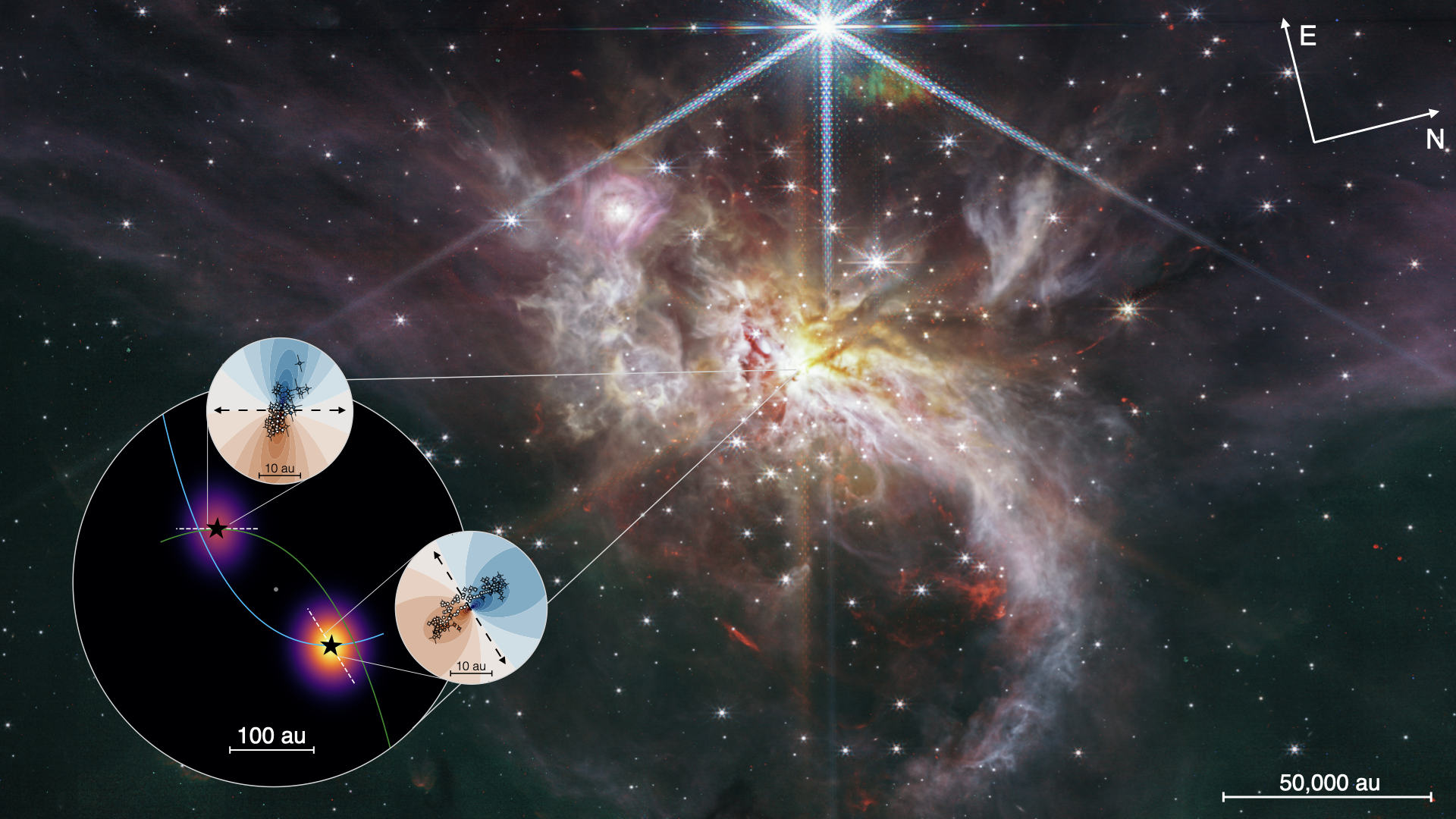
Using the ALMA radio telescope, astronomers have observed the unique formation of two massive stars becoming a binary system, diverging from the conventional belief that binary stars form from the same collapsing gas and dust cloud. Findings about the binary system, IRAS 07299−1651, located approximately 5,300 light-years away, suggest that these stars joined forces later in their infancy.
Key Findings:
-
Approximately half of sun-sized stars in the Milky Way have a companion star, with the percentage for massive stars rising to around 90%. Understanding these binary systems is crucial to comprehending stellar evolution and galactic structure.
-
The research team discovered that the disks of material around the protostars are misaligned—a rarity if the stars had formed from the same cloud. The observations involved eight years of mapping the stars’ positions and analyzing data from ALMA, the Very Large Array (VLA), and infrared images from the James Webb Space Telescope (JWST).
-
Team leader Yichen Zhang highlighted the significance of observing two massive stars in their birth phase, noting the importance of their chaotic orbit and the unexpected eccentricity of their paths.
Chaotic Birth:
-
The researchers initially anticipated neat, circular orbits but instead found highly eccentric ones. The misalignment of their surrounding disks pointed towards the stars forming in separate clouds, later coming together due to chance.
-
Historical data indicates that this encounter probably occurred about 60 years ago—a blink of an eye in cosmic time. Despite this, the stars’ surrounding disks have retained their structure.
Future Research:
The fate of IRAS 07299−1651 remains uncertain; it’s unclear if these stars will continue to orbit each other or drift apart. Ongoing and future observations could reveal insights into how common such chance encounters are and whether many binaries are formed this way.
The research has been published in Nature Astronomy on September 8, and offers a new perspective on the chaotic early lives of stars, emphasizing the potential for chance interactions to shape cosmic structures.