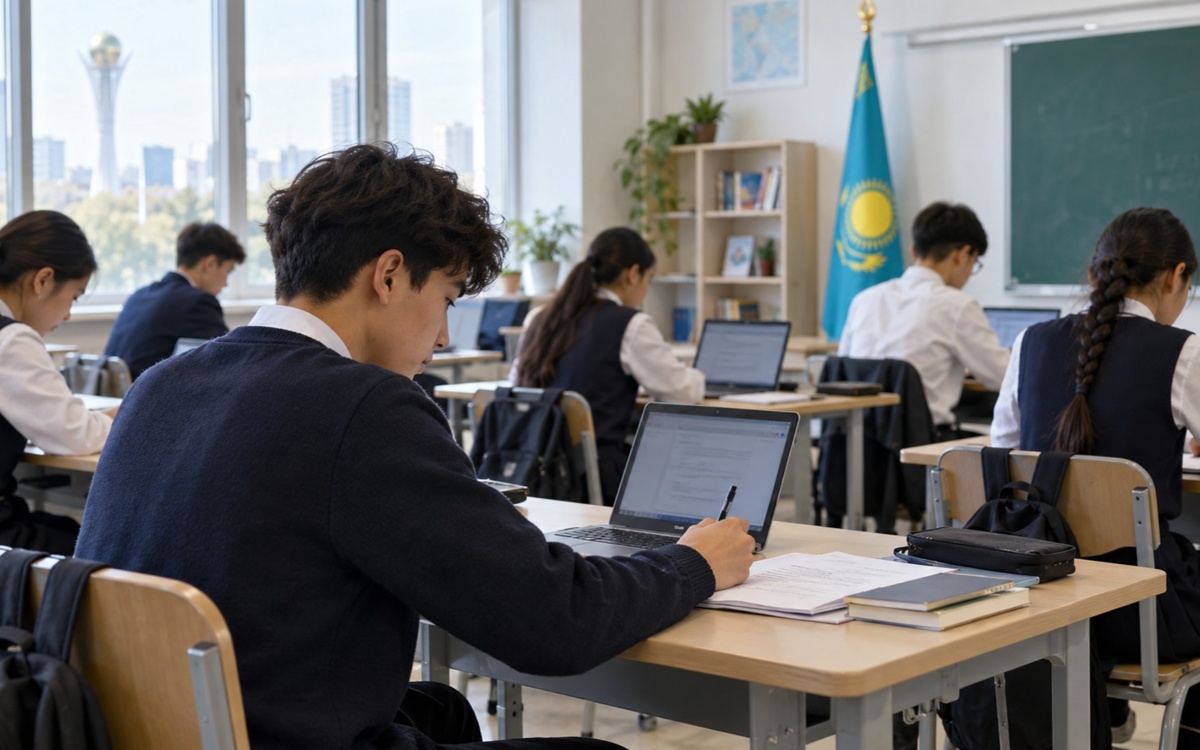
Summary of PISA 2025 Results for Kazakhstan
Publication Date: September 8, 2023
Source: PISA 2025 Results (Volume I)
Key Findings:
-
Average Scores:
- Science: 420 points
- Reading: 385 points
- Math: 414 points
- OECD Averages: Science (482), Reading (461), Math (463)
-
Proficiency Levels:
- 41.1% of Kazakhstani 15-year-olds scored below Level 2 in all subjects.
- Only 1.4% reached the highest proficiency levels in at least one subject (OECD average: 11.9%).
Progress Trends:
- Long-term improvement in Science: +34 points over ten years.
- Reading: No significant change; Math: negative trend.
- Significant decline observed between 2022 and 2025:
- Science: -4 points
- Reading: -1 point
- Math: -12 points (statistically significant)
Socioeconomic Disparities:
- Smaller performance gap between advantaged and disadvantaged students (41 points compared to 85 points OECD average).
- Socioeconomic factors accounted for 4.6% of score variation in Kazakhstan (11.6% OECD average).
Gender Differences:
- Girls performed better in Science (+5 points) and Reading (+27 points).
- Boys outperformed girls in Math (+9 points). Notably, the Math gender gap widened due to greater declines in girls’ scores.
Classroom Environment:
- Kazakhstan reported favorable classroom conditions:
- Higher teacher support and discipline perceptions.
- 53.4% of students attended schools with no teacher shortages (OECD average: 28.8%).
Comparisons with Central Asian Countries:
- Uzbekistan: 438 points in Science, with the largest gain of 83 points.
- Kyrgyzstan: 363 points in Science.
- Tajikistan (Dushanbe): 334 points in Science.
Technology Integration:
- AI Usage: 47% of students used AI chatbots weekly for learning, close to the OECD average.
- Teaching on evaluating AI output was more prevalent, with 80.2% of Kazakhstani students receiving such instruction compared to an OECD average of 62.6%.
- Fewer distractions from digital devices (52.1% reported no distractions vs. 39.2% OECD average).
This snapshot emphasizes the challenges and opportunities regarding educational performance in Kazakhstan, covering proficiency, gender disparities, and the evolving role of technology in learning environments.