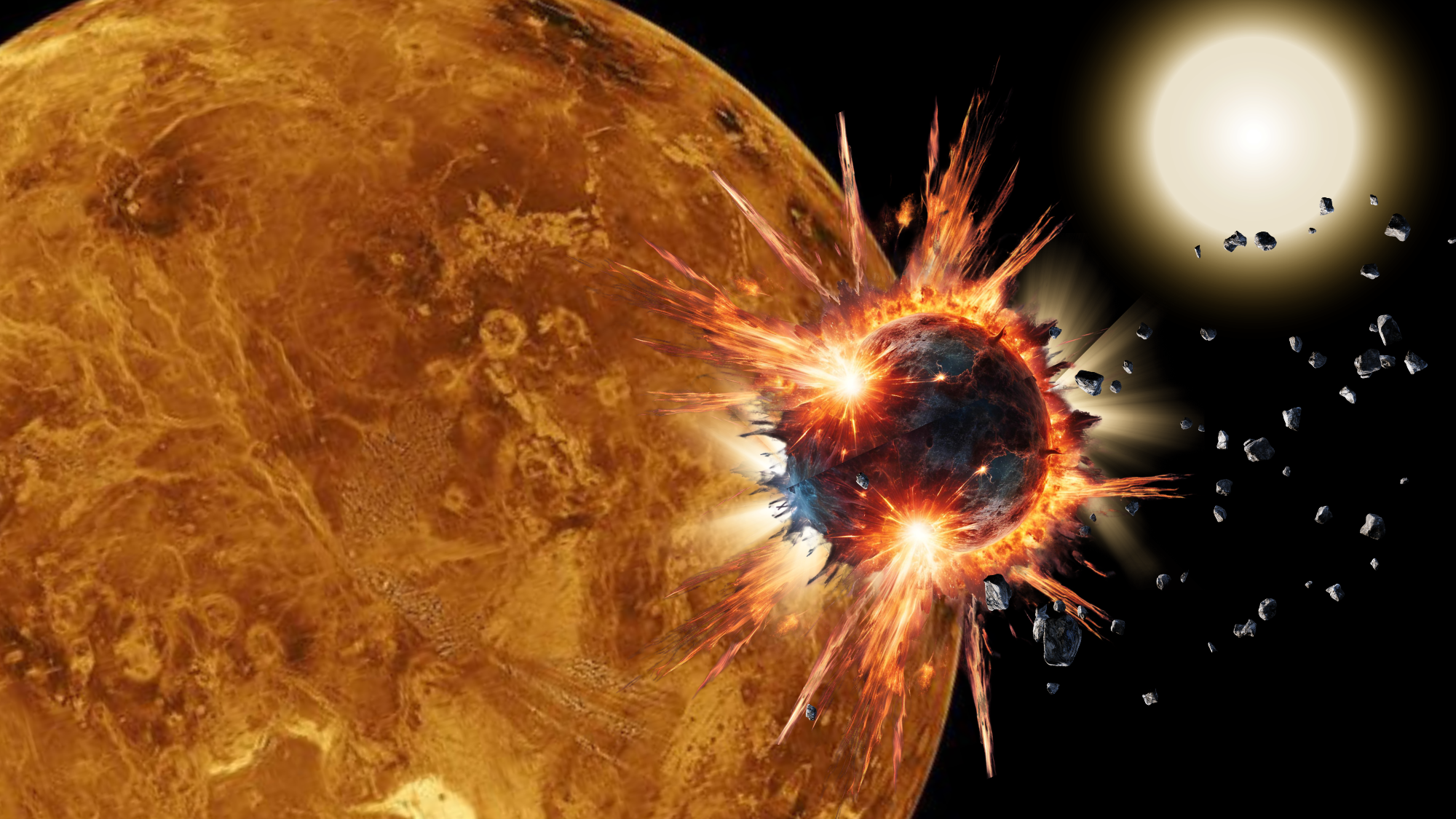
Scientists now believe they understand why Venus, often dubbed Earth’s twin, has no moon. Research suggests that the hottest planet in our solar system may have consumed its own natural satellite. While both Venus and Earth share similarities in size, mass, and rocky compositions, they diverge significantly in other aspects, such as temperature and atmospheric conditions. Earth has a single moon, while both Venus and Mercury are devoid of any moons.
A team led by Stephen R. Kane from the University of California, Riverside, pondered whether Venus always lacked a moon or if it potentially had one in the past that was lost. To explore this, they conducted simulations examining the gravitational dynamics between Venus and a hypothetical moon as well as the sun.
Their findings indicated that any moon orbiting Venus would likely spiral inward over time, eventually being torn apart by the planet’s gravity. Interestingly, heavier moons were found to be destroyed faster, as they would sap Venus’s spin efficiency more rapidly.
For a moon to have survived, Venus would have needed to spin quickly at the time of the moon’s formation, with a day shorter than about 12 hours, along with a moon that was not too massive. Such conditions are unlikely given what is understood about early Venus.
While direct evidence of a lost moon may never be found, researchers hope future missions, like NASA’s DAVINCI, could provide insights into Venus’s atmospheric and interior compositions, allowing for a better understanding of such historical scenarios.