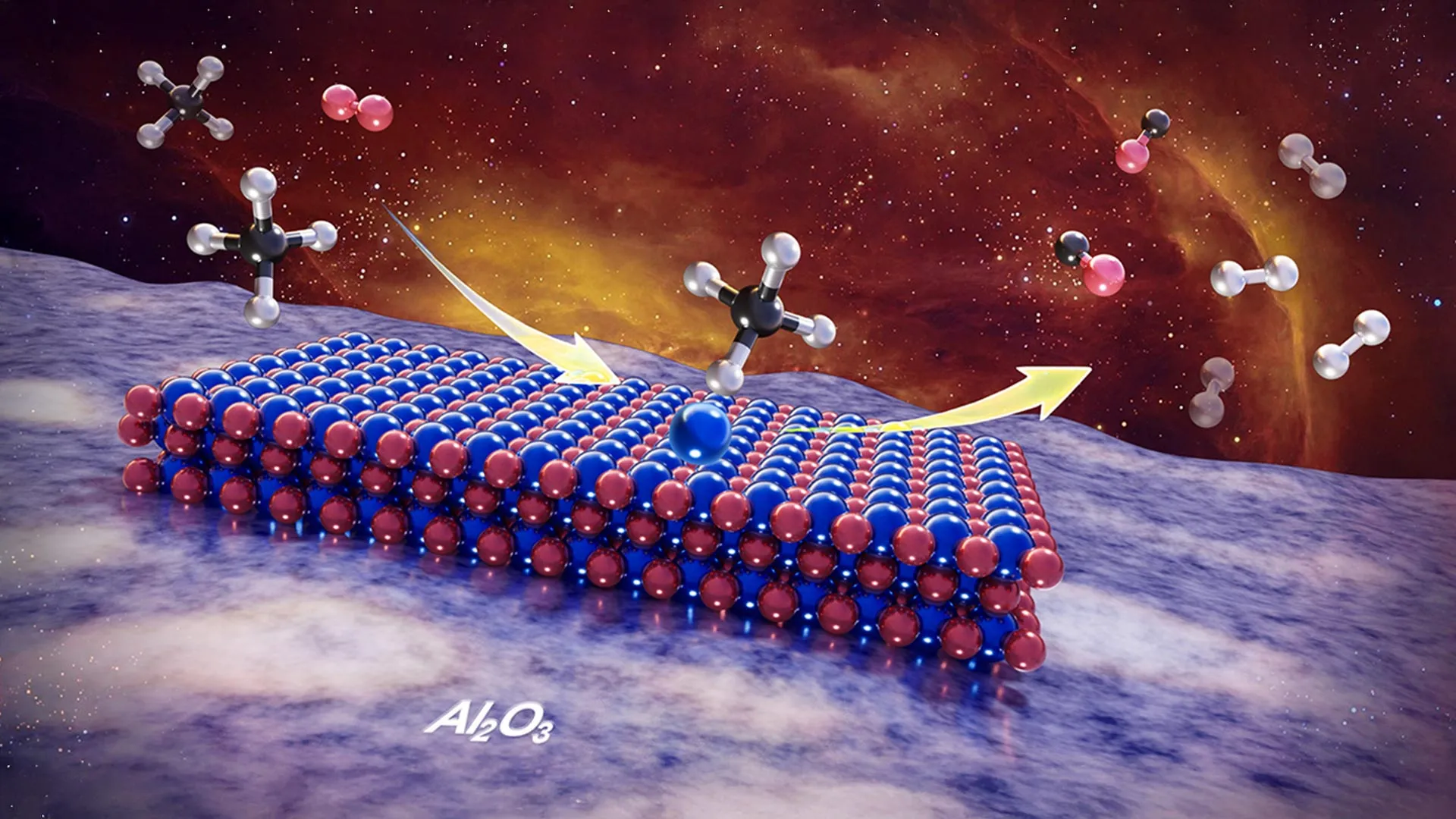
The study on the partial oxidation of methane (POM) marks a significant advancement in understanding catalytic processes. Traditionally, metallic nickel (Ni) nanoparticles were thought to be the primary active centers for this reaction. However, researchers have uncovered that the real activity might originate from a dynamic atomic structure that forms during the process.
Key findings from the research include:
-
Dynamic Active Structure: The study revealed that a reconstructed structural unit [Ni1O4Ni4] emerges on the NiO(100) surface during POM. This unit significantly lowers the energy required to break C-H bonds in methane, making the reaction more efficient.
-
Catalyst Composition: The innovative Ni/Al2O3 catalyst was created with only 0.8 wt% nickel, yet it demonstrated remarkable performance, converting 92% of methane while maintaining high selectivities for CO and H2.
-
Metallic Nickel’s Role: Surprisingly, upon completing the reaction, there was minimal detectable metallic nickel. Instead, a pre-formed NiO phase was insufficient for achieving POM activity, further emphasizing the critical role of the reconstructed structure.
-
In Situ Characterization: The research underscores the importance of observing catalysts under real operating conditions, suggesting that dynamic changes in atomic arrangements can lead to enhanced catalytic performance without relying on high metal loadings.
This work, led by prominent researchers from the Dalian Institute of Chemical Physics and other institutions, opens avenues for designing more effective catalysts by focusing on the structures that emerge during reactions rather than relying solely on metallic forms.