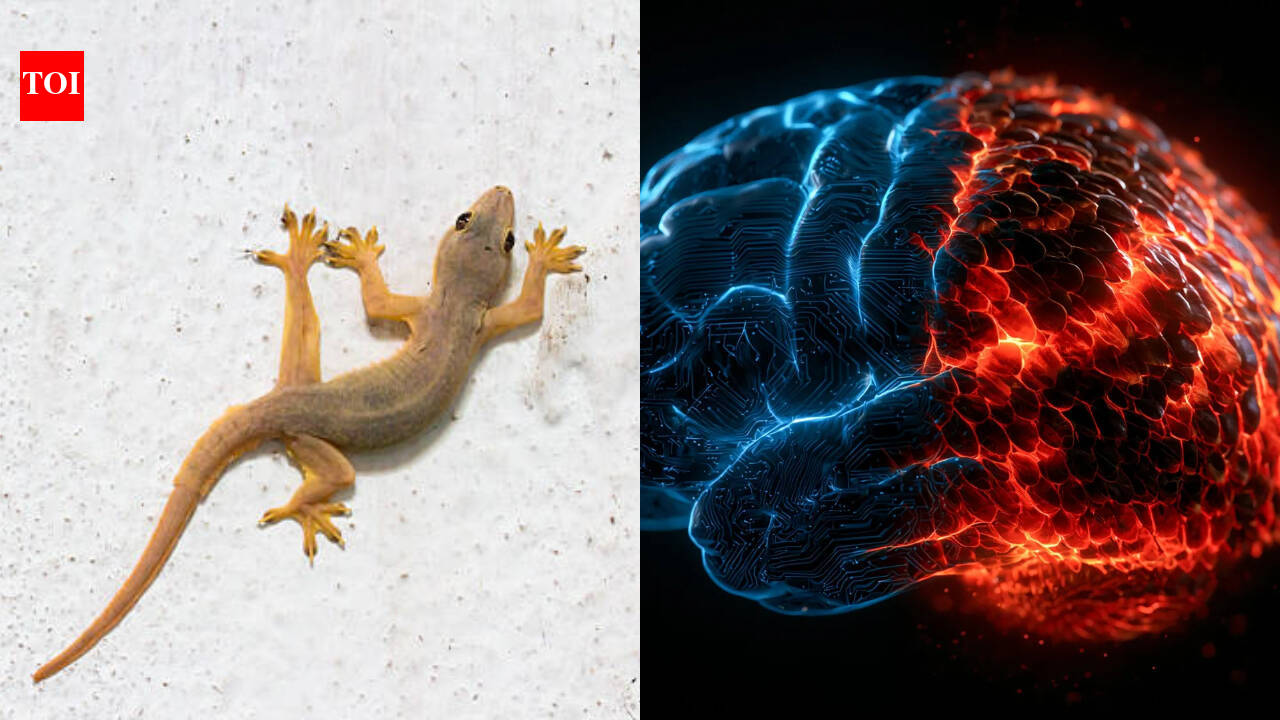
New Insights into Brain Evolution
For decades, the human brain was viewed as an evolutionary skyscraper—with ancient instincts forming the base, emotions in the middle, and advanced reasoning at the top. While this framework provided a simplistic understanding, recent research from Georgia Tech suggests a more complex narrative.
Challenging the “Lizard Brain” Theory
Traditionally, the brain was conceptualized in layers, with a primitive “reptilian brain” beneath a sophisticated neocortex. However, this new study posits that brain evolution might be more about competition between different neural circuit wiring methods. The research indicates that a limited brain space has led to a trade-off, shaping the evolution of intelligence.
Key Findings from the Research
-
Interconnected Neural Systems:
- The study found that growth in one part of the limbic system correlates with increases in other parts, while the neocortex tends to occupy less space in the brain.
- This suggests that these regions may function as connected systems rather than isolated structures.
-
Wiring Strategies:
- Neocortex circuits are spatially mapped, corresponding directly to body parts. In contrast, the limbic system’s connections are distributed, akin to a barcode.
- Artificial neural networks were employed to test these wiring strategies, revealing that localized connections excelled in tasks like vision, while distributed wiring was better for tasks involving smell and memory.
-
Evolutionary Trade-offs:
- The research simulated how different wiring strategies compete for neural resources in an artificial environment, demonstrating a balancing act based on ecological demands.
- For instance, species like the nine-banded armadillo, which relies heavily on smell, have larger limbic systems, while squirrel monkeys, which depend on vision, exhibit a dominant neocortex.
Implications for AI
The findings extend beyond biology, offering insights into artificial intelligence. Current AI systems often require extensive training data, unlike biological brains which are prewired and adapt through experience. Incorporating similar architectures in AI could lead to systems that learn more efficiently and with less energy.
Conclusion
This research prompts a reevaluation of how we understand intelligence. It highlights the evolutionary balancing act that shapes brain architecture—not merely a hierarchy of ancient and modern structures, but an intricate negotiation of wiring strategies that best serve an organism’s environment. The “lizard brain” metaphor may be catchy, but the reality of brain evolution is undeniably more intricate.