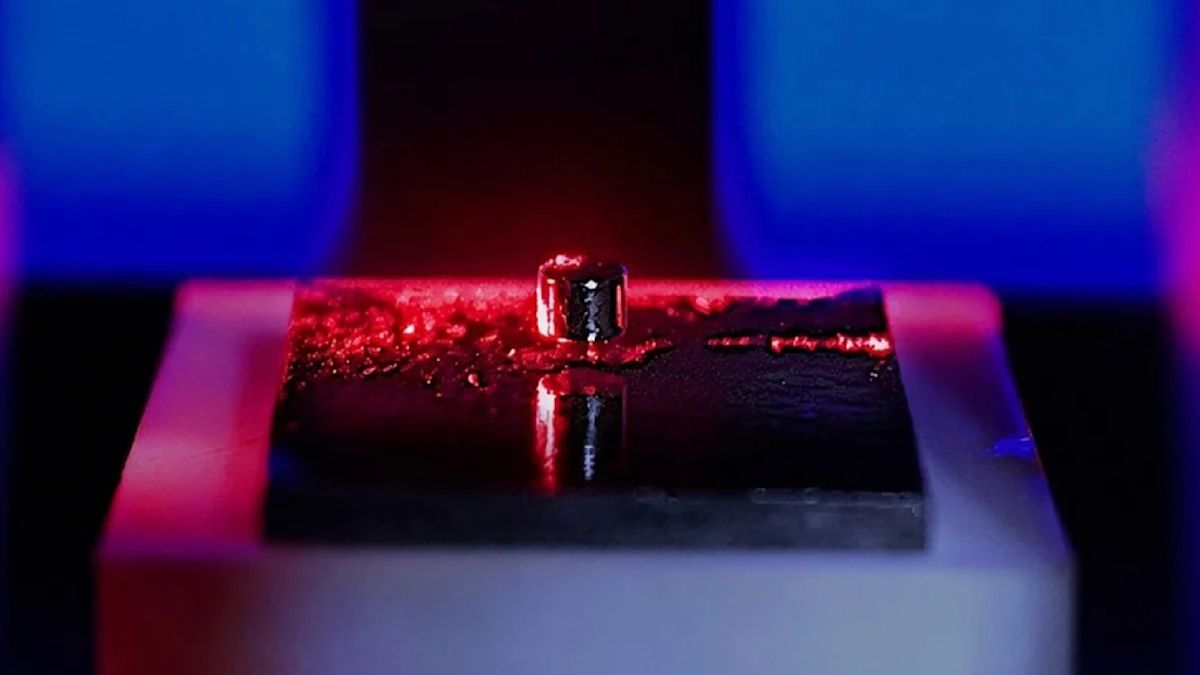
New Levitated Magnet Magnetometer Could Change Physics and Medicine
A groundbreaking device, the Levitated Magnet Magnetometer (LeMaMa), developed by researchers from Peking University and Germany’s Johannes Gutenberg University Mainz, has demonstrated the ability to detect magnetic signals a billion times weaker than Earth’s own magnetic field. This innovative technology is believed to enhance the search for dark matter and provide new methods for monitoring brain activity.
Mechanism of the LeMaMa
The LeMaMa functions similarly to a compass, but instead of a fixed pivot, it features a freely floating needle. This needle, just 0.4 millimeters thick, is held mid-air by an upward force from another magnet and diamagnetic materials placed below, allowing for stable floating. This setup enables the detection of magnetic fields at unprecedented sensitivity levels, down to femtotesla—one quadrillionth of a tesla.
Reducing Environmental Noise
Achieving such high sensitivity required the researchers to minimize environmental noise. The sensing magnet is housed in a vacuum chamber, resting on a vibration-isolation platform, ensuring precise measurements without interference.
Traditional methods for femtotesla measurements included superconducting quantum interference devices (SQUIDs) that necessitate cryogenic conditions or spin-exchange relaxation-free atomic magnetometers limited by environmental conditions. In contrast, LeMaMa operates efficiently at room temperature without the need for extensive shielding or bulky equipment.
Real-World Applications and Future Potential
Initial tests revealed the device’s capability to detect tiny magnetic fluctuations, even against the backdrop of Earth’s strong magnetic field. The research team has already applied LeMaMa to search for axion dark matter, achieving sensitivity improvements by several orders of magnitude.
With its compact size, LeMaMa holds promise beyond physics. It could advance neuroimaging techniques in biomedicine by measuring weak neural signals, while its small form factor is also suitable for high-precision geophysical exploration and resource surveying.
As the technology matures, LeMaMa could pave the way for significant advancements in both scientific research and clinical applications, potentially transforming how we study the universe and the human brain.