Insider Brief
-
Researchers have measured the effect of gravity on the quantum phase of freely falling atoms, affirming Einstein’s equivalence principle in the quantum realm.
-
The Quantum Galileo Interferometer utilized ultracold rubidium atoms, splitting them into two paths—one stationary and another falling—to detect phase differences.
-
Although the experiment does not unify gravity and quantum mechanics, it paves the way for future studies with heavier objects like nanodiamonds.
-
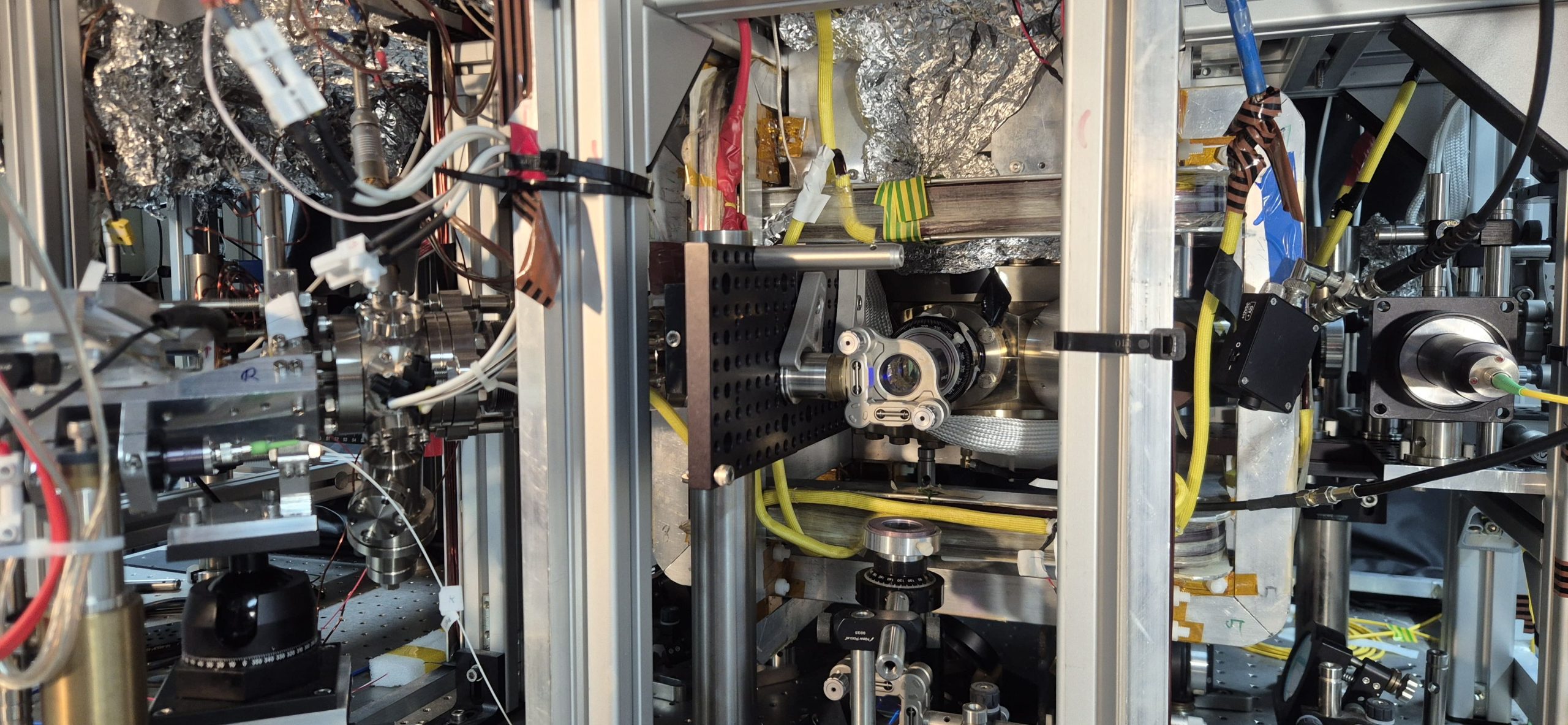
Experimental Setup: A vacuum chamber mimicked space conditions to minimize disturbances. It featured a 2D MOT feeding atoms into a science chamber, surrounded by antennas, coils, and optical fibers for manipulation and measurement.
Press Release Summary
An international team, including Nobel laureate Professor Sir Roger Penrose, has experimentally confirmed a gravitational effect on quantum objects, showcasing a link between Einstein’s gravity and quantum mechanics. Conducted by Ben-Gurion University, the University of Ulm, and the University of Oxford, results were published on September 2 in Science Advances.
Despite the long-standing frameworks of quantum mechanics and general relativity, how these two intersect remains unclear. This innovative experiment measured a specific quantum property change of falling atoms, consistent with Einstein’s principles.
Experiment Details
The researchers designed a Quantum Galileo Interferometer that splits the quantum wave of an atom, holding one while permitting the other to fall freely. After rejoining the waves, they measured phase interference, directly linking quantum phenomena to gravitational effects.
Using ultracold rubidium atoms, they manipulated atomic waves with precise magnetic fields, allowing for new exploratory potential in the interaction between gravity and quantum physics.
Lead author Professor Ron Folman highlighted the experiment’s ability to bridge critical theoretical gaps in contemporary physics. Professor Vlatko Vedral emphasized that the findings reinforce quantum laws even in the context of gravity, while noting the limitations on current tests regarding massive objects.
Conclusion
Though this study does not unify gravity and quantum dynamics, it supports the consistency of Einstein’s principles within tested quantum conditions and sets the stage for future experiments that may probe deeper into the gravitational effects on larger quantum objects. The collaborative effort includes contributions from institutions such as the University of Southampton, German Aerospace Center, and Texas A&M University.