The United States boasts the most powerful submarine fleet globally, with its nuclear-powered attack submarines showcasing advanced capabilities, including stealth, endurance, sophisticated sensors, long-range guided weapons, and highly skilled crews. In the event of a major conflict with China, these submarines would play a crucial role, being pivotal in safeguarding U.S. interests. Consequently, analyses of a potential Pacific conflict frequently emphasize American submarines in tasks such as neutralizing Chinese surface vessels, targeting logistics, implementing blockades, gathering intelligence, and striking land targets.
Such confidence is well-founded, yet there exists a significant issue regarding combat readiness. Often, military capabilities are represented through inventories—numbers of attack submarines, aircraft carriers, and other assets—which serves as a useful starting point in evaluating military strength. However, inventory numbers do not paint the complete picture of combat readiness. A vessel may exist but might not be available, or it could be available but not in the right position, thus lacking the necessary capabilities.
This distinction between nominal and deployable power becomes especially pertinent during a prolonged conventional conflict. A submarine stationed in the Western Pacific cannot simultaneously patrol in the North Atlantic. Submarines undergoing maintenance cannot suddenly be counted on as part of the force in a Taiwan conflict just because they exist in the Navy’s inventory. Moreover, torpedoes and missiles used in combat must be replenished, and damaged submarines need repair. Factors like crew availability, maintenance facilities, and transit times all contribute to the overall assessment of combat power.
The essential inquiry, therefore, is not the total number of submarines the United States possesses, but rather how much submarine combat power can be effectively concentrated against a specific adversary, in a particular theater of war, during a defined timeframe while still fulfilling other critical missions. Addressing this question necessitates a realistic evaluation of the fleet beyond just nominal inventory numbers.
This analysis does not seek to understate the effectiveness of American submarines; their impressive capabilities make them a noteworthy case study. If a weapon widely considered to be superior fails to generate sufficient combat power to meet its strategic objectives, U.S. leaders might significantly miscalculate their strategy in a confrontation with China.
The Impressive Silent Service
The U.S. Navy’s submarine fleet presents an overwhelming force encompassing ballistic missile submarines that form the maritime component of the nation’s nuclear deterrent, guided missile submarines capable of launching extensive salvos of conventional cruise missiles, and a substantial contingent of nuclear-powered attack submarines. Among these, the attack submarines are directly relevant to naval engagements in potential conflicts with China.
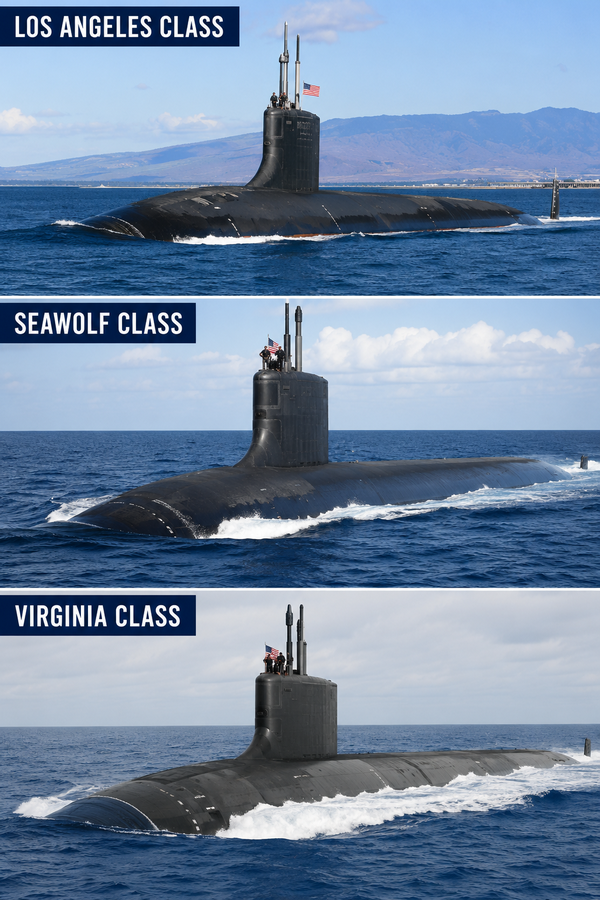
U.S. Navy nuclear powered attack submarine classes – silent and deadly hunters
American attack submarines (SSNs) have traits particularly suited for a Pacific conflict. Their nuclear propulsion allows for unparalleled cruising endurance, letting them cover vast distances without the need for refueling. They can remain submerged for long periods and operate independently of vulnerable surface ships. In a scenario where the Chinese navy increasingly challenges U.S. surface and air operations near mainland Asia, submarines provide invaluable combat power, not reliant on nearby airfields or large naval vessels surviving within China’s missile range.
These advantages clarify why submarines are frequently highlighted in analyses surrounding a Taiwan conflict. However, the available inventory can lead to a subtle analytical misjudgment. When one speaks of numerous attack submarines, there’s a tendency to visualize them as an on-demand combat resource for any military scenario. In reality, they are not.
The U.S. submarine force operates within a globally tasked military framework, not as a single, readily deployable fleet. At any given moment, submarines are allocated to deployment, transit, training, maintenance, upgrading, certification, repairs, and various other missions. Some vessels may be immediately accessible to a Pacific commander, whereas others might become available after weeks or months. Certain boats will remain unavailable due to operational demands. Consequently, the first reduction in available combat power occurs even before any conflict begins.
Inventory Is Not Availability
In war planning, submarines undergoing maintenance or stationed in shipyards cannot be deployed. The first cut to the American attack-submarine force is straightforward to quantify since the maintenance issue is significant and well-documented. As of April 2026, the Congressional Budget Office reported that the Navy had 48 nuclear-powered attack submarines, but a third of them were either undergoing or waiting for maintenance. The CBO’s conclusion was clear: with roughly one-third of the fleet out of commission for maintenance, the Navy could deploy, at best, only 32 SSNs.
This is not merely a fleeting statistic. Data from the Congressional Research Service reveals that maintenance has consistently sidelined about one-third of the SSN fleet for much of this decade. For example, in FY2021, 18 out of 49 SSNs were in maintenance or awaiting maintenance, resulting in 31 operationally ready submarines. In FY2022, the figures showed 33 of 49 unavailable for operation, with similar statistics for FY2023 and FY2024. The share out of commission ranged from 33 to 37 percent.
The seriousness of this issue prompted the Chief of Naval Operations’ 2024 Navigation Plan to set a target of achieving 80 percent operational availability for attack submarines by 2027. A review by the Government Accountability Office in 2026 indicated that maintenance delays remained a key constraint on the availability of SSNs. The four public naval shipyards handle nearly all maintenance tasks for the Navy’s nuclear-powered submarines, creating a competition for specialized facilities and personnel. Moreover, maintenance periods for SSNs often exceed their planned duration.
Additionally, the age distribution of the fleet complicates maintenance challenges. By September 2026, the remaining Los Angeles-class submarines averaged over 33 years since their commissioning, whereas Virginia-class submarines averaged only around ten years. Almost the entire existing Los Angeles cohort has reached or surpassed 30 years of service. While age alone does not determine operational readiness, it does contribute to maintenance availability and creates uneven pressures related to maintenance and decommissioning within the nominal SSN inventory.
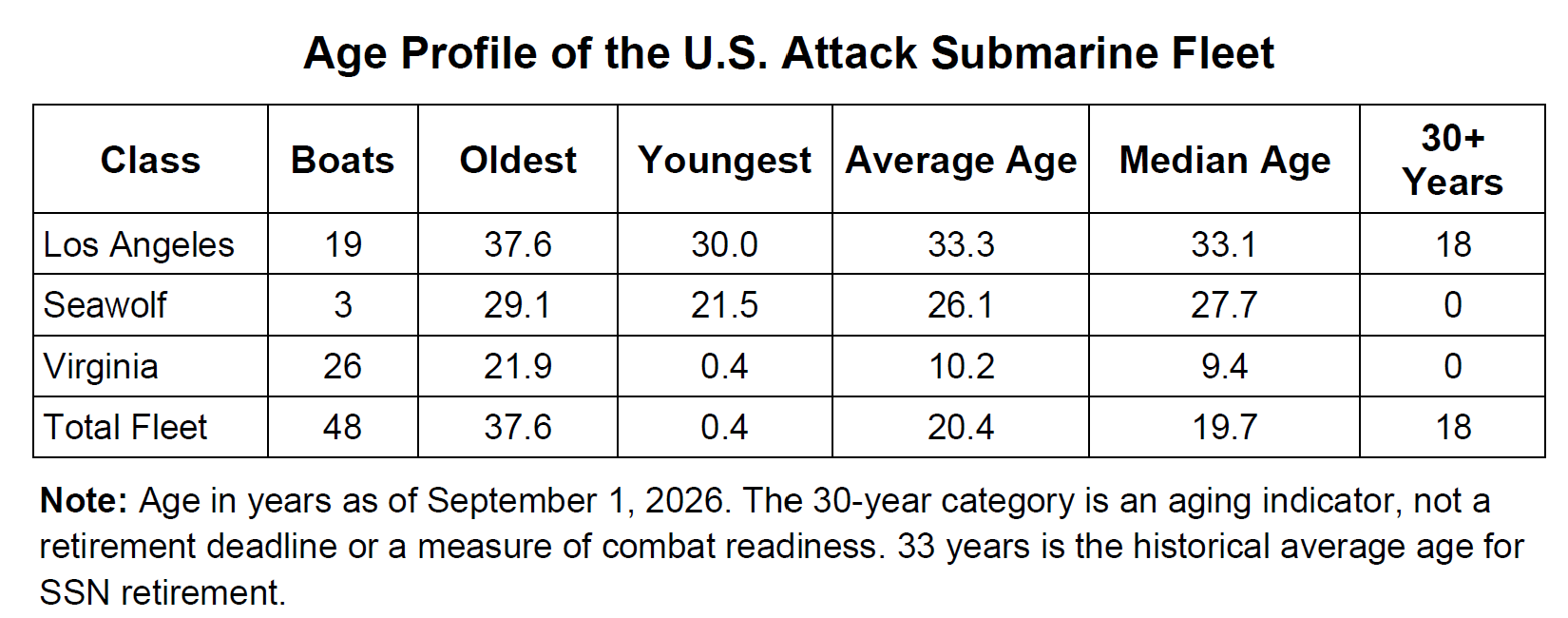
For our purposes, the implications of these statistics matter more than the underlying causes. The CBO’s findings in April 2026 serve as a decisive reference, showing that nominal inventory translates directly into deployable capability. Before factoring in geographic considerations, competing missions, deployment cycles, weapons use, battle damage, or adversarial actions, maintenance reduces the inventory of 48 nominal attack submarines to approximately 32 potentially deployable vessels. First discount: 48 SSNs → approximately 32 potentially deployable SSNs.
Even this number is somewhat optimistic. “Potentially deployable” means a submarine that can be utilized for combat, but not immediately available for an operation. The critical point is that maintenance effectively eliminates about one-third of the nominal SSN fleet before specific war requirements are even factored in.
Deployable Is Not Deployed
The initial discount has brought the nominal fleet of 48 attack submarines down to around 32 that could potentially be deployed. However, “potentially deployable” still differs significantly from “available for combat.” Submarines undergo a force-generation cycle that alternates between deployment, training, certification, maintenance, and crew recovery.
The Government Accountability Office recently outlined this cycle for 44 Los Angeles- and Virginia-class attack submarines. They experience an 18-month operational cycle comprising approximately 12 months of training and intermediate maintenance followed by six months of deployment. A 30-day stand-down post-deployment expands a complete cycle’s duration to about 19 months. The three Seawolf-class submarines have different operational characteristics and were excluded from this standard analysis.
In this operational model, six months of deployment out of approximately 19 translates to around 32 percent of the full cycle. Applying this ratio to our maintenance-available fleet of 32 submarines yields about ten active SSNs at any one time. Actual operations, however, may not adhere to this neat framework. Schedules may overlap, deployments can be prolonged, and crises can prompt surge operations. A major conflict with China would likely necessitate more submarines being deployed. Yet, this surge draws down future readiness.
Submarines nearing deployment can be sent out earlier, existing deployments extended, training periods shortened, and scheduled maintenance deferred. None of these actions resolve the underlying demands of operational readiness. Crews require recovery, deferred maintenance will eventually need to be performed, and submarines hurried through the force-generation process will need to be reestablished later. A brief conflict can consume readiness accumulated during peacetime, while a protracted war must regenerate the readiness expended.
Thus, the relevant metric for enduring conventional warfare isn’t the maximum number of submarines that could be hastily deployed at the outset. Instead, it reflects the force that the Navy can consistently cycle through combat operations.
Using the standard deployment ratio on the maintenance-available fleet results in a steady-state output of roughly ten deployed SSNs worldwide. This number shouldn’t be misconstrued as a prediction that only ten American attack submarines would be operational during a conflict with China. It’s a baseline for force generation rather than an upper limit for wartime capacity. The calculation remains inherently approximate since the GAO’s operational cycle applies specifically to the Los Angeles- and Virginia-class submarines, intentionally excluding the differently employed Seawolf class. Second discount: approximately 32 potentially deployable SSNs → around 10 typically deployed SSNs worldwide.
However, these ten submarines are not strictly earmarked for combat operations in the Western Pacific. They represent the sustainable output of a globally engaged submarine fleet. An essential next question is how much of that output can realistically be allocated to a conflict with China.
The Missions Allocation Challenge
The United States operates a worldwide navy, and its attack submarines do not solely exist to counter China. They are tasked with a variety of missions, including anti-submarine and anti-surface warfare, ground attacks, intelligence, surveillance, reconnaissance, special operations, mine warfare, and support for naval fleets. Submarines also carry out intelligence operations that serve national interests beyond strictly naval requirements.
A conflict with China would prioritise these missions vigorously, but it would not eliminate competing demands. Russian ballistic and attack submarines would still need monitoring, and the intelligence demands would significantly escalate during a major conflict. Other naval task forces might still need undersea support, and U.S. decision-makers would also have to consider the possibility that a conflict mainly focused on China could expand.
This scenario highlights a common pitfall in military force comparisons: asset double counting. Some arguments promote the submarine fleet solely in relation to China, while others invoke the same vessels against various other adversaries, invoke them for carrier protection, intelligence gathering, land strikes, or hunting missile submarines.
While each assertion may individually appear valid, collectively they are impossible. The same submarine cannot engage in anti-ship operations near Taiwan, monitor Russian submarine activity elsewhere, collect intelligence in different regions, and provide protection to a carrier strike group thousands of miles away. Assigning a vessel to one task incurs opportunity costs in every mission it can no longer fulfill.
Capability can also be double counted. While submarines in the same nominal category may be capable of performing many tasks, they are not uniformly effective across all tasks. Geography, weapon configurations, sensor capabilities, communication requirements, and tactical circumstances all influence their usefulness. A submarine capable of executing multiple missions may not necessarily be able to do so concurrently or with equal efficacy.
Therefore, a portion of the deployed SSN fleet must remain allocated to tasks outside the primary battle zone against China. It is impossible to ascertain an exact number based on available public data, but an escalating conflict with China would certainly compel Washington to divert submarines toward the Pacific. Mission durations could be curtailed, and risks accepted elsewhere, but those missions would not disappear altogether; they would create strategic risks.
This trade-off becomes increasingly significant in a prolonged war. A brief conflict encourages concentration of forces, whereas a drawn-out war provides adversaries the opportunity to exploit any gaps that arise. This highlights a broader principle for evaluating military capability: a force should be assessed against a specific objective only to the degree that it can realistically be allocated to that objective, taking operational constraints into account.
The next reduction occurs due to geography. After the United States determines which submarines to commit, those vessels must transit to their operational areas, expending valuable time to generate combat effectiveness thousands of miles from significant American logistical support.
The Tyranny of Distance
While nuclear propulsion grants American attack submarines exceptional range, it’s crucial to differentiate between range and presence. Although a submarine can traverse thousands of miles without refueling, it must still dedicate time to cover those distances. This is critical because a substantial portion of the U.S. submarine fleet is stationed far from the primary theaters of a conflict with China. Guam is the closest significant American submarine base, situated approximately 1,500 nautical miles from Taiwan. Comparatively, Pearl Harbor is about 4,500 nautical miles away, while submarines leaving San Diego must travel approximately 6,500 nautical miles. Submarines based in the Atlantic face even longer transits. The following map illustrates the distance an SSN would cover from Guam in daily increments at an illustrative cruising speed of 20 knots:
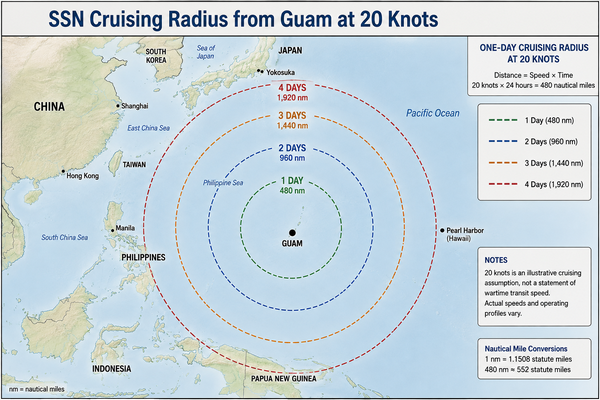
The key resource is not merely submarines but combat-submarine time: the portion of a submarine’s availability that is actually spent executing useful combat missions within the theater. A submarine taking two weeks to cross the Pacific remains unavailable for other missions during that transit while not yet generating combat power in a conflict against China.
Forward deployment can somewhat alleviate this issue. Guam has become increasingly essential for American undersea operations. By July 2026, four attack submarines were forward deployed there, including USS Minnesota, the first Virginia-class submarine permanently stationed in Guam. These submarines would be vital during the initial stages of a conflict, as they could reach Western Pacific operational areas much quicker than those based in Hawaii or on the U.S. mainland.
However, having four forward-deployed submarines does not negate the geographical challenges of a protracted conflict. Additional submarines will still need to arrive from distant bases, while vessels leaving the operational area for maintenance, repairs, or resupplying will lose valuable combat time during both outbound and return transit.
Understanding the difference between initial strength and sustainable strength is paramount. In the early days of conflict, Washington could concentrate submarines already in the Pacific, accelerate departures of boats nearing deployment, and redirect other SSNs toward the theater. The resulting force could temporarily exceed typical peacetime deployment levels. But maintaining this concentration necessitates a continuous influx of replacement boats as those currently deployed exhaust their weapons, develop maintenance concerns, or complete lengthy missions.
Distance functions as an ongoing constraint rather than a one-off mobilization expense. Consider a submarine forced to depart the operational area to return to Guam. Travelling at 20 knots, a round trip between Taiwan and Guam would consume roughly six days, not accounting for weapons reloads, maintenance, crew needs, or potential delays. A vessel returning to Hawaii or the mainland would incur even greater delays that detract from combat time.
This elucidates why nuclear endurance may lead to misinterpretations in strategic comparisons. While a submarine can remain at sea for months thanks to its reactor, it still operates within a broader system governed by geography, armaments, maintenance, and logistical considerations. The more pertinent inquiry isn’t merely how long an SSN can remain submerged, but how much of its available time can be effectively converted into combat outcomes in the necessary locations.
The specific geographical discount will vary significantly based on bases, mission assignments, operational areas, and the progression of the conflict. Thus, it shouldn’t be assigned a fixed empirical percentage. However, it’s unreasonably assigned a value of zero. While distance does not preclude American submarines from engaging China, it reduces the effectiveness with which the submarine fleet can generate and replenish combat power against the adversary. Such a distinction becomes even more relevant once submarines begin to engage in combat.
The Magazine Depth Limitation
One unique aspect of American attack submarines stems from their nuclear propulsion: their endurance significantly exceeds their weapons capacity. An SSN may remain at sea for extended periods, but it cannot sustain combat indefinitely without resupplying its limited inventory of armaments.
This consideration takes on particular importance in a naval campaign. Virginia-class submarines feature four 21-inch torpedo tubes, typically carrying around 20–26 Mk 48 heavyweight torpedoes. Other weapons or payloads can occupy that same space. Virginia-class vessels can also carry Tomahawk cruise missiles in vertical launch systems, with greater missile capacity on variants equipped with the Virginia Payload Module. However, increasing vertical-launch capacity does not augment the number of Mk 48 torpedoes available for particular anti-submarine or anti-surface missions.
While possessing twenty or more heavyweight torpedoes provides formidable firepower, it does not constitute an unlimited supply. Actual munition uses will depend on a variety of factors, including target types, engagement conditions, and combat needs. For example, some targets may necessitate multiple shots, or certain weapons might not perform as expected. Furthermore, a submarine commander would typically retain some weapons for self-defense and subsequent engagements.
The real constraint, therefore, is not solely the quantity of munitions aboard a submarine, but how quickly combat operations deplete them. A high-intensity campaign that enhances a submarine’s effectiveness could simultaneously constrain its magazines, limiting sustained operations.
Once a submarine has expended its munitions, nuclear endurance can no longer address the problem. Currently, replenishing Mk 48 torpedoes requires the submarine to retract from patrol to a suitable pier or submarine tender for reloading. For combat power to be restored, three essential elements must converge: the submarine, replacement weapons, and the appropriate facility for transfer.
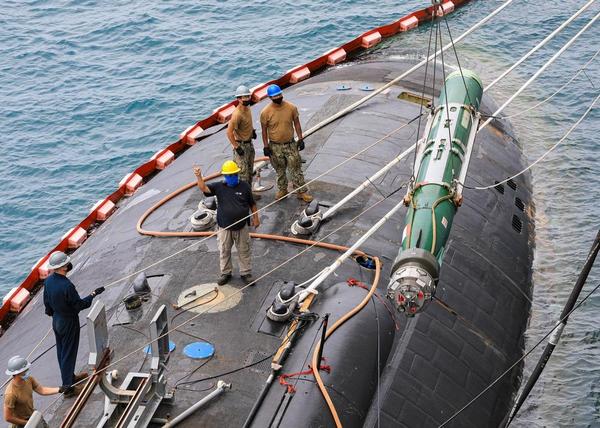
Transfer of MK 48 torpedo to docked submarine
Geographical factors also play a significant role. Guam is approximately 1,500 nautical miles from Taiwan. At a cruising speed of 20 knots, a submarine traveling between the two locations would spend around six days just on transit, not accounting for weapons loading, maintenance, operational readiness, or potential delays. Furthermore, rearming from greater distances would only increase these time penalties.
This converts arms expenditure into a generational challenge. Successfully launching weapons diminishes an enemy’s capacity, but this success may simultaneously trigger a countdown for the submarine’s temporary exclusion from combat. Successfully keeping pressure on an adversary necessitates sufficient vessels ready to replace those temporarily withdrawn for rearmament while simultaneously sending others back towards the theater.
Rearmament also highlights vulnerabilities that cannot be obscured by a submarine’s renowned stealth. A submerged SSN is exceedingly difficult to detect and target. However, its support network is far less obscure, encompassing identifiable assets such as Guam, submarine tenders, ammunition facilities, piers, maintenance centers, and weapons storage locations. Notably, Guam itself lies within range of Chinese conventional missile systems.
This means that an enemy does not have to physically destroy an SSN to diminish SSN combat effectiveness. They can similarly achieve impactful results by attacking or disrupting the infrastructure that supports the submarines, increasing turnaround times, and thereby reducing effective combat-submarine time. The submarines can conceal themselves beneath the waves, yet their logistical networks remain exposed.
These aspects further blur the lines between the theoretically available number of submarines and the sustained combat power they can provide. As with geographical considerations and mission allocation, it is challenging to predict the magnitude of this discount precisely. Variables like weapon use, target accessibility, tactical outcomes, logistics capabilities, and enemy assaults on support systems complicate this task. However, it’s evident that uncertainty doesn’t warrant assigning a value of zero to this discount.
Military inventories represent stocks, but warfare operates on a flow basis. The sustainable fighting capacity of the submarine force hinges not just on the quantity of available vessels and armaments, but also on the speed with which armed submarines can return to combat after expending their capabilities. How many boats are actively fighting is more critical than merely how many exist.
Attrition and the Replacement Problem
Thus far, all calculations have assumed that submarines withdrawn from combat will eventually rejoin the fray. Yet, in a prolonged conflict, there’s a harsh reality: some may not return. Although American attack submarines are highly capable and tough to detect, they certainly aren’t invulnerable. The Chinese anti-submarine warfare capabilities encompass surface vessels, submarines, maritime patrol aircraft, helicopters, sensor systems, and other surveillance mechanisms. The true effectiveness of these capabilities against contemporary American SSNs is uncertain, primarily due to the classified nature of much relevant information.
We cannot responsibly predict an exact submarine attrition rate, but identifying the underlying structural problem is essential. Every SSN that is lost in combat effectively vanishes from the force for a time that likely exceeds the overall duration of the conflict. The U.S. cannot replace nuclear-powered attack submarines on a wartime schedule. As of April 2026, the Congressional Budget Office revealed that Virginia-class production averaged around 1.1 submarines annually over the preceding two years—significantly below the Navy’s desired rate of two per year. CBO also noted that constructing a new submarine now takes about a decade. Concurrently, the Navy is building the Columbia-class ballistic missile submarines, which are given the highest priority and draw upon much of the same specialized nuclear submarine industrial base.
This aspect renders submarine attrition fundamentally different from both ammunition usage and scheduled maintenance. A torpedo can be replaced eventually, and a submarine undergoing maintenance can be restored to duty. Yet, a submarine sunk in combat remains absent from the available fleet throughout the relevant conflict duration. Even a minor attrition rate can become significant over an extended war. If the sustainable combat strength in the main conflict zone folds into the single digits, the loss of a single submarine transforms from a small fraction of a 48-boat inventory into a substantial reduction in the force generating combat effects at that time.
This asymmetry becomes more pronounced over time. While China will also experience losses, including personnel, vessels, aircraft, and coastal infrastructure, the comparison should not merely revolve around which side loses more platforms. Instead, attention must fall on each side’s ability to regenerate the specific combat capabilities utilized. In a conflict occurring near a continental power’s industrial base, the replacement and repair challenges differ considerably from those faced by an expeditionary naval force relying on platforms that take roughly a decade to craft.
None of this indicates that China could easily locate and destroy American attack submarines; this is not the argument being made. The point is rather that U.S. submarine losses, if they happen, are essentially irrecoverable during the relevant timeframe of warfare. Attrition plays an unyielding role: maintenance losses can be recovered, transit delays of combat time can be reclaimed, magazines can be restocked; yet a sunk SSN is permanently lost.
The submarine fleet can surge, rotate, and rearm, but it cannot regenerate lost submarines.
The adverse scenario further examined here does not assume any losses occurring in combat or significant disruptions to Guam or other submarine-supporting facilities. These impactful consequences are left outside the numerical model due to the inherent difficulties in assigning percentages to them. Instead, the resulting adverse estimate should not be interpreted as a worst-case scenario, but rather as a bounded exploration in which no American submarine is lost, and primary support systems remain substantially intact. With these boundaries in place, we can sum up the discounts and ascertain what the nominal 48-submarine inventory may actually signify in terms of sustainable combat capability.
Discounting the U.S. Attack Submarine Force
We can consolidate the constraints detailed thus far into an approximate estimate of the sustainable submarine combat power in a prolonged conventional conflict with China. This exercise is not designed to predict how many American attack submarines would be operating near China on a given day; wartime deployment levels will fluctuate, surges may occur, missions may be altered, and operational decisions hidden from public view will influence outcomes. The aim is to distinguish nominal inventories from viable combat power.
The first two discounts possess relatively firm empirical bases. According to the CBO’s records in April 2026, there were 48 SSNs, with roughly a third under maintenance, leaving a maximum of 32 potentially deployable boats. The GAO’s conventional force generation model illustrates an operational cycle that presumes a typical six-month deployment in a broader sequence of 19 months. When this ratio is applicable to the maintenance-ready fleet, it indicates approximately ten regularly deployed SSNs globally. Beyond this point, publicly available information does not facilitate the same level of precision. Hence, we’ll examine two explicitly illustrative scenarios.
The optimistic scenario presumes that maintenance performance remains stable even under wartime pressures, the conventional force-generation cycle continues to operate efficiently, with 80 percent of deployed SSN capacity available against China, geographic considerations consuming only five percent of the combat capacity, and weapons expenditure and rearming imposing another ten percent penalty.
The pessimistic case—which is intentionally conservative—assumes a ten percent deterioration in maintenance and readiness beyond the existing maintenance discount, a further ten percent decrease in force-generation efficiency, only 60 percent of deployed SSN capacity is directed toward the core theater against China after competing missions are accounted for, a 20 percent geographical penalty, and a 30 percent regeneration burden. Importantly, this adverse case assumes zero combat losses and minimal incidents impacting Guam or other essential submarine-support infrastructures. It should thus not be interpreted as the ultimate worst-case scenario.
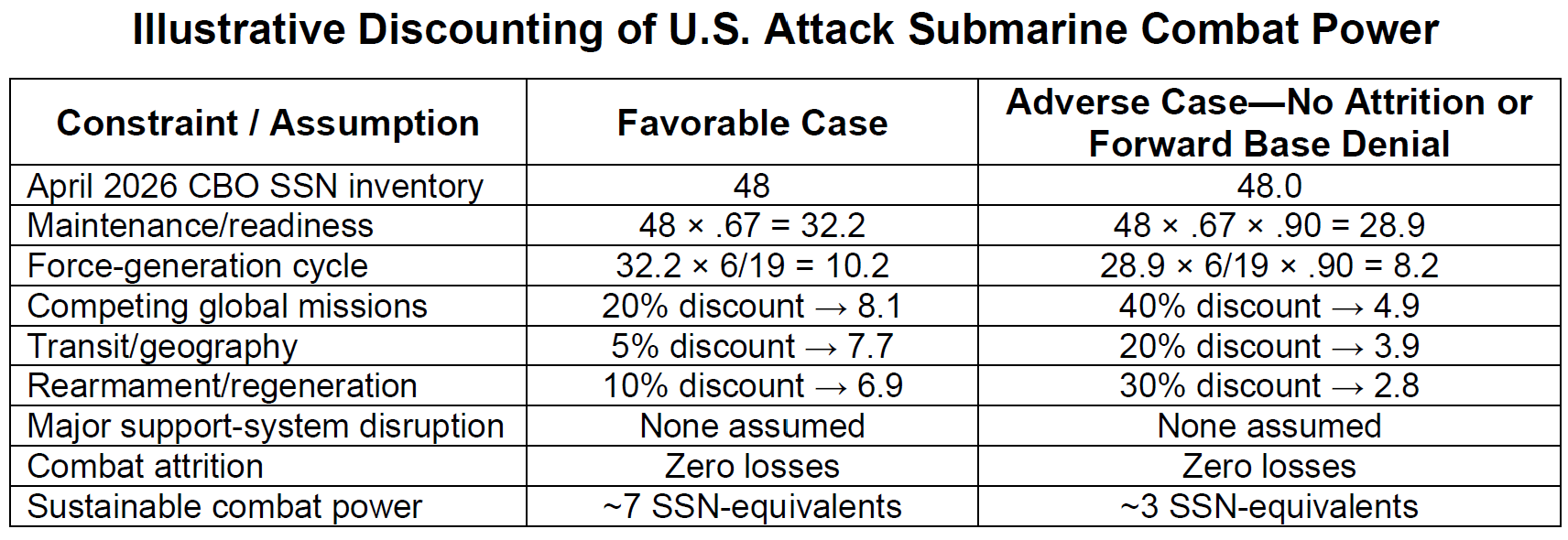
The arithmetic depicted in the table should not be misconstrued as indicating a precision that the underlying data cannot support. The maintenance statistic originates from the CBO, while the force generation ratio derives from GAO’s notional operational cycle. The subsequent percentages related to missions, geography, and regeneration are analytical assumptions introduced to highlight the significance of constraints frequently overlooked in conventional inventory comparisons. They should not be read as official Navy estimates.
Moreover, the later adjustments should not be interpreted as strictly independent variables. Geography impacts rearming times; mission allocation dictates submarine positioning, and maintenance interplays with operational tempo. Thus, the computed discounts represent an illustrative accounting framework rather than asserting that these factors can be wholly isolated statistically from one another.
The impact of the outcomes matters more than the individual calculations. Beginning with the nominal U.S. attack submarine fleet does not yield a scenario where 48 vessels are consistently prepared for deployment in the Western Pacific. The empirically grounded maintenance and deployment-cycle reductions alone compress the fleet to around ten boats active on average across the globe. Recognizing the additional complexities of competing missions, geographical factors, and regeneration capabilities suggests that sustainable combat power in theater could reasonably extend into high single digits. Under favorable circumstances, the model estimates roughly seven SSN-equivalent vessels could be positioned to effectively engage against China. In contrast, adverse assumptions may constrict that estimate to about three.
The concept of SSN-equivalent is crucial. These figures should not be construed as forecasting that precisely seven or three submarines will patrol a specific area at any moment. Instead, they reflect the calculated combat power available once accounting for the fractions of the nominal fleet impeded by maintenance, force generation, alternate missions, transit durations, and logistical refreshment. The actual number of submarines in-theater at any given moment could fluctuate significantly.
The adverse scenario is particularly illuminating, as it does not rest upon catastrophic assumptions. No American submarine is presumed lost, and Guam retains operational capabilities. Supply lines for the submarines are predicted to remain stable, with no incidents largely compromising their operational support network. The adverse scenario merely factors in moderate dips in readiness and operational efficiency, continued competing missions, significant geographic friction, and greater burdens imposed by logistics for reconstitution.
This realization lies at the core of the accounting challenge. Military inventories embody stocks. War denotes flows. The strategic capability of this submarine fleet hinges not solely on quantities of available vessels and armaments, but on the rate at which effectively armed, maintained, and properly positioned submarines can reach combat zones and return post-engagement. Warfare is driven by streams of usable combat power, not just stockpiles.
Conclusion
The United States commands the most proficient nuclear-powered attack submarine fleet on the planet. These submarines are stealthy, heavily armed, and highly skilled operationally, making them formidable assets against potential threats. In a confrontation with China, they could deal substantial damage to adversarial naval forces. Nevertheless, this discussion doesn’t resolve the major question posed earlier. The crux of the matter isn’t whether an American SSN can neutralize Chinese warships; it is how much submarine combat power the United States can sustainably wield against China throughout a prolonged conventional conflict. Addressing this requires a different kind of assessment.
In April 2026, CBO tallied 48 U.S. attack submarines. However, maintenance cuts this figure to a maximum of 32 deployable units. Applying GAO’s operational cycle reduces the steady-state available output to about ten SSNs worldwide. Those submarines must then be distributed across competing missions, traversing vast distances, stocked with limited armaments, periodically withdrawn for rearming and maintenance, and supported by vulnerable logistical infrastructure.
The illustrative model ultimately yields a sustainable combat strength of about seven SSN-equivalents in favorable situations and possibly three in adverse conditions. This unfavorable scenario isn’t the worst-case outcome; it postulates that no American submarine is lost and that important facilities such as Guam remain operable, while only modest drops in readiness or operational efficiency are argued.
The numbers provided are not deterministic forecasts. During the course of a conflict, the actual submarine strength available can shift markedly. The U.S. Navy could surge submarines toward the Western Pacific in the early stages of a conflict, potentially mobilizing much more combat power than the steadystate model suggests. However, it’s essential to understand that such surges involve using resources that will affect future readiness. With prolonged conflict, the underlying arithmetic becomes undeniable.
The distinction between inventory and sustainable combat power extends beyond submarines. Recent U.S. military operations against Iran exemplify the same principle. Carrier fleets can be redeployed, deployments can be prolonged, logistics can sustain far-off operations, and extensive stockpiles of munitions may become expended. Yet, these efforts consume readiness elsewhere. Ships and aircraft accrue maintenance needs, crew deployment periods are extended, munition inventories dwindle, and forces reassigned to one campaign become unavailable to others.
Hence, military capabilities are not merely additive. A carrier repositioned from the Pacific to the Middle East does not amplify American naval power; it reallocates it. A submarine designated to shadow Chinese warships cannot simultaneously surveil Russian submarines. A submarine coming from Hawaii counts in the inventory, yet isn’t generating immediate combat impact near China. Meanwhile, submarines returning to Guam for rearmament remain operational but are temporarily absent from the confrontation. Once a submarine is lost in battle, it remains on the Navy’s historical account, yet cannot be regenerated promptly on a wartime timeline.
Such understandings illustrate why nominal force comparisons can be quite misleading. They encourage analysts to juxtapose entire inventories, assuming every unit is simultaneously ready, armed, appropriately located, logistically supported, and unencumbered by other commitments. This assumption fails to hold true. The stakes are particularly high when evaluating potential conflicts with great powers over considerable distances. China would engage from proximity to its primary bases, industrial zones, missile capabilities, airfields, and repair facilities, while the U.S. must project significant combat power across the Pacific while managing global commitments. Despite nuclear deterrence and stealth providing the U.S. submarines an edge, geographical constraints and logistical challenges remain inescapable.
Additionally, exceptional tactical capabilities do not resolve the issue of scale. A small contingent of SSNs might destroy a disproportionately large number of Chinese vessels, rendering them invaluable weapons. Nevertheless, this does not guarantee that they suffice to alter the outcome of an extended conflict that involves considerable naval assets, airpower, extensive land forces, satellite systems, cyber operations, and immense industrial resources.
Tactical efficacy does not ensure strategic adequacy. This point is particularly vital given that the attack-submarine fleet is difficult to replenish. While munitions can be manufactured and damaged facilities repaired, changes to deployment schedules may be enacted, constructing a Virginia-class submarine currently requires about a decade. An SSN sunk during a major conflict is rendered out of commission throughout the war. The submarine force can surge, rotate, and rearm, yet cannot regenerate lost vessels.
None of this affirms that American submarines would falter against China; they could be devastatingly effective. Chinese anti-submarine warfare may falter, American commanders could attain favorable engagement outcomes, and Chinese naval efforts could crumble under sustained undersea offensives. Conversely, it is just as feasible that a fleet of formidable submarines could eliminate numerous targets yet remain insufficient in size, mobility, or logistical replenishment to influence the overall context of a broader conflict. In that scenario, they may remain tactically strong while becoming strategically inconsequential as the war progresses.
The United States may present 48 attack submarines on paper, yet maintenance assessments alone reduce that figure to 32. The conventional force generation cycle further limits the steady-state engaged force to around ten worldwide. When recognizing competing missions, geographical factors, and logistical regeneration, sustainable combat power against China likely nosedives into single digits—perhaps even lower under adverse but not catastrophic assumptions. Such a meager submarine force may still retain potency, yet the Pacific presents a vast battleground contested by a formidable adversary.
Ultimately, the fundamental query persists: can American submarines prevail against the Chinese navy? A favorable outcome hinges on whether sufficient American submarines can effectively engage, sustain combat presence, resupply, regenerate, and continue to influence the fight to ensure a decisive victory. These foundational assumptions about the Navy’s silent force warrant thorough scrutiny.

