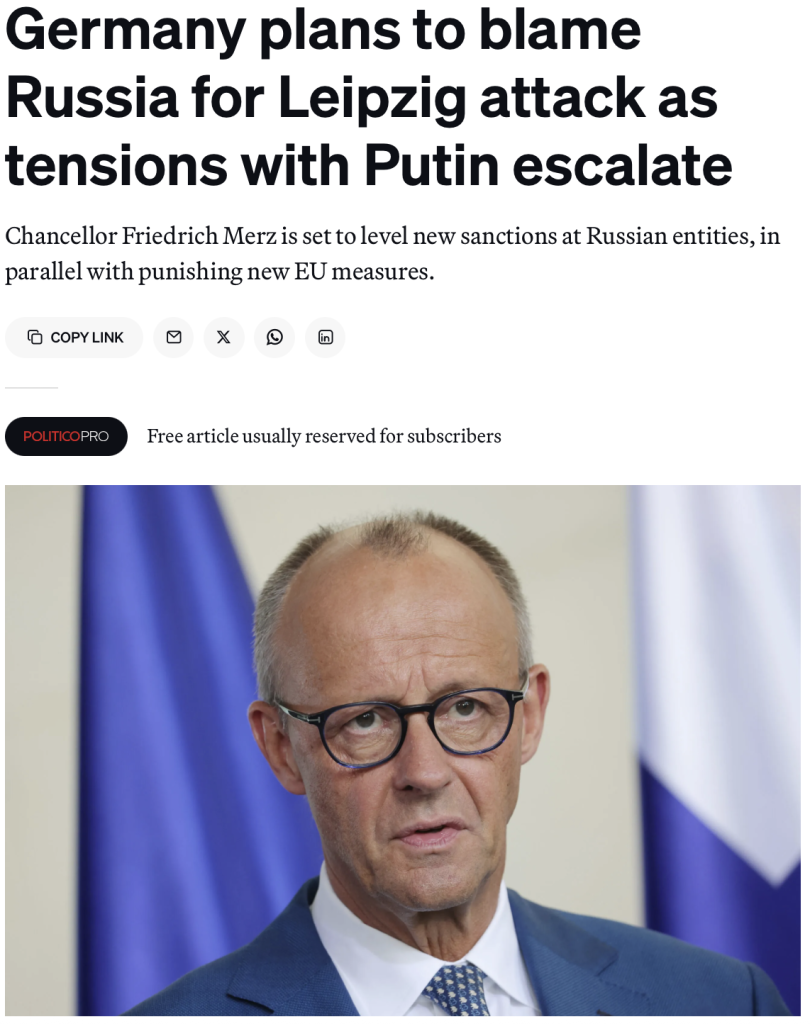
Recent developments in the ongoing conflict involving Europe and Russia have been notable. The UK is deploying drones into Russian territory with the intention of targeting Russian forces, while London boasts about the production of Storm Shadow missiles in Ukraine. Germany discusses enhancing its efforts in the region, and the EU continues to funnel resources into drone technology that effectively targets Russian civilians and infrastructure.
In this tense atmosphere, one might expect Russia to retaliate against these European actions. As accusations of hybrid warfare escalate, the question remains whether the reports of Russian activities are rooted in reality or if they are merely an exaggeration by European operatives seeking to justify the escalating costs of the conflict.
In a recent twist, CIA Director John Ratcliffe was reportedly dispatched to Moscow to caution Russia against attacking NATO states. The situation took an even stranger turn with reports suggesting that he informed Russian officials about their deteriorating position in the war:
This story is even more absurd than first look. Follow the NYT hyperlinks, and the CIA chief sources his “Russians dead in 35 minutes” intel from a widely mocked FP story by Peter Frankopan, who sourced it from Astra, a Russian opposition Telegram channel.https://t.co/LPDqHpYMEG pic.twitter.com/pSpxtf3BXQ
— Mark Ames (@MarkAmesExiled) August 28, 2026
If we are to take Ratcliffe’s warning at face value, the situation indicates that Europe is effectively stepping into the role once held by US proxies like Ukraine and Israel. They are actively engaging in attacks while the US, despite its involvement through funding and logistical support, presents itself as an impartial mediator. However, it is unlikely that Russia views this role with any credibility. There are also alternative interpretations regarding Ratcliffe’s visit.
My take on the CIA director’s Moscow trip is different from everyone else’s.
Media says Ratcliffe flew to Moscow to warn Russia. I think that’s backwards.
He was called in to be warned by Russia.
Think about it. If America wanted to warn Russia, they’d do it publicly. They’ve…
— SlavicPatriot (@infantserbian) August 28, 2026
There’s also a chance that Ratcliffe’s visit was meant to deliver a peace plea, potentially coinciding with a push from the Vatican for de-escalation. Nevertheless, tensions have escalated further with Russian strikes becoming more frequent against Ukrainian infrastructure, leading to heightened anxiety among European leaders.
Daily allegations of Russian hybrid warfare continue to emerge. For instance, Politico reported:
In Romania, a marine drone loaded with explosives was intercepted a short distance from the Neptun Deep gas platform in the Black Sea. President Nicușor Dan squarely blamed Russia for this incident. Shortly thereafter, Slovak police foiled a planned arson attack on a drone manufacturing facility. Estonian authorities also began investigating potential Russian links after a fire at a defense contractor’s facility. Additional explosions at ammunition plants in Italy and Bulgaria are also under scrutiny, though there is no clear evidence of Russian sabotage in those instances.
If these reports are accurate, we have entered a precarious phase where both sides are seemingly daring each other to act.
The UK and European leaders appear increasingly inclined to escalate the situation. London, in particular, is at the forefront, claiming to provide UK-made drones for deep strikes into Russian territory. Following Prime Minister Andy Burnham’s announcement regarding support for the manufacturing of Storm Shadows in Ukraine, Russian Foreign Ministry spokesperson Maria Zakharova cautioned that strikes on Russian territory might provoke retaliatory action against British military bases beyond just Ukraine. Storm Shadows were soon utilized in an assault on a shopping center in Donetsk.
❗️Eight people were injured in Donetsk after Ukrainian Armed Forces struck the “Donetsk City” shopping center area with Storm Shadow/SCALP-EG missiles, — Denis Pushilin, head of the DPR
Among the injured are two girls born in 2010 and 2016, three women, and three men. Three more… pic.twitter.com/Oz6G9QQtFa
— Zlatti71 (@Zlatti_71) August 26, 2026
Unexpectedly, in London, a major fire broke out at an industrial site near Wembley Stadium:
A major fire has broken out at an industrial site near Wembley stadium in north London.
Twenty fire engines and 125 firefighters are battling the blaze on Hannah Close, Neasden, at what is believed to be an Amazon warehouse🔗https://t.co/IPmZC0wuKO pic.twitter.com/TIz2ZbvpwH
— The Telegraph (@Telegraph) August 28, 2026
Additionally, the UK government is now advising citizens to stock up on canned goods. Meanwhile, other countries are intensifying their preparations across Europe.
The French military is racing to bolster defenses against potential drone swarms. “It’s nothing catastrophic; we are still at peace. But we need to make this move,” stated Gen. Fabien Mandon, chief of France’s defense staff, ominously suggesting that conflict may soon arise.
Germany is moving forward with its Zeitenwende 2.0 initiative.

Meanwhile, Munich’s beer halls are bustling with high-tech entrepreneurs enthusiastic about the influx of funds aimed at developing weaponry directed against Russia.
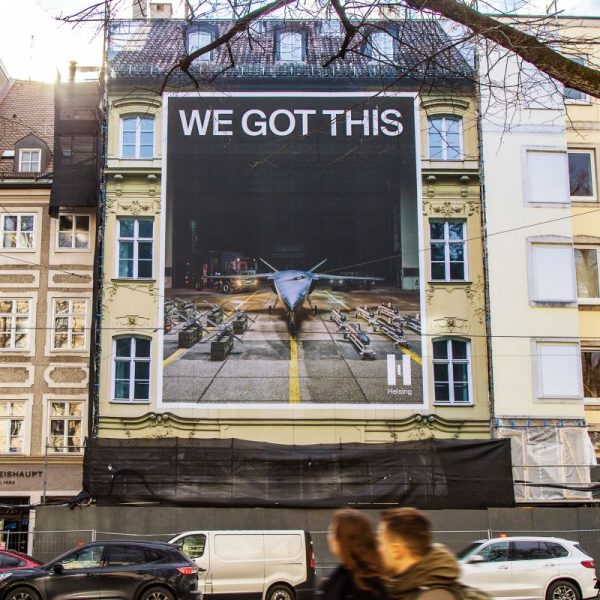
Munich-based defense tech company Helsing adorns city with posters. Source.
The flourishing defense start-up landscape in Munich contrasts starkly with a broader economic downturn across Germany, exemplifying a worrying trend throughout Europe.
As nations attempt to achieve the lofty target of devoting 5% of their GDP to defense by 2035, a significant shift in resources from social programs to the military-industrial complex is underway. Germany, for example, has boosted its defense budget by 24% this year, allocating $114 billion.
Efforts at all societal levels—economic, political, and media—are being recalibrated toward a war-centric approach. German politicians are increasingly vocal about the concept of “war readiness,” echoing sentiments reminiscent of the Nazi regime.

Mainstream media in Germany largely operates as an extension of the Atlantean elite, posing few questions beyond the discussion of military preparedness and strategies to enhance military effectiveness against Russia.
Finnish President Alexander Stubb, a former associate of Trump, posits an intriguing theory regarding tactics in the ongoing conflict:
Alexander Stubb says that hitting logistics centers like Wildberries increases the price of the war for Russia and bumps up the number of Russians who want to end the war by another 10%.
He insists on the fact that this is a sensible military strategy from Ukraine and the only… pic.twitter.com/jcrvkSc0AO
— Margarita Simonyan (@M_Simonyan) August 25, 2026
<p Amidst a landscape filled with misleading narratives, a recent Politico article implies a shift in Ukraine’s strategy, suggesting a willingness to target Russian civilians as it faces its potential downfall in the conflict, all in the name of winning public support.
The repetitive message from the EU remains unchanged, with Ursula von der Leyen stating:
Today, Romania destroyed a naval drone carrying explosives near its Neptun Deep platform in the Black Sea.
An escalating campaign of threats is underway, unsettling our citizens and seeking to divide our Union.
This is hybrid warfare.
The founding mission of our Union is to…
— Ursula von der Leyen (@vonderleyen) August 20, 2026
However, it is essential to note that the control over NATO’s highest military officer, Supreme Allied Commander Europe (SACEUR), remains firmly in American hands at the NATO Summit in Ankara. This demonstrates that the narrative about the US lessening its role in Europe is misleading; SACEUR and the US have garnered greater authority over European forces, effectively allowing Washington to make decisions regarding troop movements without requiring consent from national parliaments.
As the risk of direct engagement between Europe and Russia looms closer, this delegation of responsibility to the US is significant.
The prevailing narrative of NATO 3.0 emphasizes the need for European nations to not only increase funding but also to bear military casualties in an effort to “extend” Russian lines, mirroring the strategies outlined in a notable 2019 RAND report.
A more recent report from the U.S. Army War College highlights similar themes, emphasizing the need for Europe to adopt a more significant role in the conflict against Russia, thereby allowing the US to focus on its priorities in other regions like the Western Hemisphere and the Indo-Pacific. However, the specifics of Europe’s intended role remain vague.
The expectation is that European nations will provide the blood, resources, and land necessary to support U.S. objectives. This approach prepares Europe for proxy warfare, learning from past missteps associated with Project Ukraine. The report admits:
A deliberate and systematic “steel porcupine” strategy in Ukraine would have strengthened the denial pillar of NATO’s deterrence strategy.
Under this framework, Europe will take on the brunt of Russian attacks while simultaneously engaging in a prolonged campaign of air warfare designed to exhaust Russian forces. While this strategy may appear irrational, there are no indications that the European elite share this sentiment.
If European leaders were genuinely wary, they would not have systematically maneuvered their nations into their current predicament—a shift away from social investment to an emphasis on American energy and arms, all while surrendering military authority to the US.
With no energy independence, technological prowess, military capacity, or diplomatic agency, what is Europe but a mere proxy? We are aware of the typical outcomes for countries in this situation.
Revolution or War?
Notwithstanding the efforts of European elites, it remains unclear whether the populace will comply with these developments. How can one realistically expect Europeans to enlist in front-line combat? From my vantage point in Italy, this seems unlikely. Instead, it appears more plausible that we might witness an uprising against any government that attempts to coerce citizens into military service.
European initiatives to boost military recruitment are predictably falling flat.
A recent commenter on NC, Kouros, shared valuable insights regarding the challenges recruiters face, in response to a piece in The Economist titled ‘Would Europeans fight if it came to that?’ I have included those reflections at the end of this article.
Could Russian attacks or staged provocations alter this dynamic?
What about the economic landscape, such as a severe recession that jeopardizes social safety nets? We are witnessing early signs of this, with traditional sectors struggling and social services getting defunded, while military tech hubs like Munich thrive.
All this turmoil begs the question: what is the end goal? To maintain a narrative of “overextending” Russia in the hope it will implode?
Or does this shift serve as a diversion from acknowledging that Project Ukraine has faltered?
Political figures seem to be merely fulfilling their roles, potentially influenced by external entities such as the CIA. Lawrence Wilkerson, a former U.S. Army officer, verified:
🚨 EX-INSIDER BOMBSHELL: WE CREATED THIS EUROPE ON PURPOSE – CIA BOUGHT STOLTENBERG, RUTTE AND ENTIRE GOVERNMENTS
I have never heard the truth stated so directly. Colonel Lawrence Wilkerson, retired U.S. Army officer and former Chief of Staff to the Secretary of State, just… pic.twitter.com/3yif2levDv
— Mark (@Mark4XX) August 23, 2026
This could be the more optimistic interpretation. Conversely, it’s plausible that political figures may view themselves as reckless gamblers who believe their only path to sustaining power lies in remaining tethered to the US. The scenario where Russia would strike NATO territory might provide justification for them, allowing them to assert, “Look, we were right! We had no choice but to bet everything on Ukraine as our first line of defense against the supposed Russian menace!”
These current governments may face a reckoning sooner rather than later.
A political earthquake is looming in Germany; it has been forthcoming, and similar to France, the “center,” if it even exists anymore, must recognize that the “cordon sanitaire” is merely a façade for their failures.
— Claus Vistesen (@ClausVistesen) August 19, 2026
Past upheavals across Europe—from Italy to Sweden—demonstrate that despite challenges, the Atlanticist network manages to keep the momentum going. Presumably, the objective remains to sustain the current system while maintaining the status quo, enabling the ongoing extraction of resources from a struggling European continent.
***
From Kouros:
Dear Professor Tocci,
I read your article in The Economist with considerable interest and significant frustration. I feel compelled to engage with critical viewpoints that the format of your piece did not allow for, particularly because I have a son of military age and refuse to accept the arguments about European readiness for war without demanding clarity on their intentions.
I am a Canadian environmental epidemiologist. Canada lost 61,000 lives during World War I because of Britain’s conflict, and another 45,000 in World War II, with unclear justifications still reverberating today. I cannot support sending my son into another ambiguous engagement without a clear understanding of the reasoning behind it.
Your argument is logically coherent based on its premises: European support for Ukraine would serve primarily as a psychological and political signal, indicating to Russia and the United States that Europe is willing to endure costs for its security. I acknowledge this rationale but refuse to accept the intellectual methods that frame this argument, which reduce living individuals—specifically sons—into abstractions of conflict readiness without contemplating the tangible consequences.
The crux of the matter lies within these premises, which you are more familiar with than most. The Istanbul Charter for European Security of 1999, embraced by all OSCE members—including Russia and the United States—explicitly states that no state can bolster its security at another’s expense. The Astana Commemorative Declaration reaffirmed this in 2010, even as the question of further eastern expansion was debated. You were part of drafting the European Global Strategy; you know these documents exist. Yet, your argument operates as if they have no relevance.
I do not intend to defend the Russian invasion, which is fundamentally a war crime causing immense suffering to Ukrainians. It is possible for both these statements to coexist: the invasion is unacceptable, and a series of Western decisions contributed to this situation, neglecting established legal commitments. The push to incorporate Ukraine into NATO, which set off the particular chain of events leading to this conflict, contravened the indivisible security principle that all parties endorsed. Acknowledging this does not mitigate the invasion; it complicates the expectations you impose upon European parents regarding where they might be asked to sacrifice their children.
Your proposal to achieve the correct emotional responses through casualty exposure will not resolve this complication; it will only exacerbate it.
You cannot legitimately ask the populace to risk their children for a security arrangement without disclosing how that order was formulated, its foundational commitments, and which thereof were adhered to or violated. I implore you to communicate this openly, not in a format suitable for The Economist but in a manner befitting a serious analyst addressing the parents of sons who are abstracted into these strategic discussions.
Respectfully,
Nathalie Tocci
Dear xxxxxx,
Thank you for your thoughtful response. It’s clear our conversation warrants careful attention, and I appreciate that you’re engaging with such seriousness.I understand that your argument centers on deterrence rather than warmongering, and I appreciate that distinction. My concern lies with the rationale: the assumption that demonstrating a readiness to fight necessitates exposure to danger. While internally coherent, this makes a notable assumption: that adversaries are deterred solely by military signals and not by other strategies, including legal frameworks that all parties endorsed as non-military deterrence mechanisms. You have not engaged with these frameworks either in your article or your reply, leading me to wonder if that is due to their perceived irrelevance or the complexities they introduce into your argument.
Your scenario, which posits Russia could attack a NATO member while entangled in Ukraine, requires Russia to exhibit irrationality in escalating towards NATO Article 5, while simultaneously being rational in its decisions regarding troop presence in a post-ceasefire context. This discrepancy needs resolution, which your response does not achieve.
While I cannot predict Canada’s stance, I do know how I would react as a parent considering your propositions. I am already contemplating assisting my son to relocate elsewhere if conscription arises over this supposed European resolve. This is not a provocative statement but a realistic assessment from the perspective of a parent whose willingness you hypothesize about. The disconnect between your theoretical framework and the lived reality at the kitchen table is considerable and remains inadequately addressed.
I wish you success in your endeavors; these are crucial questions that deserve serious reflection. However, I feel the legal frameworks meant to avert such predicaments warrant greater seriousness than they have received from those positioned to provide it.
Sincerely,