[This article on the ongoing situation in Iran was published ahead of its final edit. Please check back or refresh this page at 8:30 AM EDT for updates]
Understanding the Current Conflict in Iran
The ongoing conflict in Iran represents a significant challenge not just for the region but also for the global powers involved. The facades of military superiority are starting to falter, particularly for the United States. Although the U.S. retains a massive nuclear arsenal, its conventional military effectiveness appears to be diminishing under the pressure of its global obligations.
This situation raises concerns: if U.S. conventional power continues to wane, might it become limited to tactics reminiscent of a less formidable nation, focusing solely on destructive capabilities? The discussions among experts about the possibility of nuclear options in Iran underline this troubling trajectory for U.S. military strategy.
In the boxing ring of international conflict, the U.S. can be likened to an aging fighter who, despite taking heavy hits in warfare and economic standing, keeps returning for more. Iran is prepared to inflict further damage. The U.S. has made grand promises of economic repercussions, but many of these measures may not be sustainable given its current limitations. Meanwhile, Iran possesses various strategies to tighten the noose around U.S. resources, particularly through disrupting traffic in the Strait of Hormuz, which could amplify the economic strain globally.
The inadequacies of the U.S. military are glaringly evident, especially in its diminishing stock of defensive and offensive capabilities. The operational viability of its naval bases is in question as Iran continues to demonstrate its ability to target these key support points effectively.
As we transition from old tactics, countries like the U.S. have also cut back on the size of their naval fleet, limiting their options in critical regions. Indicators of this decline are apparent, with some ships reportedly in less than optimal condition—a troubling sign for military readiness.
Jesus Christ.
This Arleigh-Burke Destroyer looks like we raised it from bottom of the ocean and put it back into service.
Embarrassing, quite frankly. pic.twitter.com/PRpMbdVR44
— Maine (@TheMaineWonk) August 16, 2026
Maintaining a blockade is increasingly challenging, as evidenced by the U.S. Navy’s struggle with logistics. If operational capabilities are already stretched to their limits, how can we expect a successful ground operation? Military experts had previously deemed any ground action a significant challenge, exacerbated by the current state of the Navy.
Simplicius examines the effectiveness of Iran’s military strategy, noting that U.S. naval issues stem from Iran’s calculated approach to targeting U.S. bases in the region:
…the most interesting item over the transom today are new reports… that U.S. naval problems in the theater all stemmed from Iran’s deliberate strategy of wiping out U.S. bases in the region…
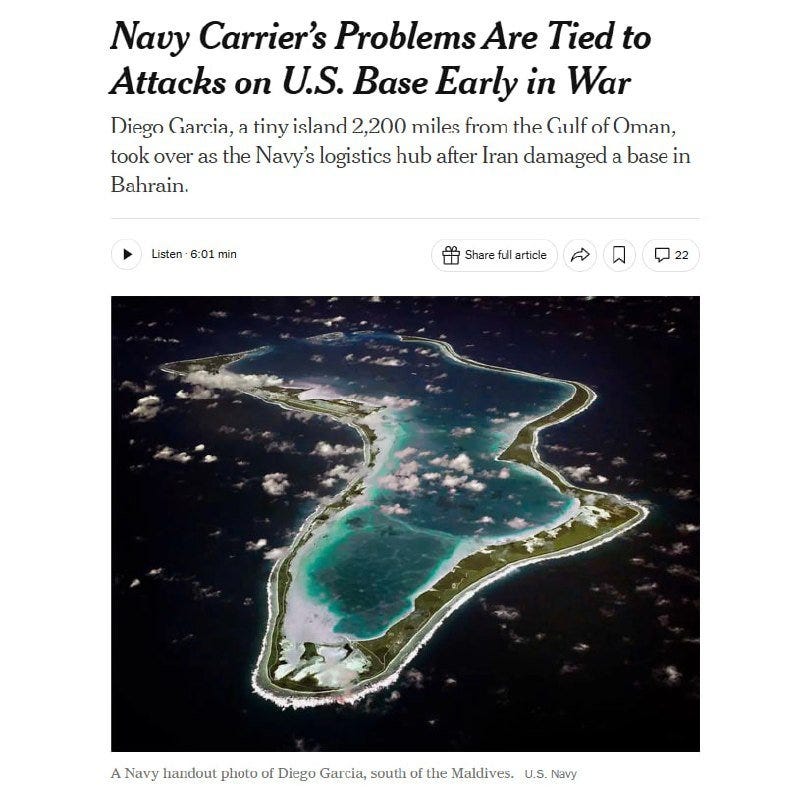
The reports indicate that difficulties for the U.S. Navy commenced following Iran’s initial strikes, which resulted in substantial damage to a key logistics hub in Bahrain:
The aircraft carrier U.S.S. Abraham Lincoln’s supply problems began soon after the first day of the war, as Iranian missiles and attack drones fell on a Navy base in Bahrain.
The Iranian attack, retaliation for the U.S.-Israeli assault on Tehran, destroyed much of the base. And as it went up in smoke, so did a major logistics hub that the Navy has relied on for decades…..
Reports have surfaced about a Pentagon operation aimed at relocating strategic assets away from Iranian reach, further complicating logistical ties while revealing a reliance on aging U.S. military infrastructure.
The condition of the U.S. Navy has astonished observers, especially as it becomes increasingly vital in a significant conflict:
The loss of the hub in Bahrain has contributed to a host of reported problems on carriers supporting operations against Iran, as Democratic senators raise concerns about the Lincoln’s 5,000 sailors and their nearly nine-month deployment…..
The evident decline of the U.S. Navy emphasizes the effectiveness of Iran’s strategy: eliminate American surveillance capabilities, saturate defenses, and then strike logistics nodes, stretching U.S. resources to their breaking point.
Experts have highlighted the aging supply chain and diminishing resources, emphasizing the unsustainable nature of current military operations:
Warships do not carry enough on their own to stay at sea indefinitely. What keeps a carrier strike group fed, fueled, and armed without returning to port is a dedicated fleet of supply ships called the Combat Logistics Force (CLF)….
The Combat Logistics Force today numbers about 34 ships — a figure that has stayed essentially flat for well over a decade.
The line from a thinned logistics force to a specific empty tray runs through a system with almost no slack left in it. A navy running long deployments in distant waters on a supply fleet that has stayed flat in numbers while shedding its most capable ships is a navy operating with vanishing margin.
The implications are significant: Iran remains poised to enhance its strategic positioning while the U.S. grapples with burgeoning vulnerabilities. Key negotiations are ongoing regarding the Strait of Hormuz, with Iranian officials asserting their unyielding control over this strategic chokepoint.
JUST IN: Iran suggests no amount of negotiation can change its permanent control over the Strait of Hormuz…
Iran’s stated intent to maintain control over this vital waterway reinforces its position—not merely as a regional power but also as a significant player in the global energy market.
With the U.S. threatening further economic sanctions, there are notable challenges on the horizon:
- Treasury Secretary Scott Bessent is preparing unprecedented economic measures against Iran, despite existing naval blockades and sanctions.
- Although the U.S. could target Chinese firms connected to Iran’s oil exports, this risks escalating tensions with Beijing.
- Other strategies could include threatening sanctions against trading partners, complicating the intricate relations that sustain Iran’s economy.
Bloomberg’s analyses have highlighted warnings about potential energy crises that could arise as supply chains become regular targets in this intensified conflict.
It would be tempting to conclude that the dangers of energy supply disruptions have been overstated…
A second phase of the Hormuz crisis could prove substantially more damaging than the first.
As the geopolitical situation evolves, the pressures surrounding the Strait of Hormuz highlight the essential interplay between U.S. military operations and Iranian responses. Iran is capitalizing on its military strategy to enhance its defensive and offensive capabilities while the U.S. navigates the logistical complexities of an overstretched military.
Conclusion
The unfolding dynamics in the Iran conflict illustrate the challenges faced by U.S. military forces in maintaining a coherent strategy against an increasingly adept opponent. The pressure exerted by Iran’s tactical maneuvers against weakened U.S. logistical support is a reminder of the complexities of modern warfare. As both nations prepare for potential escalations, the ability to navigate this intricate landscape will determine not only regional stability but also global economic ramifications.

