In recent years, the conflict between Iran and the United States has highlighted a significant disparity in military capabilities. The United States boasts a formidable edge in conventional naval and air force capabilities, advanced surveillance technology, and weaponry. On the other hand, Iran finds itself at a considerable disadvantage, unable to engage in a conventional face-off with the U.S. Navy and suffering significant naval losses at the onset of the conflict. Despite this, Iran has shown a persistent ability to threaten military and commercial traffic in the Persian Gulf and the Strait of Hormuz, indicating that unconventional warfare tactics can effectively contest superior military forces.
Historically, triumph in naval warfare has often hinged on the eradication or neutralization of the enemy’s fleet, which would grant the victor control over the surrounding maritime territory. This control would enable blockades, protect trade routes, and facilitate military power projection. However, the dynamics observed in the Persian Gulf defy these traditional expectations. Although its conventional naval fleet was severely compromised, Iran managed to utilize a blend of unconventional tactics such as land-based missiles, drones, sea mines, and small vessels to challenge U.S. naval operations without engaging in direct confrontations at sea.
Additionally, Iran targeted U.S. bases, undermining a critical component of American power in the region. Precision missile and drone strikes effectively compromised the use of key resources for air and naval operations, revealing that a military base does not need to be completely obliterated to lose its efficacy. A base can become significantly less valuable if it becomes too vulnerable to attacks, making the concentration of personnel, ammunition, and aircraft perilous.
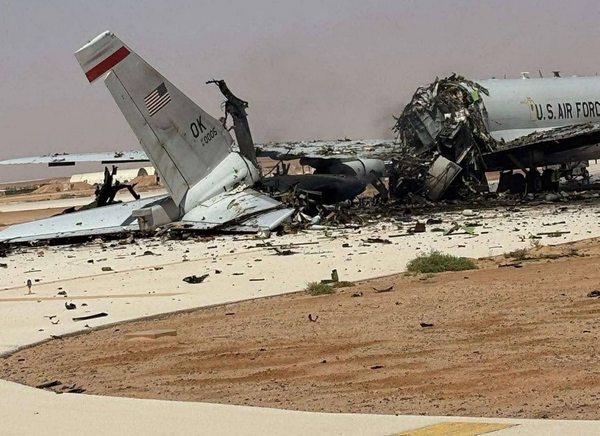
Precision strike on a base: a U.S. Air Force E-3 Sentry destroyed at Prince Sultan Air Base, Saudi Arabia, following an Iranian strike, March 27, 2026. Image released by Press TV/Iranian state media
Through these unconventional tactics, Iran illustrated that a nation with limited naval capabilities can still maintain a significant capacity to deny access to vital maritime routes while simultaneously disrupting the infrastructure essential for sustaining a powerful adversarial force. This resulted in the failure of the U.S. to fulfill its strategic objectives in the region. The immediate implications resonate within the Gulf; however, broader lessons arise concerning U.S.-China relations in the Pacific theater.
China presents the United States with a geographical asymmetry on a much grander scale. American military might must traverse the Pacific and rely on a network of forward bases and resources. Conversely, China holds significant advantages: a vastly larger industrial foundation, extensive missile capabilities, and advanced reconnaissance systems, all within a continent’s defensive depth. This raises a critical question: If Iran could effectively challenge the U.S. Navy using precision strikes and maritime denial, what capabilities should the United States anticipate from China? This question may necessitate a reevaluation of not only American military strategies concerning Taiwan but also the foundational principles of modern naval power.
For over a hundred years, American naval strategy has been heavily influenced by Alfred Thayer Mahan’s theories, emphasizing the need for a network of bases to support powerful fleets operating far from home. Mahan argued that a navy’s ability to command the seas ultimately stemmed from its logistics and support systems. However, the developments observed in the Iran conflict suggest that precision strikes and continuous surveillance are beginning to challenge the effectiveness of this long-standing framework.
Mahan’s Architecture of Sea Power
Mahan developed his sea power theories amidst a technological upheaval. When he published The Influence of Sea Power upon History in 1890, technological advancements had shifted naval warfare significantly. No longer reliant on sailing vessels, the emergence of steam-powered and armored ships underscored the importance of logistics in sustained military operations.

Alfred Thayer Mahan
According to Mahan, a steam fleet could not project power indefinitely from its home ports without coaling stations and logistical support networks. Thus, a navy’s effective reach depended on its ability to operate from a well-equipped support structure. His principle was clear: overseas bases enhance fleet reach and sustainability.
Mahan also champions the concentration of naval power to secure command of the sea. It was believed that a concentrated fleet could decisively defeat an enemy fleet, granting access to the maritime realm for trade, transportation, and military dominance. This framework remained intact throughout various technological advancements, from the replacement of coal with oil to the rise of aircraft carriers and submarines; yet, the fundamental requirement for logistical support persisted.
Historical events, such as the attack on Pearl Harbor during World War II, underscored the critical nature of this supporting infrastructure. Pearl Harbor served as more than just a home to the U.S. Pacific Fleet; it functioned as a strategic base that enabled American naval operations across the central Pacific. Its resources—fuel, repairs, ammunition, and personnel—were instrumental in sustaining military efforts, even after suffering considerable losses to its fleet.
The destruction of ships and their supporting infrastructure are not interchangeable. While damaged ships can often be repaired or replaced, functional bases allow for the rapid regeneration of combat power. Conversely, if a warship is forced to operate further from necessary logistical support, its utility decreases significantly.
After World War II, the United States built an expansive version of the Mahanian naval strategy. Across the Pacific and globally, an interconnected web of ports, airfields, fuel depots, and repair facilities enabled American forces to maintain a persistent global presence. However, in today’s precision-strike era, this very architecture may pose a vulnerability.
Iran Attacks the Strategic Foundation
The vulnerabilities of Mahan’s architecture become apparent when precision weapons are both accurate and plentiful. Military bases such as airfields, fuel depots, and repair facilities present identifiable targets that can be effectively attacked. Though Iran lacks the conventional military power comparable to the United States, its missile and drone capabilities successfully demonstrated that forward bases could be struck, underscoring the need for reevaluation of military infrastructure assumptions.
The effectiveness of a base is not solely determined by whether it can be destroyed; rather, it hinges on its ability to fulfill wartime functions while under attack. Vital operations such as aircraft movement, fuel distribution, and equipment maintenance are crucial for sustaining military effectiveness.
Targeting naval bases presents unique challenges. While a warship’s mobility at sea complicates its targeting, once it enters a harbor, much of that advantage dissipates. Historical records reveal predictable ports of call where specific ships replenish and refuel, making them vulnerable to subsequent attacks.
The behavior of U.S. naval forces during the Iran conflict illustrated the gravity of this issue. Operations in confined waters such as the Persian Gulf became increasingly precarious due to the risk of missile and drone strikes on nearby bases. As a result, combat vessels refrained from entering Gulf waters, demonstrating the lethal implications of concentrated logistical hubs.
Iran’s strikes did more than hit individual targets; they disrupted the premise that U.S. military infrastructure could reliably sustain combat power. Despite severe losses, Iran maintained its control in the Persian Gulf, employing a blend of land-based denial and distributed systems to contest maritime space, challenging two core assumptions of Mahan’s theory: that forward bases ensure support for expeditionary fleets and that superior naval forces can guarantee access to these bases.
The Underway Replenishment Trap
One solution to vulnerable forward bases is enhanced mobility. If ships are attractive targets in port, why not resupply them out at sea? Modern navies have invested in developing underway replenishment capabilities to allow naval vessels to remain operational for more extended periods without returning to harbor. However, this approach does not eliminate the dependence on land-based logistical support; it merely shifts it further back.
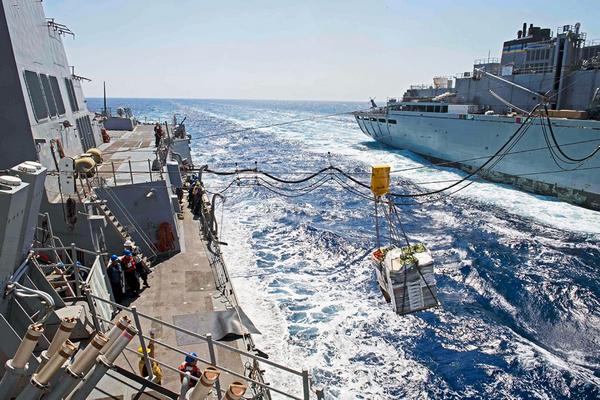
USN underway replenishment.
Moreover, supply vessels must also be resupplied at their source. If security at land-based facilities declines, sustaining ongoing operations becomes progressively untenable, as replenishment ships themselves also require maintenance and port access.
Additionally, while fuel and supplies can be transferred at sea, munitions for specific naval platforms cannot be routinely replenished in this manner, necessitating a return to shore for rearmament. Hence, the effective measure of a navy’s strength isn’t merely its inventory of vessels, but its ability to maintain effective combat power over time, which diminishes if logistical bases become unreliable.
Furthermore, significant conflict can rapidly deplete munitions stocks, as highlighted by the rapid consumption of U.S. missiles during the Iran conflict. A potential conflict with China could impose even heavier demands on U.S. capabilities, requiring careful consideration of munitions replenishment, carrying capacity, and national industrial output.
U.S. Pacific Basing Geographic Constraints
The vulnerabilities of forward-based logistics become especially pronounced in the Western Pacific due to vast distances. To safeguard these infrastructures from precision strikes, two primary strategies emerge: relocating crucial functions away from the threat or dispersing them across multiple locations. Both approaches enhance survivability but introduce operational complexities.
The first avenue for base survivability focuses on depth. The following table showcases the geographic evolution of U.S. basing in response to increasing threats.
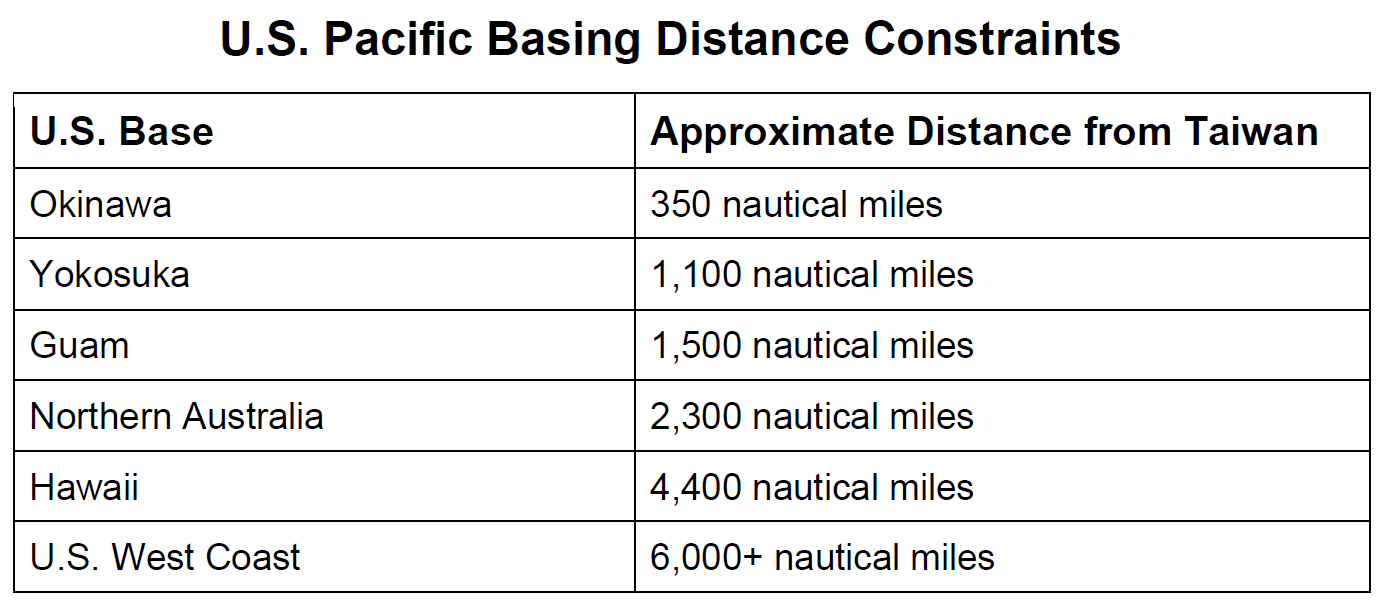
These distances serve as approximations, but they clearly illustrate the strategic implications. If facilities in Japan become isolated, reliance shifts toward bases in Guam, while further operational concerns arise if Guam also becomes untenable.
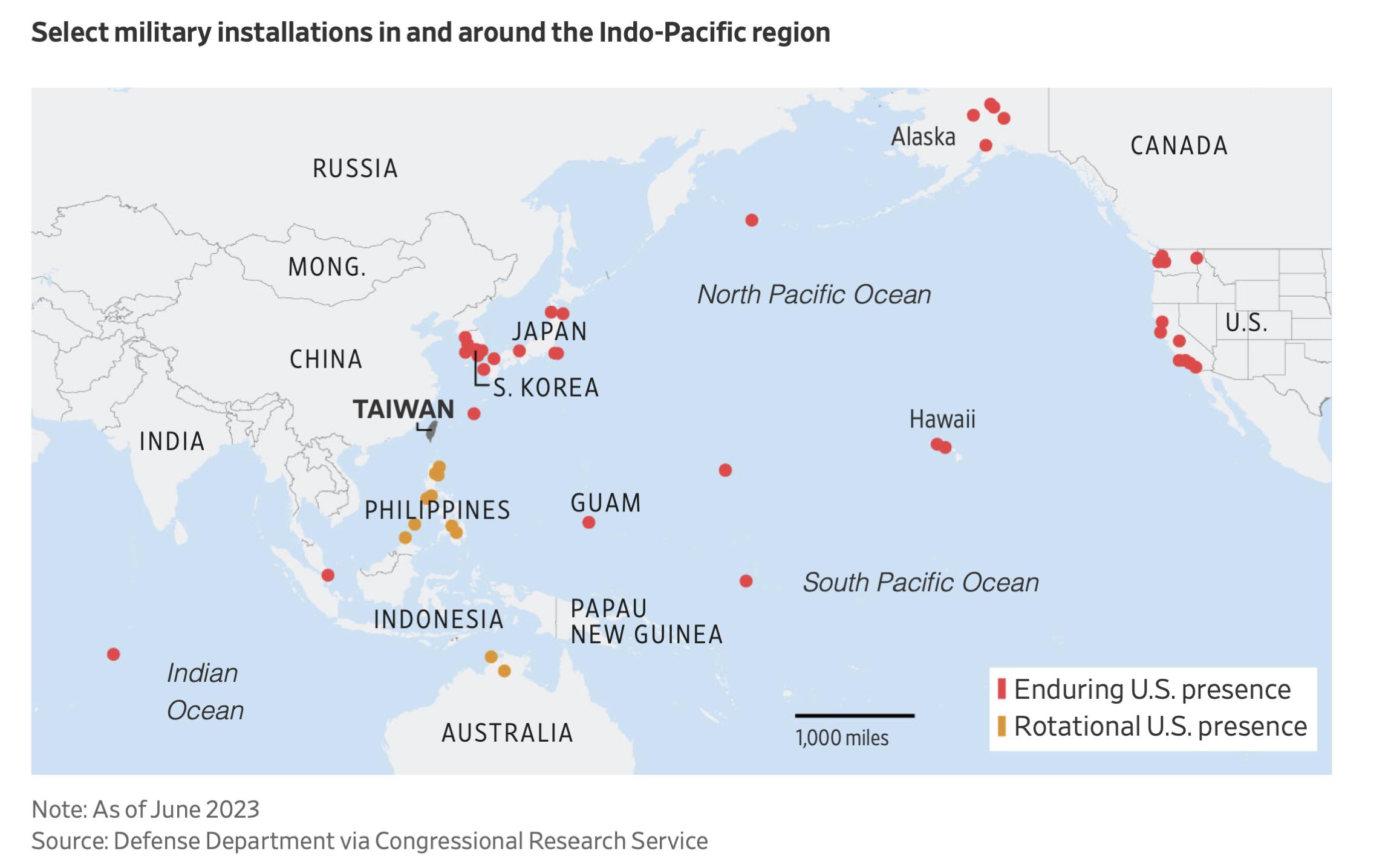
Long distances don’t require American forces to be annihilated to mitigate combat power. A submarine that must reload in Hawaii rather than Guam incurs significant transit times, while replenishment vessels from more distant ports contribute less timely support to combatants. The absence of forward bases results in diminished sustainable combat power over time.
The second avenue of survivability is dispersal. Rather than relocating critical functions, services can be distributed among several smaller locations. While this reduces the importance of any one target, it imposes operational costs associated with efficiency. Dispersed resources may require duplication or be moved around among locations as necessary.
As these operational realities become evident, it becomes clear that precision strikes don’t merely threaten the logistics chain; they hinder the capacity to sustain effective combat power overall. For the U.S., geographic constraints become explicit, while for potential adversaries like China, vast resources provide much-needed defensive depth.
China A Fortiori
Drawing parallels between Iran and China is critical since many of the same vulnerabilities observed in U.S. operations are magnified with an adversary possessing far greater capabilities. The goal here is not to predict the outcome but to assess whether the U.S. vulnerabilities revealed during the Iran conflict would be exacerbated against a more formidable continental adversary.
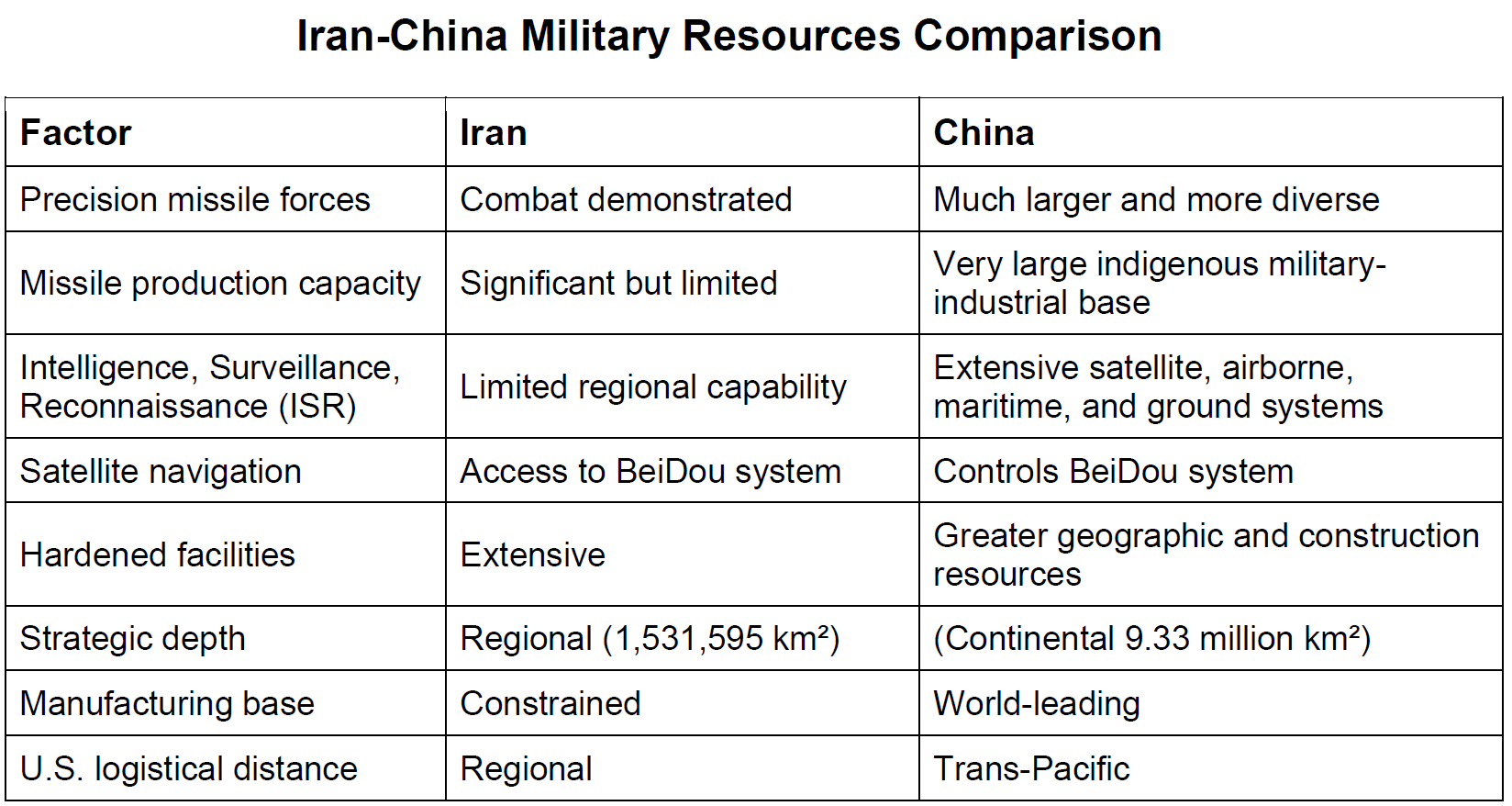
Though precise ratios between military capabilities are unclear due to classified data, the disparity becomes evident. China’s substantial industrial output, coupled with its ability to sustain mass production rates of modern munitions, presents a significant challenge to U.S. military responses.
Moreover, China’s advantage extends to key materials required for modern weaponry, raising concerns over the availability of critical inputs for sustaining munitions production in the face of uncertainty in supply chains.
China’s reconnaissance capabilities vastly outstrip those of Iran, further complicating the landscape for U.S. operations within the Pacific. The necessity for long-range precision strikes and the challenge of tracking moving fleets while also keeping fixed facilities secure remains an evolving dilemma. In a potential conflict, the logistics and operational dynamics heavily favor the continental defender.
Chinese planners have likely gleaned valuable insights from the U.S. engagements in the region, identifying weaknesses in American military frameworks, which further exacerbates the strategic deficiencies facing U.S. planners today. Thus, the vulnerabilities demonstrated in the Iran conflict could have dire implications if applied to a future conflict with China, especially with the added complexity of vast oceanic distances.
Taiwan in the New Strategic Equation
Emerging technologies complicate both American and Chinese military strategies in the Taiwan Strait, balancing the risks of launching large-scale amphibious operations with the need for strategic deterrence. Modern warfare emphasizes a precision-strike paradigm that favors the defender, greatly increasing the dangers associated with launching large conventional maneuvers.
Similar to Iran’s tactics in the Strait of Hormuz, China may not need to overwhelm Taiwan with a full-scale invasion; rather, it can generate considerable leverage by exerting pressure over critical shipping lanes and ports, effectively isolating the island and threatening its supply lines without a direct occupation.
All of this reflects a nuanced shift in military strategy, complicating the traditional assumptions regarding both naval power projection and coastal defense. The emerging landscape emphasizes the importance of controlling logistics and the ability to prevent adversaries from operating within one’s own sphere of maritime influence.
The Future of Sea Control
If precision strike capabilities manifest a clear threat to hostile fleets within their littorals, the traditional role of blue-water naval power in ensuring the blockade and control of distant trade routes may remain intact. This aspect is illustrated by the potential for control over strategic chokepoints such as the Strait of Malacca, through which a substantial portion of China’s maritime trade traverses outside the reach of its shoreline defenses.
However, these forms of interdiction are not without their vulnerabilities. An interdicting vessel may reveal itself in its attempts to halt a merchant ship, thereby exposing itself to potential strikes. As such, the traditional principles of naval warfare are evolving, with the importance of distributed networks increasingly overshadowing the need for concentrated naval units.
Furthermore, the implementation of submarine blockades introduces another layer of challenge. While submarines can assert control with stealth, effectively interdicting without revealing surface unit locations, they are limited in number, which constrains their operational effectiveness over time.
The operational efficiency gained from centralized naval deployments must be counterbalanced with the advantages of distributed forces capable of maintaining a presence across broad maritime areas. The strategic landscape continues to evolve, and the traditional interconnectedness of naval power may diminish as technological advancements reshape existing paradigms.
RIP Carrier Strike Group?
The aircraft carrier has held a central position in American naval strategy since World War II due to its multifunctional prowess. The ability to act as a mobile airbase, providing concentrated offensive power while traveling great distances, remains an invaluable asset. However, the evolving technological landscape increasingly questions the assumptions once regarded as fundamental to carrier effectiveness.
While aircraft carriers offer mobility, modern surveillance techniques have drastically reduced the advantage of keeping vessels concealed at sea. Instead of being able to disappear in the vast ocean, carriers now face heightened scrutiny from advanced sensors, making their operational survivability dependent on counteracting intelligence and reconnaissance systems.
This evolving scrutiny highlights a critical realization: a carrier’s combat endurance is not infinite. Extended high-intensity operations necessitate logistics that cannot be sustained indefinitely, irrespective of nuclear capabilities. Thus, the performance metrics for naval power must also consider the necessity of regeneration post-conflict.
Mobility remains essential in mitigating exposure, but increased distance comes at a cost, affecting strike efficiency and overall combat output. While carriers remain powerful tools, their dominance as the centerpiece of naval force projection is increasingly being challenged.
The Geopolitical Superstructure
These developments extend beyond naval warfare, necessitating a reevaluation of American foreign policy and military presence globally. The reliance on overseas bases has historically provided the logistical backbone for American military operations, but as modern warfare evolves, their roles may change dramatically.
Even though certain overseas bases offer strategic advantages, concentrating logistics at fewer, larger installations risks becoming untenable in the face of evolving threats, particularly from adversarial precision strike capabilities.
In reaction to these changes, the U.S. may pursue a new model of military engagement that integrates a mixture of smaller facilities, rotational deployments, and other military presence forms that lessen dependency on large, concentrated assets.
The geopolitical landscape shifting towards a more dispersed and flexible architectural framework emphasizes that while U.S. military presence abroad will likely endure, the traditional logistics and power projection mechanisms must adapt in light of emerging realities.
Naval Strategy after Mahan
Despite the evolution of tactics, the role of naval power remains relevant. Responsible for protecting commerce, conducting search and rescue operations, ensuring safe passage, and maintaining maritime security, physical presence at sea continues to be crucial. Nevertheless, the conventional architecture supporting naval power must be critically assessed for its ongoing effectiveness.
The classical Mahanian model focused on concentrated capabilities, bringing together advanced ships, crews, and support structures. However, as technology evolves, the imperative now is to foster a strategy that prioritizes distribution and flexibility.
Survivability through distribution. Concentrated valor in visible platforms or installations poses attractive targets. Distributing capabilities reduces the ramifications associated with losing any single asset. There exists a trade-off between operational efficiency and vulnerability, necessitating a careful balancing act.
Separation of presence from firepower. A maritime vessel serving an inspection or escort mission may not require full combat capabilities, but rather a network that allows for distributed sensors and command structures to coordinate effectively.
Combat power regeneration. A modern measure of naval effectiveness isn’t merely time spent deployed but the system’s ability to replenish expended assets efficiently. Regeneration needs to be a strategic consideration across the entire combat framework.
Geography as defensive depth. U.S. strategy has traditionally sought to mitigate distance through forward positioning. However, precision strike capabilities reveal the advantage of distance as a protective measure, particularly when facing continental adversaries.
Situational sea control. Continuous dominance over sea territories may no longer be a capability within reach while maintaining sufficient deterrent power to prevent adversaries from operating freely. Iran demonstrated this on a regional scale, while China’s resources allow for broader application.
In conclusion, while naval power retains its importance, future strategies must adapt to the realities shaped by precision warfare, technological advancements, and geopolitical constraints. This evolution requires rethinking how naval forces project power, the role of bases, and the principles that govern maritime strategy in an era where the command of the sea may look vastly different.


