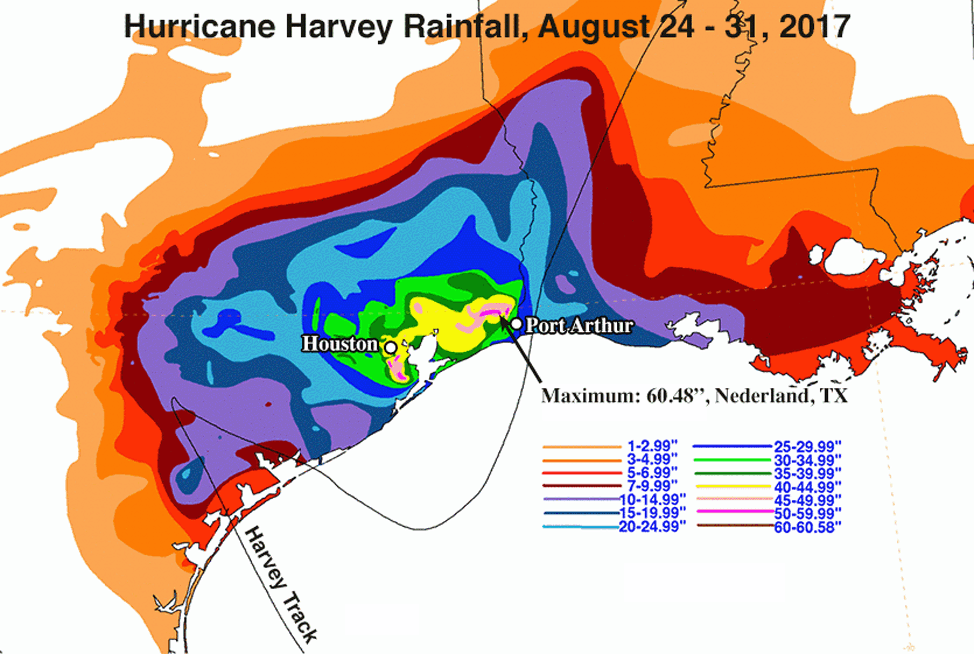
Escalating Flood Risks Ahead
Charleston, South Carolina: A coastal flood once deemed a one-in-10-year occurrence in 1901 transpired 17 times in 2025.
Galveston, Texas: The same flood that occurred once in a decade in 1904 took place nine times in 2024.
Atlantic City, New Jersey: A one-in-10-year coastal flood from 1911 occurred 10 times in 2024.
Miami, Florida: The one-in-10-year flood from 1931 was reported for 14 consecutive days during the “king tides” in October 2025.
Key West, Florida: A one-in-10-year coastal flood recorded in 1913 astonishingly occurred on 26 of 27 days during the “king tides” of October 2025. Notably, a flood event projected once every 100 years in 1913 has coincidentally happened three times within the past decade.
Data: NOAA
Impending Surge in Compound Flood Risks
A return period indicates the frequency with which we can expect a specific weather event. For instance, using data from NOAA, a flood with a 1% annual chance (one-in-100-year storm) is analyzed based on historical rainfall statistics.
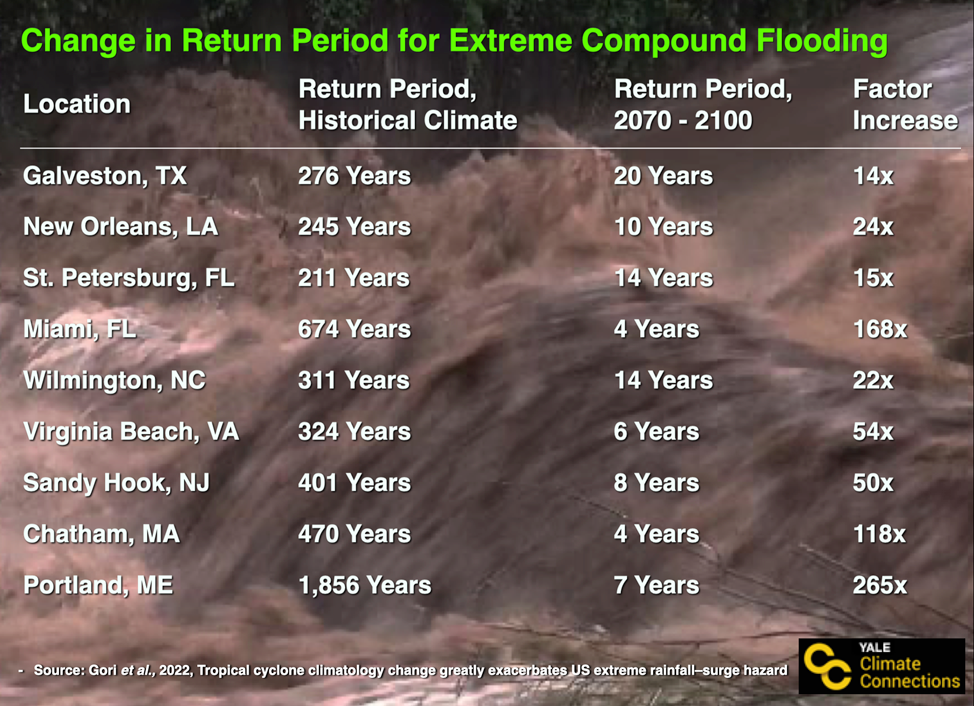
A 2022 study, Tropical cyclone climatology change greatly exacerbates US extreme rainfall-surge hazard, examined the probability of a severe compound flood scenario—when a one-in-100-year storm surge coincides with a one-in-100-year rainfall event. Traditionally, such events occurred roughly every 200-500 years along the Gulf and southeast Atlantic coasts (up to Chesapeake Bay) and were rarer in New England.
However, projections under an extreme global warming scenario for 2100 indicate that these probabilities could expand by factors of seven to 36 in the South, and 30 to 195 in northern regions, reflecting a tremendous uptick in extreme flood risk. Even moderate global warming scenarios suggest a notable escalation in flood threats.
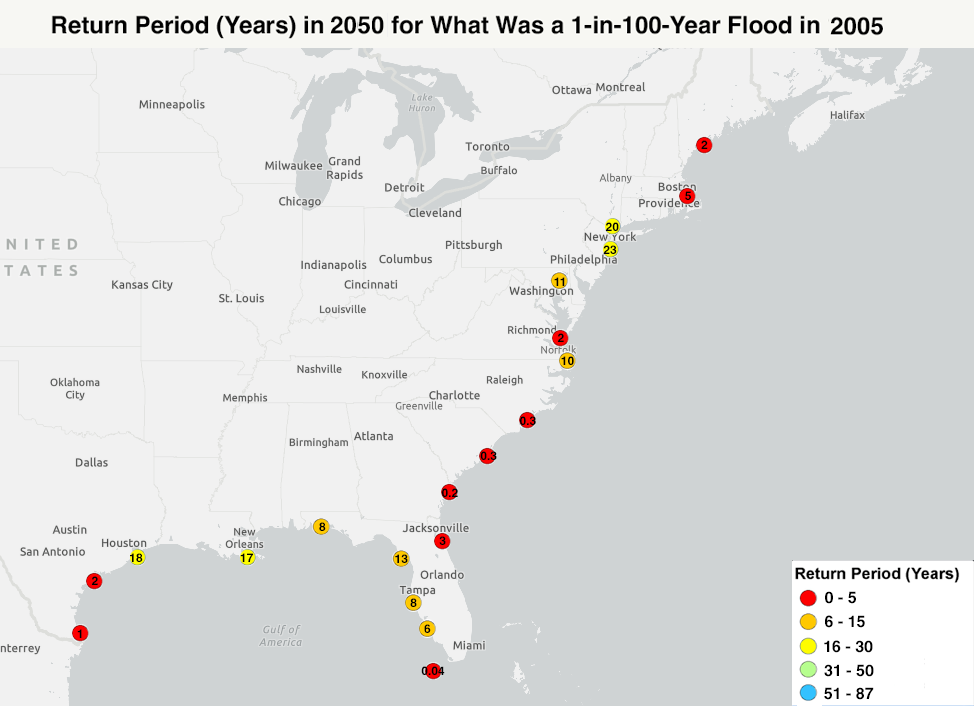
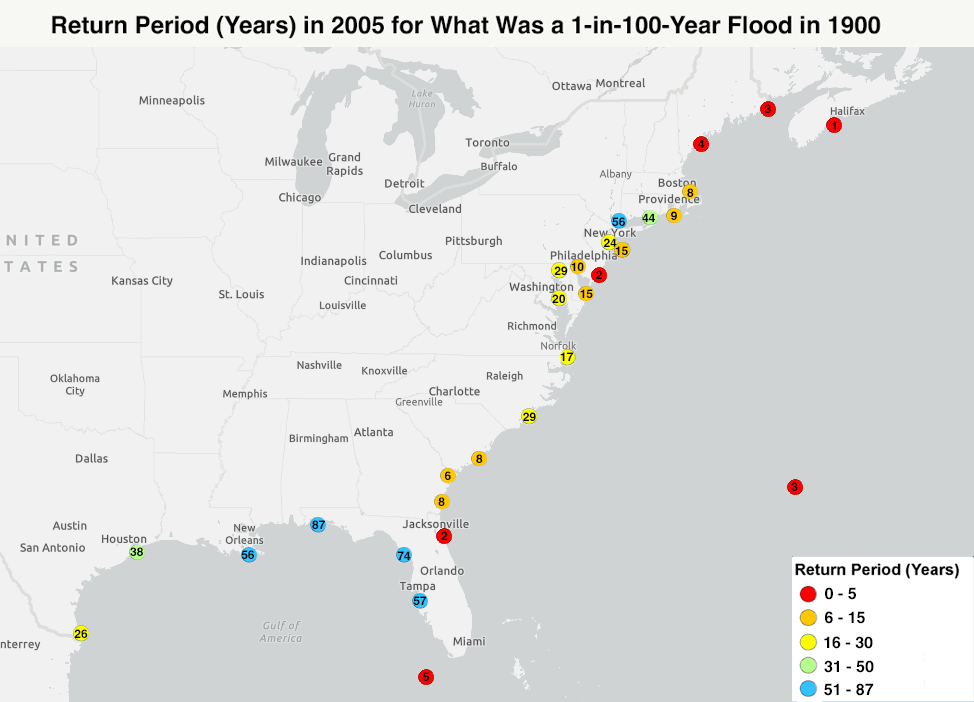 Figure 3. The historical return period in years for events considered a one-in-100-year flood in 1900, now altered due to relative sea level rise. The data plotted originates from the 2026 study, Human-driven sea-level rise has quadrupled the frequency of coastal sea-level extremes since 1900. For instance, a 100-year coastal flood occurring in 1900 in Jacksonville, Florida, and Atlantic City, New Jersey, has been redefined as a one-in-two-year flood by 2005 (denoted by red circles with the number “2”). This change only accounts for sea level rise—additional flood risk factors due to precipitation changes are not considered.
The most significant increases in risk are anticipated in northern regions, attributed to climate change-driven precipitation surges closer to the poles. This aligns with findings from a 2020 study, More meteorological events that drive compound coastal flooding are projected under climate change, which noted that the greatest combined flood threats will likely emerge north of the 40°N latitude.
The Primary Driver of Increased Future Coastal Flood Risk: Hurricane Intensity and Speed
The model referenced in the 2022 study anticipated that the top 10% of the most intense hurricanes will generally strengthen by 15-30% and slow down by 20-30% along most U.S. coastlines compared to historical data. “The surge in storm intensity combined with a reduction in translation speed raises the likelihood of extreme rainfall and storm tides,” the authors noted.
Heightened Inland Flood Risks Along the Gulf Coast
Rivers flowing into the Gulf of Mexico have experienced significant increases in maximum streamflow over the recent decades, often ranging from 20% to 40%. Consequently, they face a heightened risk of compound flooding. A 2021 study documented long-term increases in frequency of compound flooding from storm surges and heavy rainfall along northeastern Gulf rivers. Remarkably, the most severe events were located considerably inland, beyond the reach of tidal influences, rather than at the coast, where such events are typically anticipated. A 2026 study analyzing North and South Carolina similarly reported significant inland expansion of compound flooding threats in a warming climate.
Hurricane Sandy-like Events: Increasing Likelihoods by 2100
In October 2012, Hurricane Sandy initiated catastrophic surge-driven flooding across densely populated areas of New York City, resulting in damages exceeding $91 billion (in 2026 USD). A 2024 study, Climate Change Contributions to Increasing Compound Flooding Risk in New York City, suggests that events akin to Sandy could currently be expected approximately once every 150 years. However, due to climate change—manifested through sea level rise and escalating hurricane strength—this frequency could transform to one occurrence every 65 years by 2050, and once every 30 years by 2100, based on a slightly higher emissions trajectory than we are currently following.
Increased Early Season Compound Flood Threats From Hurricanes
According to a 2022 study, Earlier onset of North Atlantic hurricane season with warming oceans, the onset of named storm landfalls in the continental U.S. has become progressively earlier—averaging two days per decade since 1900. Modeling studies predict an extended hurricane season due to climate change. For instance, a 2017 study indicated that a two-month longer hurricane season (from May to December) could increase flood-risk days by 28% to 180% across four river basins in the Southeastern U.S.
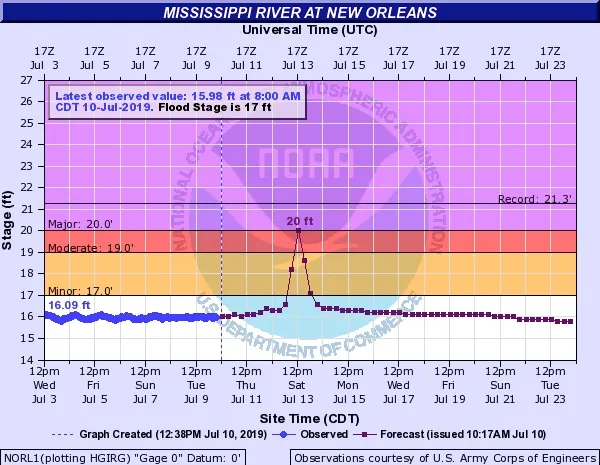
As I indicated in a 2019 post, New Orleans’ Achilles Heel: A Hurricane Storm Surge During a Mississippi River Flood?, earlier hurricanes present a rising threat of storm surges propagating up the Mississippi River, potentially overwhelming New Orleans’ levees, especially given the river’s tendency to run high during late spring and early summer. This risk became apparent in July 2019, when Hurricane Barry sent a storm surge up the Mississippi while the river was already elevated due to spring runoff (Fig. 5). Fortunately, Barry’s intensification was delayed until after passing the river’s mouth, resulting in a less severe storm surge than anticipated.
Other Compound Hurricane Threats
Climate change is likely to intensify two additional categories of compound hurricane threats. One of these was examined in my prior post, The emerging danger of post-hurricane heat waves (2026). Moreover, more powerful hurricanes featuring higher wind speeds and heavier rains pose the risk of simultaneous high-end wind damage and severe inland flooding, which could overwhelm existing infrastructure and hinder emergency response capacities.
A preprint of a 2026 paper awaiting peer-review, Global Warming Amplifies Inland Compound Risks From Tropical Cyclones, revealed that comparing the recent climate (1981-2020) with projected extreme climate change scenarios for later this century (2061-2100), there is an anticipated increase of 61-115% in annual probabilities of compound wind and precipitation extremes ranking in the top 1% globally within 100 kilometers of the coast, escalating further to 92-204% for areas located 100-500 kilometers inland. This inland amplification is spurred by more intense hurricanes making landfall and the enhanced moisture availability due to a 7% increase in water vapor capacity per degree Celsius of warming. The effects of Hurricane Helene in 2024 in western North Carolina may serve as a warning of what is to come.
Coastal Regions Facing Uninhabitability
A 2020 study, Sea-level rise exponentially increases coastal flood frequency, determined that for vulnerable coastal locations in the U.S., the likelihood of a one-in-50-year coastal flood may double approximately every five years into the foreseeable future. This assessment accounted for storm surges from hurricanes, as well as more common coastal storms like Nor’easters. The U.S. Army Corps of Engineers reports that most coastal defense structures in the U.S. were built for return periods of 50 to 100 years, meaning the acute increase in flood risk across numerous sites underscores a serious vulnerability. Furthermore, if high-end sea-level rise projections of one meter (3.28 feet) by 2100 are realized, “once-in-a-lifetime” coastal floods could occur nearly daily before the century’s close. (NOAA’s 2022 sea level rise forecast estimates a 50% chance that sea levels along the contiguous U.S. coast will exceed 0.7 meters by 2100.)
When we consider the substantial additional risks posed by compound flooding, securing insurance for homes may become increasingly challenging. As climate change amplifies flood risks due to sea level rise, intense rainfall, and stronger/slower-moving hurricanes, many areas of the U.S. Gulf and Atlantic coasts may become uninhabitable by late this century, even under moderate global warming scenarios. A 2026 study, The Growth Effects of Natural Disasters: Evidence From A Novel Global Dataset Over 1970-2023, found that a one-in-100-year flood can reduce GDP by about 0.5%. This highlights how regions could rapidly become unlivable if “once-in-a-lifetime” floods happen almost annually in low-lying areas. Indeed, flooding from hurricanes has already caused some U.S. communities to effectively abandon their homes, with others already facing significant threats, topics which will be elaborated upon in future discussions (hint: barrier islands top the list).
In response to these challenges, significant financial investment will be necessary to safeguard critical locations while withdrawing from, or entirely vacating, others. A mass migration away from coastal areas in the U.S. is a likely future scenario due to the escalating climate-induced flood risks. This potential exodus may commence in just a few years. To grasp the forthcoming changes, I encourage reading my 2024 post, When will climate change turn life in the U.S. upside down?


