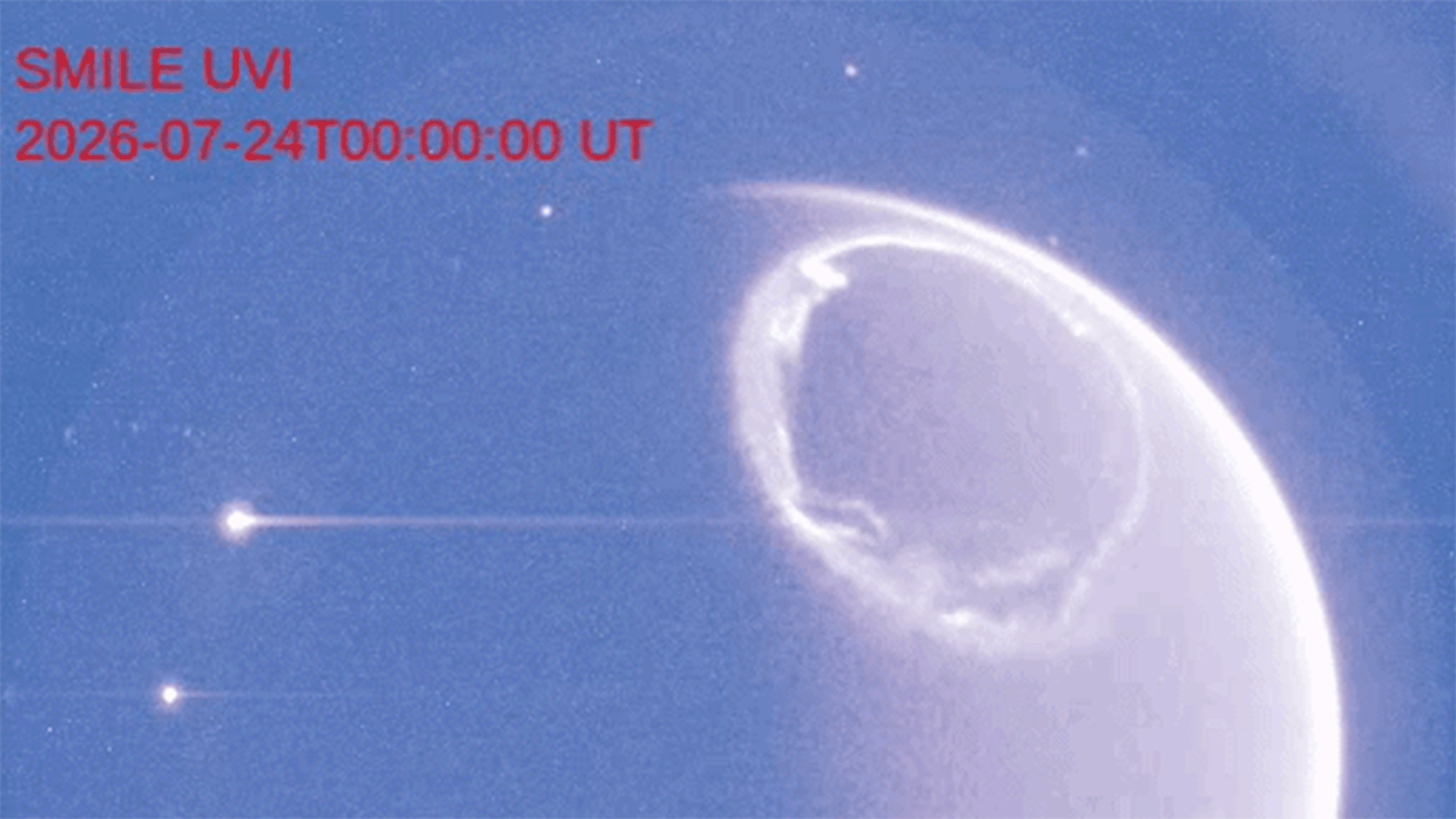
New Images from Earth-Observing Satellite: Stunning Views of Daytime Auroras
Earth’s auroras, often visible only at night and near the poles, have been captured in breathtaking detail by the new Smile spacecraft. These images show massive auroras rippling over the North Pole even in broad daylight.
Key Facts
- What is it? An aurora on the sunlit side of Earth.
- Location: Over the North Pole, viewed from approximately 75,000 miles away.
- Date Shared: September 30.
The Smile mission, a collaboration between the European Space Agency and the Chinese Academy of Sciences, officially commenced its scientific operations this week. The spacecraft’s first images, taken in ultraviolet light, depict a vast ring of charged particles coiling around the North Pole, while the Earth glows ghostly and dim in the foreground.
The Science Behind Auroras
Auroras result from electrical storms interacting with charged solar particles, which collide with molecules in Earth’s atmosphere. The signature display of colors is unique to our planet, although auroras can occur on other planets, typically not in such vibrant hues.
Advanced Capabilities
Launched on May 19, Smile is positioned in a highly elliptical orbit, allowing it to monitor the North Pole continuously for 45 hours at a time. Besides the Ultraviolet Aurora Imager, it is equipped with instruments to detect X-rays and measure magnetic fields.
In upcoming observations, the Smile spacecraft will offer unprecedented insights into solar activity and Earth’s atmospheric phenomena, marking a significant advancement in space science.
Additional Milestones
Recently, the spacecraft’s soft X-ray imager was also tested, successfully capturing images of Cassiopeia A, a supernova remnant located 11,000 light-years away. While the camera operates well, it still needs calibration to reduce light interference from Earth.
The Smile mission promises not only to provide stunning imagery but also to enhance our understanding of space weather and its effects on our planet.


