Both the US and Israel have their motives and capabilities.
Recent events surrounding the Spanish enclave of Ceuta have raised many questions. As the situation continues to evolve, it becomes increasingly complex. Within just 36 hours last week, around 60,000 Moroccans crossed the border into Ceuta, a city with a population of only 84,000.
To grasp the magnitude of this influx, consider this: the number is over five times the highest recorded migrant arrivals to the Greek islands during the 2015 Syrian Civil War, as well as to the Italian island of Lampedusa in 2023, according to Le Grand Continent. Elon Musk, in a rather unhelpful analogy, compared the situation to the film World War Z, where swarms of zombies breach a fortified wall—ironically, into Israel.
“The Border Is Wide Open”
Initially, it was rumors circulating on social media that the Spanish border was open for crossings without proper documentation that fueled this dramatic shift. Reports from Spanish news outlets indicated a recent ruling by Spain’s Supreme Court, which stated that authorities could not summarily deport migrants arriving by sea without due process.
This ruling, issued on July 8, created an operational void that was reportedly exploited by human smuggling networks, further exacerbated by misleading information shared online. According to El País:
“The Spanish border is open, and you can cross without papers,” became a widespread message that spurred waves of young people to head towards the northern regions of Morocco…
Everything appeared coordinated. Human smuggling networks even provided details about where to acquire wetsuits, fins, and other gear, alongside Google Maps screenshots directing them to Tarajal beach—the section of the border with lesser police presence, where they might escape from poverty.
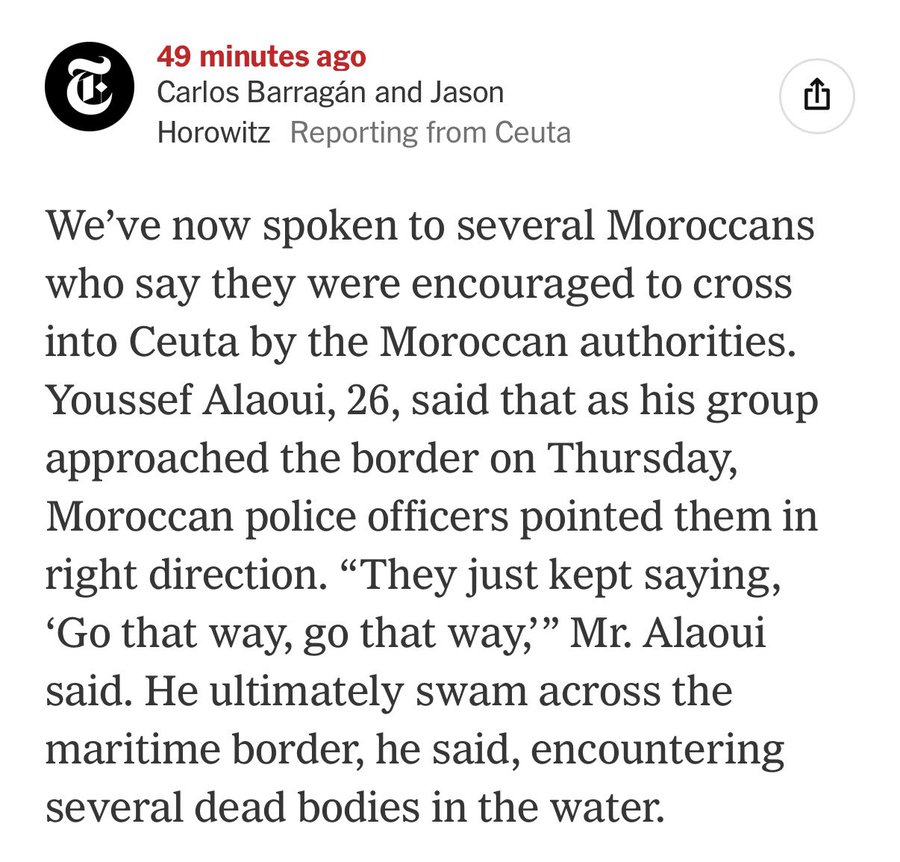
Following this, truck convoys began transporting thousands of migrants to the Spanish border. Incredibly, these migrants faced no resistance from Moroccan authorities; in fact, they were seemingly guided towards the weakest points in the border defenses. As recounted by El Diario:
“We were told that the Ceuta border had opened, and we came running. Some friends informed us: They’re letting us in!”
The young men took a bus to Tarajal and encountered Moroccan agents gesturing for them to continue towards Ceuta—accounts corroborated by others interviewed by elDiario.es. “Access was free. The police said: ‘Enter Ceuta.’”
Trucks are seen transporting Moroccan migrants towards the Spanish border at Ceuta, reported to be among hundreds.
Unverified reports suggest that Rabat is funding this migration. pic.twitter.com/lfGPwGLQJH
— Open Source Intel (@Osint613) July 31, 2026
Ben Jelloun, a celebrated Moroccan author familiar to the royal palace, expressed shame and anger in an op-ed for Le360 about this exodus toward Ceuta. He observed that “the Moroccan police were not intervening” as he saw young people making their way toward the border after attending a ceremonial event on Thursday, July 30.
In the tragic events that unfolded, 88 individuals lost their lives in Spain, including 13 children; the number of casualties on the Moroccan side remains unclear. Many others were in their youth…
A promising young Moroccan women’s soccer player drowned at Ceuta’s gates. Faten Ben Omar El Azizi, aged 20, played for Moghreb Atlético de Tétouan. The club expressed sorrow in a statement, “Why did they open the [Ceuta] gate so our children would face death?”…
— Ignacio Cembrero (@icembrero) August 2, 2026
Most migrants who survived the chaos swiftly left Spanish territory. By Saturday morning, reports emerged that the vast majority had returned to Morocco, likely with some encouragement from Spanish forces. This was not the case for migrants arriving from other regions of Africa, numbering in the low thousands, who remained in Ceuta.
Spain has managed to reverse a significant influx of migrants into Ceuta, with most of the more than 50,000 who crossed backpedaling voluntarily https://t.co/LJrJGhIozZ pic.twitter.com/DIegyDxVe3
— Reuters (@Reuters) July 31, 2026
A recent tweet from Vijay Prashad warrants attention, as he noted that the individuals who briefly crossed into Ceuta appeared more like a “rent-a-mob” rather than traditional migrants. He questioned whether the entire event was orchestrated to provoke a diplomatic crisis with Spain:
Having traversed the Sahara with migrants years ago, those who entered Ceuta from Morocco did not resemble typical migrants (no luggage) nor behaved like them (quickly returning home with no protest). They seemed organized, like a rent-a-mob from Morocco’s… pic.twitter.com/0XkOfUqHyc
— Vijay Prashad (@vijayprashad) August 1, 2026
Hybrid War: On Whose Behalf?
The use of migration as a pressure tactic in “hybrid” operations has been seen before, notably in Turkey under Erdoğan. However, the questions remain: on whose behalf are these operations being conducted?
Morocco may indeed be acting on its own. This is not the first instance of Rabat employing immigration coercion against Spain. In April 2021, a surge of around 10,000 migrants flooded Ceuta shortly after Brahim Ghali, leader of the Polisario Front, entered Spain seeking COVID-19 treatment. His covert entry sparked a significant diplomatic row between the two nations.
Similar to previous incidents, there is a noticeable Algerian influence at play. Only a week prior to the Ceuta crisis, Spanish Prime Minister Pedro Sánchez met Algerian officials—his first since a diplomatic fallout over Spain’s endorsement of Morocco’s plans for Western Sahara.
Now, Madrid seeks to mend relations with Algeria, its primary supplier of natural gas, and is contemplating granting citizenship to 60,000 Sahrawis born during Spanish colonial rule—a move that would undoubtedly provoke Morocco. Algeria staunchly supports the Polisario Front and remains at a fragile peace with its neighbor.
Moreover, it’s plausible that Morocco is aligning itself with two significant allies: the United States and Israel. While direct evidence is still missing, both nations have substantial reasons to engage against Spain. Sánchez’s government has vocally opposed US and Israeli actions in Gaza and maintained ties with China, diverging from broader EU strategies. Perhaps most tellingly, Sánchez has denied US military access to Spanish bases for operations against Iran.
Political survival is paramount for Sánchez as elections approach next year, especially amid growing corruption allegations against his administration. This has prompted him to adopt policies that resonate positively with voters.
In the process, however, he has antagonized two formidable adversaries: the administrations of Trump and Netanyahu in the US and Israel. As Juan David Rojas noted for Unheard, “MAGA has designated Spain as Public Enemy No. 1 due to its government’s hardline stance against the US and Israel.”
Warning signs had been evident months beforehand, an issue we discussed in an earlier post: “Are the US and Israel Planning to Use Morocco As a Weapon Against Spain?”
The Trump administration issued numerous threats against Spain after Sánchez denied access to military operations targeting Iran. Sánchez has also stood against Israel’s actions in Gaza and Lebanon, raising alarms about potential trouble at Spain’s southern border.
Some have suggested that the US should escalate military presence to Morocco, a nation aligned with Israel. This could possibly lead to supporting independence movements in Ceuta and Melilla, two autonomous enclaves on Morocco’s coast that the US has recognized in the past.
Furthermore, prominent figures like Michael Rubin have proposed Morocco launch a civil initiative toward Ceuta akin to the historical events of 1975, which led to Spain’s withdrawal from Western Sahara.
In interviews, US congressional representatives have even hinted at recognizing the change in status for both enclaves.
The US Congress described Ceuta and Melilla as “Spanish-administered but located on Moroccan territory”, further urging diplomatic mediation to clarify their status.
One critical factor for US and Israel regarding Ceuta and Melilla lies in their strategic geographic positioning. Situated at the Strait of Gibraltar, these enclaves control vital maritime routes, as one commenter pointed out:
Spain’s ownership of the Chafarinas archipelago and other “plazas” strengthens its territorial claims over northern Morocco, ensuring significant maritime advantages.
Even if unlikely, this scenario raises the potential for future crises, particularly for Israel, which increasingly relies on these trade routes amid recent disruptions elsewhere. Additionally, given the UK’s control over Gibraltar, it stands to reason that the Anglo-Zionist alliance would seek greater influence over the Moroccan side of the strait.
“This would enable the Anglo-Zionist coalition to assert control over both sides of the Strait of Gibraltar.”
Do you see it now? https://t.co/3tBHaQrDE3
Details continue to emerge surrounding US and Israeli backing for Morocco’s ambitions over Ceuta and Melilla.
Just weeks before migrants surged into Ceuta, the GOP allocated $40 million for Morocco, outlining the territories in question.
— Thomas Massie (@RepThomasMassie) August 2, 2026
Morocco even named a highway running through Western Sahara after President Trump, who responded on social media, expressing gratitude to King Mohammed VI.
The Moroccan King’s decision reflects his approval of the former US president, marking a geopolitical alignment that raises eyebrows.
In the aftermath of the border incident, a coordinated effort within social media from US and Israeli accounts emerged, pressing the narrative that Ceuta and Melilla were remnants of colonial rule, misplaced within Africa’s territorial disputes. Ironically, Western Sahara itself is widely recognized as the last colony remaining in Africa.
Some Israeli figures have boasted about their involvement, including statements from notable public relations channels expressing satisfaction with the perceived “organic” nature of the events.
Recently, in his criticisms of Spain, Trump has alluded to the historical conflict of 1898, in which Spain lost its overseas territories, amidst pushing back against Sánchez’s apparent support of Palestine.
Trump stated about Spain: “They are not behaving nicely, but they will learn.”
This was a blatant collaboration among the US, Israel, and Morocco designed to retaliate against Spain for its pro-Palestinian stance.
The Israeli government subsequently called for Spain to “exercise restraint, protect refugees’ rights, and prevent harm to civilians” during the Ceuta crisis, a statement laden with irony.
Further, Michael Rubin has suggested imposing sanctions on Spain for any defense equipment used against Moroccan migrants, adding to the complexity of the situation.
Also weighing in is Walid Phares, a conservative commentator and former Trump advisor, who has praised Santiago Abascal, the leader of Spain’s far-right party, VOX, characterizing him as a potential political player in the unfolding crisis.
Abascal’s political maneuvers have shifted dramatically recently, going from antagonizing Morocco to presenting them as a potential ally, an indication of the ongoing geopolitical jostling.
As elections loom, Abascal’s and the People’s Party’s combined efforts could significantly affect the political landscape, particularly given Sánchez’s dwindling support following controversial immigration policies.
The current political climate leaves Sánchez struggling to balance responses to the migrant influx while maintaining integrity with his voter base. As Rojas noted, this creates a scenario where he may deflect blame onto external actors like the US and Israel amidst tightening political pressures.
Finally, the European Union’s response has been tepid, despite the unique status of Ceuta and Melilla within the Schengen zone. Countries like Italy have called for Spain’s exclusion from the European movement framework, igniting further tensions.
As one observer pointed out, responses appear theatrically predictable, suggesting possible collusion with Moroccan interests.
In a divided EU, varying stances only further complicate a united approach to the crisis. The events in Ceuta underscore both the challenges facing Spain and the implications for broader European policy.
In summary, the situation is symptomatic of broader geopolitical interests, intertwining local issues with international stakes. Ceuta and Melilla exemplify the complexities of contested territories in a globalized world where migration, diplomacy, and political survival intersect, yielding difficult questions about sovereignty and human rights.

