Recently, the sudden influx of tens of thousands of migrants from Morocco into Spain has intensified scrutiny on the Spanish government and elevated the standing of political parties more closely aligned with Washington and Tel Aviv.
This raises a critical question: Was this migration orchestrated? Reports from El Español indicate potential involvement from Moroccan intelligence:
BREAKING: According to El Español, citing senior Spanish Civil Guard and intelligence sources, authorities allegedly identified individuals linked to Moroccan intelligence services among the crowds that entered Ceuta during the recent mass migration crisis.
The report states… pic.twitter.com/yL1s6LJQAI
— GeoInsider (@InsiderGeo) August 2, 2026
The sheer number of 60,000 individuals attempting to cross the water is certainly noteworthy, particularly since many reportedly returned to Morocco shortly thereafter:
I crossed the Sahara Desert with migrants about a decade ago. Those in the video who crossed into Ceuta from Morocco neither looked like migrants (no luggage) nor did they behave like migrants (went back home with no protest). They looked like a rent-a-mob from Morocco’s… pic.twitter.com/0XkOfUqHyc
— Vijay Prashad (@vijayprashad) August 1, 2026
In a previous incident in 2021, around 8,000 migrants entered the Spanish enclave, likely a consequence of a diplomatic clash between the two nations, during which Moroccan border guards reportedly stood down.
At that time, Spanish Prime Minister Pedro Sánchez received backing from EU officials, notably when European Council President Charles Michel emphasized, “Spain’s borders are the European Union’s borders.” However, this time around, Spain has found itself abandoned by Brussels and other nations, making it less likely for Morocco to leverage the situation for financial gain, as other countries in North Africa and the Middle East have done in the past. This points towards a potential coordinated effort aimed at undermining Sánchez’s government.
Meanwhile, Israel and the U.S., allies of Morocco, could find strategic value in the situation if it leads to the downfall of the Sánchez administration. The current government has stood as a rare voice of European dissent against NATO’s excessive defense spending and has distanced itself from involvement in Trump’s confrontational policies against Iran. Furthermore, Spain has taken steps to condemn acts of violence in Palestine, including halting military supplies to Israel. Therefore, one could ask, cui bono? Obvious beneficiaries appear to be in Washington and Tel Aviv, who have not hesitated to comment on the crisis:
Spain, which never misses an opportunity to lecture Israel, has declared a state of emergency in Ceuta following the crisis over its immigration policy.
Maybe before it continues lecturing us, it’s time it explained to the world why it still maintains colonial enclaves in…
— Danny Danon 🇮🇱 דני דנון (@dannydanon) July 30, 2026
Recent news reveals attempts by the U.S. to reframe Spanish territories as Moroccan:
BREAKING: The Trump Administration told Congress that Spanish enclaves “Ceuta and Melilla are located in Moroccan territory,” Thomas Massie revealed earlier today.
It also pledged US$40 million of U.S. taxpayers’ money for military purposes in Morocco.
“Two weeks ago the House… pic.twitter.com/cp75n716Nz
— Nury Vittachi (@NuryVittachi) August 2, 2026
As is often the case with Trump’s maneuvers, there may be an element of personal gain involved, as Morocco could reciprocate with investments in Trump-related ventures. This could also serve as a consequence for Spain’s divergence from U.S. directives. Another consideration is:
Why would Israel want its ally Morocco to control Ceuta instead of its critic Spain? One reason may be that Ceuta is the closest point in Africa to Europe, sitting astride the Strait of Gibraltar, which Spain currently controls on both sides. The Strait of…
— Kenneth Roth (@KenRoth) August 1, 2026
Regardless of the underlying motivations, the media narrative is already set in motion, and Sánchez’s adversaries are poised to exploit the incident.
By Deniz Torcu, adjunct Professor of Globalization, Business and Media at IE University. Originally published at The Conversation.
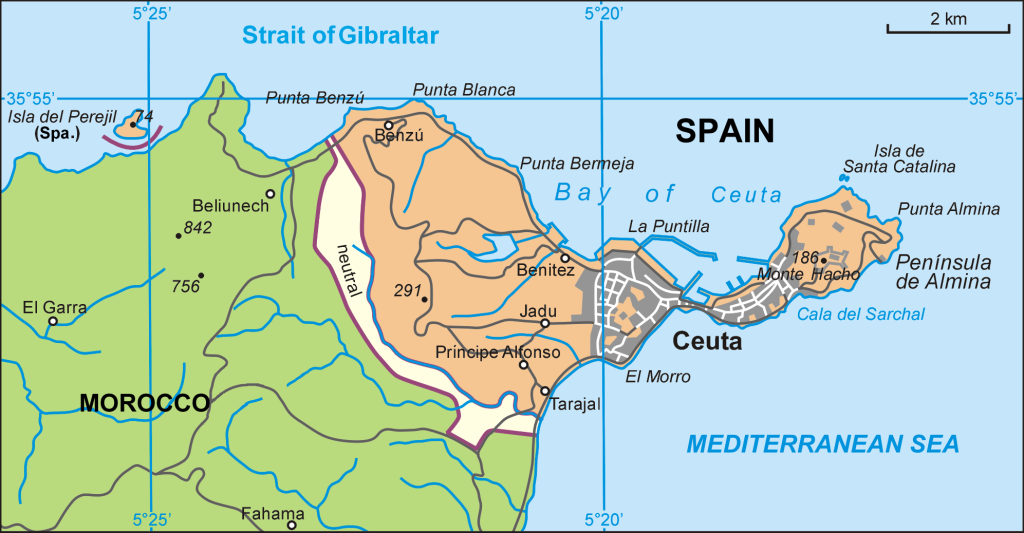
Reports indicate that over 50,000 migrants crossed into the small Spanish enclave of Ceuta within a single day as the border effectively disintegrated. Ceuta, which lies on Morocco’s northern coastline, experienced a rapid surge in entries. The Spanish government has claimed that almost all migrants have since returned to Morocco, but tragically, at least 57 migrants lost their lives during the crossing.
Confronted with uncertainty over the events leading to this mass migration, the public has been left with harrowing footage and images: individuals swimming and scrambling onto Ceuta’s Tarajal beach, tens of thousands arriving in a single day, and multiple fatalities.
In the absence of solid explanations, these visuals set the tone in public discourse. A nation’s perception of migration is shaped significantly by emotion rather than facts.
The incident at Ceuta challenges a more progressive narrative about Spain, which has portrayed itself as a welcoming and diverse society—particularly after escaping a long period of authoritarian rule. This narrative often clashes with the prevailing attitudes across much of Europe, which focus on border security and militarization.
Migrants broke through fences and swam into Spain’s North African enclave of Ceuta from Morocco, overwhelming the police and prompting Madrid to deploy the military as tens and thousands of migrants were estimated to have crossed illegally https://t.co/bX4Fas0v2i pic.twitter.com/TQVUL8Owh8
— Reuters (@Reuters) July 31, 2026
This self-image of Spain, as a cultural amalgamation at the crossroads of Europe and Africa, has historically been one of pride. The country has acted upon these ideals, evidenced by its recent establishment of a pathway to legal residency for hundreds of thousands of undocumented immigrants.
However, public perception and national identity remain fragile. They are influenced more by emotions than legal frameworks, making them susceptible to distortion and exploitation.
Shifting Public Perception
The language surrounding migration can change almost overnight. Just a day prior, discussions about migrants were characterized by neutrality, focusing on themes of integration, work permits, and community life.
Now, the imagery coming from Ceuta has given rise to a more aggressive discourse. Terms like “invasion,” “flood,” and “security threat” have surged in public dialogue and social media platforms.
This shift means that migrants, once seen as neighbors or colleagues, are now abstracted into mere statistics, which are easier to dismiss than the stories of individual lives. Statistics create a detachment that makes empathetic responses more difficult.
In contrast, the powerful images from Ceuta communicate a sentiment without the need for words. They evoke emotions and alter the starting point of discussions surrounding migration.
Spanish Prime Minister condemns ‘violation of territorial integrity’ of Ceuta. pic.twitter.com/KtVrI10Clt
— euronews (@euronews) July 31, 2026
The intense imagery from Ceuta forces the Spanish government to justify its actions, while harsher sentiments gain traction as common sense. The language once deemed inflammatory can morph into accepted discourse overnight. This highlights a significant change in the political narrative, shifting the burden of justification away from those advocating for compassion.
This dynamic presents a significant challenge for Spain’s progressive narratives about immigration and diversity, risking the narrative of an inclusive society that does not require preemptive apologies.


