In a landscape increasingly influenced by artificial intelligence (AI), the looming threat of significant job loss raises serious concerns about the future. Rob Urie explores the unsettling attitude among some elite circles regarding AI-induced mass unemployment and the social upheaval it may ignite. What is remarkable is the apparent detachment of those in power, such as Donald Trump and members of Congress, from the consequences of such widespread job losses. This lack of concern reveals significant flaws in the current political landscape.
By Rob Urie, author of Zen Economics, artist, and musician who publishes The Journal of Belligerent Pontification on Substack
When American politicians describe terrorism as a threat, they need a reality check and some basic economic understanding to recognize the various ways a nation can be undermined. From NAFTA to financialization and crypto scams, the U.S. has encountered one economic disaster after another, all led by those who profess to be in control. Although many of us doubt that AI will lead to the loss of 50% to 60% of U.S. jobs, it is astonishing that these figures are met with indifference from the likes of Trump and Congress.
For perspective, during the Great Depression, the U.S. unemployment rate peaked at 25%, which triggered large-scale protests, bolstered the labor movement, surrounded the White House with veterans demanding their pay, and ultimately contributed to the onset of World War II. Generally, governments start to worry about political instability when unemployment reaches 10%. That Trump and Congress disregarded the 50% to 60% projection for unemployment caused by AI suggests a troubling absence of responsibility among leaders. There is something profoundly broken in U.S. politics.

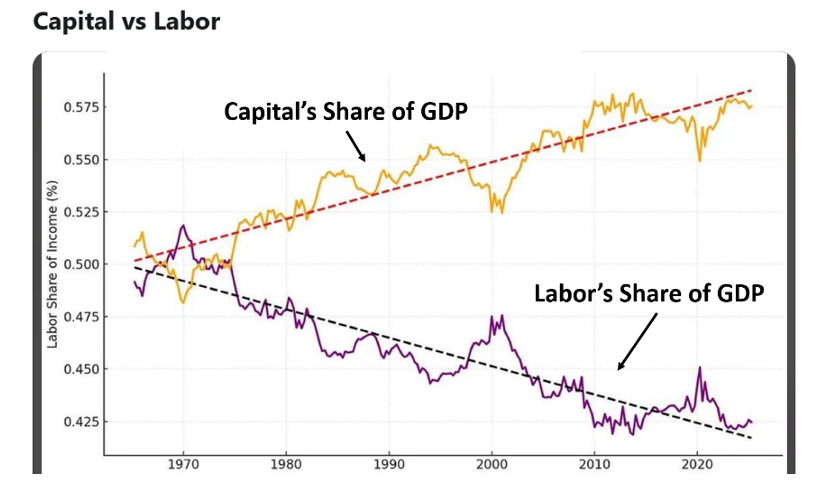
Graph: The class war is evident. The graph demonstrates that the share of national income (GDP) going to capital has been rising for five decades while labor’s share has been declining. Oligarchs benefit when capital payments rise, leaving labor to suffer losses. This trend has been ongoing for fifty years in the U.S. Source: economycharts.
A 50% unemployment rate would quickly overwhelm the state unemployment insurance systems, which already suffer from chronic underfunding. If half the population were unemployed, the insurance payouts would be grossly insufficient for survival, leading to widespread economic collapse within months. Within six months, the United States would likely descend into full economic disaster.
The political ramifications would be as severe as asking someone to fire an empty gun at their partner; while no physical harm would occur, trust would be irreparably damaged. By ignoring the predicted impacts of AI on job loss, both Trump and Congress are jeopardizing the nation’s stability, appearing content to see it all vanish as long as their personal assets continue to thrive. If this sounds like a “America first” attitude, it certainly aligns with that sentiment.
No government could endure 50% unemployment without facing widespread civil unrest. This scenario suggests that U.S. leaders prioritize personal gain through exploitation rather than the welfare of the populace. This assessment may seem harsh, but the trend of capital increasingly dominating labor interests illustrates a troubling reality. Hedonic adjustments exaggerate the value derived from capital (like AI) while downplaying labor’s declining rewards.
While Trump frequently condemned NAFTA, one must ask: why? The societal destruction caused by a 50% unemployment rate due to AI far outweighs the damage from NAFTA. The theory positing AI as a beneficial capital investment collapses at unemployment rates above 8%; to avert economic decline at 50% unemployment, productivity would need to double, an unlikely scenario given last year’s 3% increase.
Furthermore, any potential benefits from AI would disproportionately favor the oligarchs, as the newly unemployed would bear the burden of the economic fallout. This exemplifies a stark class divide. Trump’s Congress seems willing to risk national collapse if it benefits their wealth. Yet, the members appear misguided; they envision stock market gains amid extreme unemployment instead of considering the possibility of nationwide riots by disaffected citizens. Indeed, the saying goes: three days without food and no government will withstand the outcome.

Graph: From 1948 through 2025, the annual rate of real (inflation-adjusted) GDP growth has decreased from 4% to 2%. While this may not seem alarming at first glance, many areas outside of finance and technology have stagnated since the 1980s. The increasing cost of living has escalated, rendering many traditional economic measures meaningless. Source: St. Louis Federal Reserve.
The current predicament stems from a fundamental misunderstanding among American leaders regarding the post-WWII boom. They misconstrued the U.S.’s economic supremacy as evidence of capitalism’s success. The truth is that the U.S. enjoyed fortuitous geographic advantages while other nations lay in ruins after the war. This perceived success does not stem from intellect or hard work but merely from circumstance.
By the 1980s, the U.S. faced a critical choice between fostering manufacturing or pursuing asset stripping. The Reagan administration opted for the latter, increasing reliance on financial capitalism. With crypto ventures collapsing under their weight, the nation reverted to militarism—without the necessary manufacturing infrastructure to support it. When political leadership was aligned with the public interest, there were strides in education, healthcare, and social welfare. Now, with rampant exploitation, the only prospects are further exploitation.
Thus, the definition of American capitalism has morphed into a framework that guarantees wealth for the few while leaving the rest with an increasingly hollowed-out economy. American imperialism and its trends express a social logic that seeks to loot resources. Those educated in mainstream economic theories would likely find this characterization of capitalism to be a departure from the academic models, which emphasize a significant governmental role to sustain a genuinely capitalist economy.
Throughout history, monopoly power has served as an economic reflection of the political power that capitalism exercises. According to neoclassical economic theory, a robust governmental intervention is crucial to preventing concentrated wealth from obstructing competition. Hence, neoliberalism paradoxically endorses the existence of economic power while simultaneously asserting that the state serves the interests of the economically powerful. This framing allows for the notion of ‘economic freedom’ to now imply the freedom to engage in predatory practices without consequences.
Readers may remember the “Great Powers” narrative when the U.S. chose to confront Russia in 2022. Although fitting in some contexts concerning China and Russia, this approach ignores that the U.S. has abandoned the concept of national interest. The evidence lies in the few wealthy oligarchs whose ambitions align with Trump’s willingness to see significant unemployment due to AI, as long as their fortunes remain intact. This underscores the predatory nature of this stance.
In truth, the interests of these oligarchs contradict the nation’s wellbeing. Trump’s obsession with inflating the stock market serves as a means to augment oligarchs’ wealth. Trading physical assets is cumbersome; liquidating stocks for quick cash is significantly easier, further incentivized by favorable tax laws. The wealthiest 1% holds approximately half of the stock market, while the top 10% possesses around 90% of it. The stock market has become crucial for sustained oligarch control.
As of now, the benefits of AI remain largely theoretical, reliant on a series of optimistic conditions to yield any societal advantages. Current billionaires predicated on unrealized promises stand and profiting without actual business success. The executives at AI company Anthropic boast worth $15 billion each following a recent funding round, yet they lack any profitable venture. Analyst Ed Zitron claims that Anthropic’s profit margins increase directly with costs, indicating a precarious business model with no route to profitability. Why, then, are these individuals wealthy?
This concern isn’t born from envy; it arises from the cascading impact of misallocated social resources. If their desire for luxury commodities overtakes their judgment, the social power their vast wealth affords them allows them to impose disastrous choices upon the rest of society. The rise of automation and AI might characterize our future, but they also herald potential financial instability reinforced by circular financing methods. The cyclical nature of such financing risks triggering chaos if participants begin withdrawing funds.
It raises a critical question: what does American political leadership envision for the workforce in the coming decades? The prevailing fantasy suggests that ‘markets’ dictate such outcomes. In the 1990s, outsourcing was marketed as a natural consequence of wage discrepancies, yet it was largely driven by specific political agendas. U.S. industrialists believed they could eliminate organized labor by moving jobs offshore. Now, given the limitations of crypto scams, political repression appears to be the only remedy.
This repression would hold less weight if it was evident that perpetrators aimed to serve the public’s interests. Instead, the populace is perceived as bothersome obstacles to financial progress, contributing to diminishing trust in government. The belief that one of the American political parties will emerge as a savior has faded, replaced by the disheartening realization that the existing political landscape offers little reprieve. We find ourselves abandoned.
Deindustrialization represents a form of looting, facilitated through Wall Street’s asset-stripping ventures. Financialization serves as looting when those closest to the monetary fabric extract wealth for their benefit. AI also exemplifies looting, permitting companies that lack profitability— and might never achieve it—to gain substantial ‘investments’ without providing public goods. The underlying theme across these practices is the creation of wealth through destructive mechanisms. Today’s American leaders appear more focused on destruction than on the creation of sustainable systems.
With proposals for relinquishing half of the U.S. workforce, the question arises as to how such a transition is supposed to occur. The prevailing belief suggests that AI will supplant roles in customer service, accounting, and legal sectors. This notion falters; companies are opting for tiered services where lesser-prioritized customers simply fade away, unable to rectify their issues due to the unwillingness of vendors to engage responsibly.
AI appears set to perpetuate this tiered structure. Industrial automation and enterprise AI have evolved into near commodities. Experts claim that the business model will unlikely prove profitable as costs rise in tandem with revenue; thus, increasing sales inevitably grows losses. While the presumed solution is cost-cutting, companies like OpenAI are forced to slash prices to remain competitive. Yet, is AI genuinely a growth business?
Only the so-called ‘thinking machines’ present a potential return on trillions of dollars in investment. Are these machines capable of genuine thought? The disconnect arises from the reality that leading executives of competitors in the AI sector appear more like storytellers than informed leaders, with little understanding of their products. Anthropic’s Dario Amodei claims that more sophisticated AI models will achieve human-like consciousness— a fanciful notion.
However, the prevailing beliefs hold little significance in the grand scheme. The colossal financial influx is predicated on the expectation that various AI technologies will yield considerable profitability for their developers. As skepticism mounts regarding the wholesale replacement of workers by AI, the question lingers about where the promised value will originate. Having worked in corporate environments, it’s apparent that the sole reason AI vendors are securing meetings stems from the assurance that mass redundancies will occur.
While advancements in AI can create more efficient machines, they will never transition into independent thinkers. This situation echoes the analogy of constructing a bridge 90% of the way, without a clear pathway to complete the final segment. Continental philosophers elucidated long ago that realizing this last mile—transitioning from non-living to living—remains an impossible feat. American AI firms constructed their models without viable strategies to cross the chasm.
This situation is critical because the U.S. has relied heavily on the promise of AI for future growth. With capital expenditures reaching nearly one trillion dollars, and additional trillions allegedly forthcoming, the entire economy hangs perilously on this tenuous gamble. Moreover, Chinese firm DeepSeek appears to have circumvented cost issues, providing a competitive edge over U.S. counterparts.
DeepSeek’s approach cleverly transformed difficult complexities into manageable tasks, enabling efficiency in processes that could revitalize outputs when necessary. Since cost remains a principal challenge in ‘thinking machine’ AI, this provides DeepSeek with an advantage that may prove insurmountable for U.S. companies in a timely manner.
While DeepSeek’s innovative tactics may offer essential insights for surviving American firms, the prevailing financial interests will likely distance themselves from impending crises, focusing solely on profitability. Timing is crucial: investments should be made only when a business case is established. Relying on fear of missing opportunities is reminiscent of speculative bubbles, and as Will Rogers poignantly stated, when such bubbles burst, the concern will shift to ensuring the return of one’s initial investment.
This leaves the U.S. facing several challenges: 1) an inconceivable public-private industrial policy likely to trigger major economic upheavals in the coming years, 2) a commoditized AI landscape that was misrepresented as a high-growth market, 3) a newly wealthy class of billionaires who have yet to create profitable enterprises but now dictate societal norms, and 4) a Chinese competitor that offers superior products at lower costs than American companies. Much like the affordable and efficient offerings from BYD in the electric car market, consumers might favor better-performing options over traditional brands.

Graph: Deindustrialization has long been an overt policy in the U.S., solidified by a series of trade agreements since the 1970s. Its catastrophic impact displayed itself around 2001, but despite Trump’s election pledge to revive manufacturing, the industry remains stagnant. Source: St. Louis Federal Reserve.
For those who believe in an American reindustrialization, take heed: manufacturing employment has actually declined during Trump’s presidency. Numerous mainstream economists perpetuate the narrative that U.S. manufacturing is thriving while failing to acknowledge the sinister implications of hedonic adjustments applied to specific commodities like computer chips. Misinterpreting these financial statistics as indicatives of broader productivity growth misrepresents the true situation.
Valuing hedonic adjustments at 100% while actual user engagement averages merely 15% distorts the narrative of productivity growth in favor of capital, negating the labor contribution to production. This erroneous logic extends across all technological disruptions while perpetuating the monopolistic advantages of capital.
The drastic decline in U.S. GDP growth from 4% post-WWII to 2% today underscores the current U.S. stance on international relations, particularly with China, Russia, and BRICS nations. The reality is these countries didn’t deindustrialize the U.S.; the American ruling class executed that strategy. Financialization and reliance on exploitative economic models are the products of American leadership, as is the integration of generative AI for enhancing social control.
Ultimately, AI appears to be a fragile foundation for future economic ambitions. Unlike transformative technologies of the past, AI’s true strengths lie in digital automation rather than groundbreaking changes. The executive leaders who posit that AI will replace their workforce often lack an understanding of the intricacies involved in their employees’ roles. The stark reality of class stratification threatens the viability of the nation.
As we look ahead, brace for potential financial turmoil linked to AI within the next couple of years. This chaos could stem from the consequences of AI financing rather than AI technology itself. The triggering events may involve geopolitical tensions, such as renewed instability in the Strait of Hormuz, or the collapse of AI financing amidst unmet expectations. Once again, the U.S. finds itself precariously positioned, teetering on the edge of a precarious limb.
What, then, are the solutions? We must focus on re-localizing agriculture, aligning the consumer economy with social and environmental constraints, guaranteeing jobs for those willing to work, establishing a public education system from pre-K to Ph.D. standards, ensuring healthcare systems enhance life expectancy, and forming a Department of Peace aimed at curbing U.S. military interventions abroad. It’s time to remove corruption from our governance.