In the midst of ongoing tensions surrounding Iran, a new wave of reports has surfaced, hinting at the potential for renewed negotiations. However, these updates come amid contradictory information, raising questions about the situation’s complexities.
As we enter another Friday, it’s apparent that discussions regarding Iran may be back on the table, albeit without solid evidence to support such claims. Just two days ago, we noted a tweet forecasting an article by Barak Ravid of Axios, a figure often associated with positive spins on diplomatic efforts. Yet, the lone corroborating report comes from a single anonymous source cited by MSNBC, which further complicates our understanding. Historically, reports based on singular anonymous sources warrant skepticism unless additional documentation accompanies them. Even if the information shared is accurate, it could omit critical context.
Contrasting sharply with this cautious optimism is a stark report from Suliman Ahmed, relayed by Daniel Davis, claiming that Iran is preparing for a significant military strike within the next 30 hours. This escalation is alarming and suggests a deepening conflict.
Iran appears to be in a state of reflection regarding how intensely to escalate its military responses. A brief overview of recent military engagements includes:
Iran war round two: US strikes ~90 more targets, Iran fires multiple missile waves, US denies its own strikes. CENTCOM reported the successful targeting of approximately 90 Iranian military sites, with explosions documented in Bandar Abbas, Sirik, Bushehr, and Chabahar. The Islamic Revolutionary Guard Corps (IRGC) retaliated against US military bases located in Kuwait, Bahrain, Qatar, and Jordan, with Iran’s Health Ministry confirming 14 fatalities and 78 injuries across five provinces. Interestingly, the US and its Gulf allies have denied involvement in a recent attack on the Konarak naval base, raising suspicions that this is an attempt to avoid Iranian retaliation.
It is vital to recognize that any discussions surrounding negotiations often feel superficial, akin to “rearranging deck chairs on the Titanic.” The core issue remains: Iran is unlikely to concede to US demands regarding the security of the Strait of Hormuz. Oman has further complicated matters by rejecting the notion of transit fees. No amount of military posturing or bombings will deter Iran from utilizing the Strait, where it has demonstrated the ability to control maritime traffic, significantly affecting global trade routes and even risking a worldwide economic downturn.
The persistence of the US in confronting Iran seems rooted in a broader power struggle. This conflict is not solely about economic gains for Iran or its relations with Israel—rather, it fundamentally threatens the Gulf states and their energy exports, which are now effectively held hostage to Iranian decisions. As internal discontent within Iran rises, it is apparent that the Iranian leadership is deliberating its choices, potentially factoring in influences from allies like China, which has advocated for diplomatic solutions. Iran might also be waiting for a moment when it can leverage its position optimally, particularly concerning US domestic pressures.
Interestingly, the ambiguous wording of Article 5 from the contentious 2020 deal is now cited by Iran as granting it control over shipping during the stipulated 60-day Memorandum of Understanding (MOU) period. This situation illustrates a significant negotiating oversight by the previous US administration. As reported by the Wall Street Journal:
The crux of the disagreement centers on Paragraph 5, which states that Iran would take measures to restore shipping in the strategic waterway, then collaborate with Oman for future administration. However, this also included an Iranian commitment to ensure safe passage and eliminate military hazards such as mines. While US officials interpreted this clause as a pathway to unblocking the strait, hardliners in Iran are leveraging it to assert exclusive control, complicating US efforts to secure its interests in Hormuz. Consequently, progress on critical issues like the nuclear program has stalled as both sides bicker over this clause.
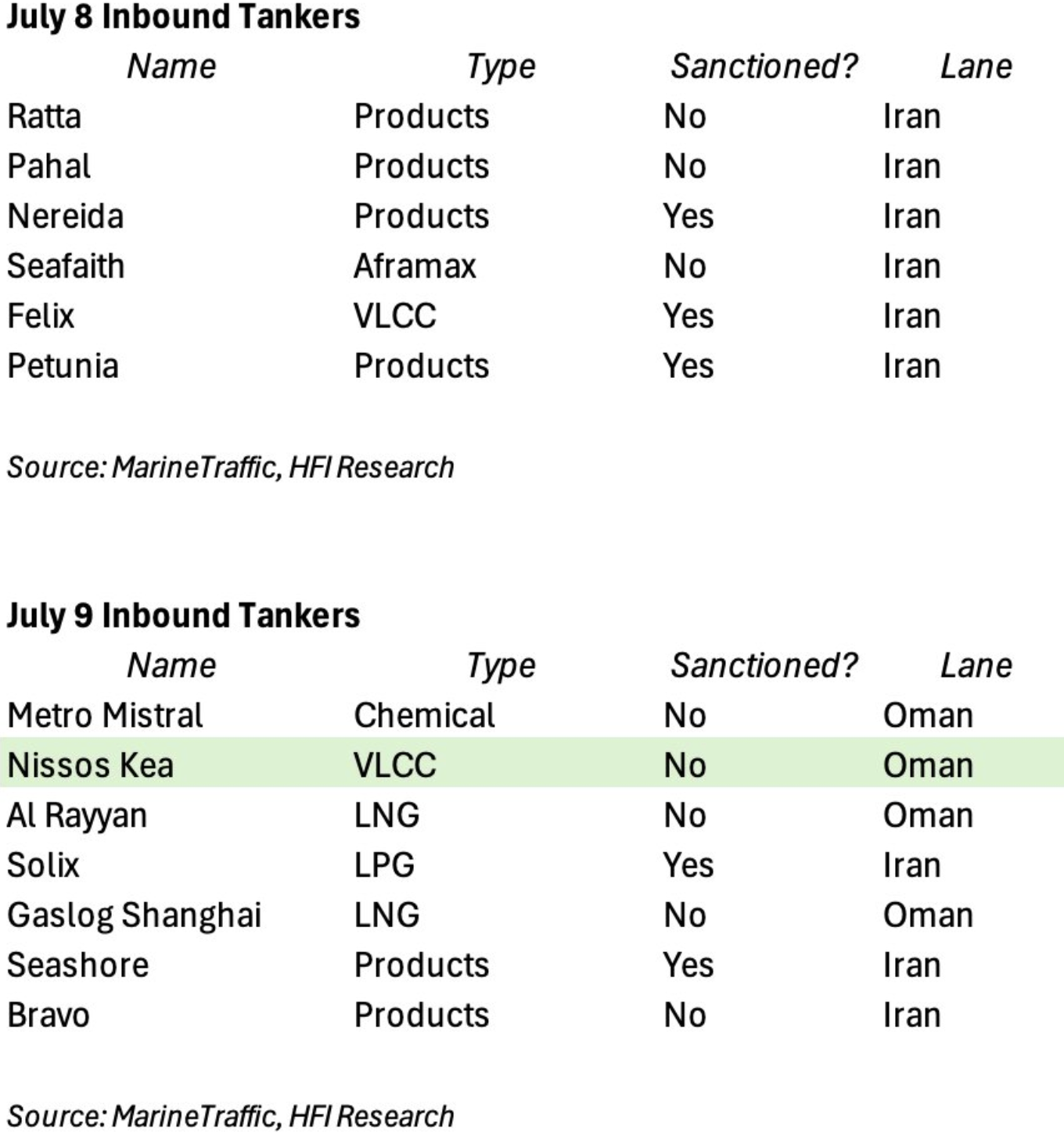
Despite these ongoing tensions, there are indications that Iran hasn’t launched aggressive actions in areas surrounding Oman for the time being.
Strait of Hormuz over the last 24 hours.
US successfully escorted one group of tankers into the Oman lane.
All of them had their AIS off, but there was one Indian cargo ship that had it on when it went through.
— HFI Research (@HFI_Research) July 10, 2026
The US has marked a definitive return to escorting vessels in the region. However, as tensions remain high, any attempts to assert control could provoke further Iranian responses, making the coming days critical.
Reports also indicate that, despite a heavy US air presence over the Strait of Hormuz in recent months, commercial shipping flows are nearly nonexistent, suggesting that Iran’s IRGC maintains significant influence over maritime operations.
JUST IN: Despite extensive U.S. air deployments, the U.S.-backed Omani corridor is witnessing negligible commercial activity.
— The Hormuz Report (@HormuzReport) July 10, 2026
If recent engagements are any indication, the probability of renewed military action grows as both nations navigate their complex standoffs with little progress toward resolution.
Diplomatic intermediaries from Qatar and Pakistan are reportedly striving to avert further escalation and revive negotiations regarding the nuclear agreement. Despite President Trump’s recent statements suggesting an end to the MOU and a reinitiation of military strikes, some parties maintain that progress was made in prior discussions which could be salvaged.
- They aim to prevent the collapse of the MOU despite rising tensions.
- Sources indicate that certain hardline factions within Iran may have spurred recent military provocations against US interests.
As of now, following two days of intense exchanges, it appears the situation has calmed somewhat, with US officials claiming no new strikes took place. However, the presence of ongoing “technical talks” remains, indicating a lingering desire for dialogue despite the backdrop of hostilities.
Meanwhile, reports from the ground suggest Iran is gearing up for a substantial military response, indicating a significant escalation from previously measured retaliatory actions. As Suliman Ahmed revealed, the Iranian leadership is preparing for a potentially extensive strike that could include various targets, making it paramount to monitor developments closely.
With ongoing military maneuvers and preparations, the stakes for both sides are escalating rapidly. This week has showcased not only military tensions but also a complex network of international diplomacy, where every move seems to hold significant weight.
To conclude, the current geopolitical climate surrounding Iran is fraught with uncertainty. As military posturing rises in parallel with diplomatic efforts, the world watches closely, hoping for a resolution rather than further conflict. The coming days could prove critical in shaping the future of US-Iran relations.

