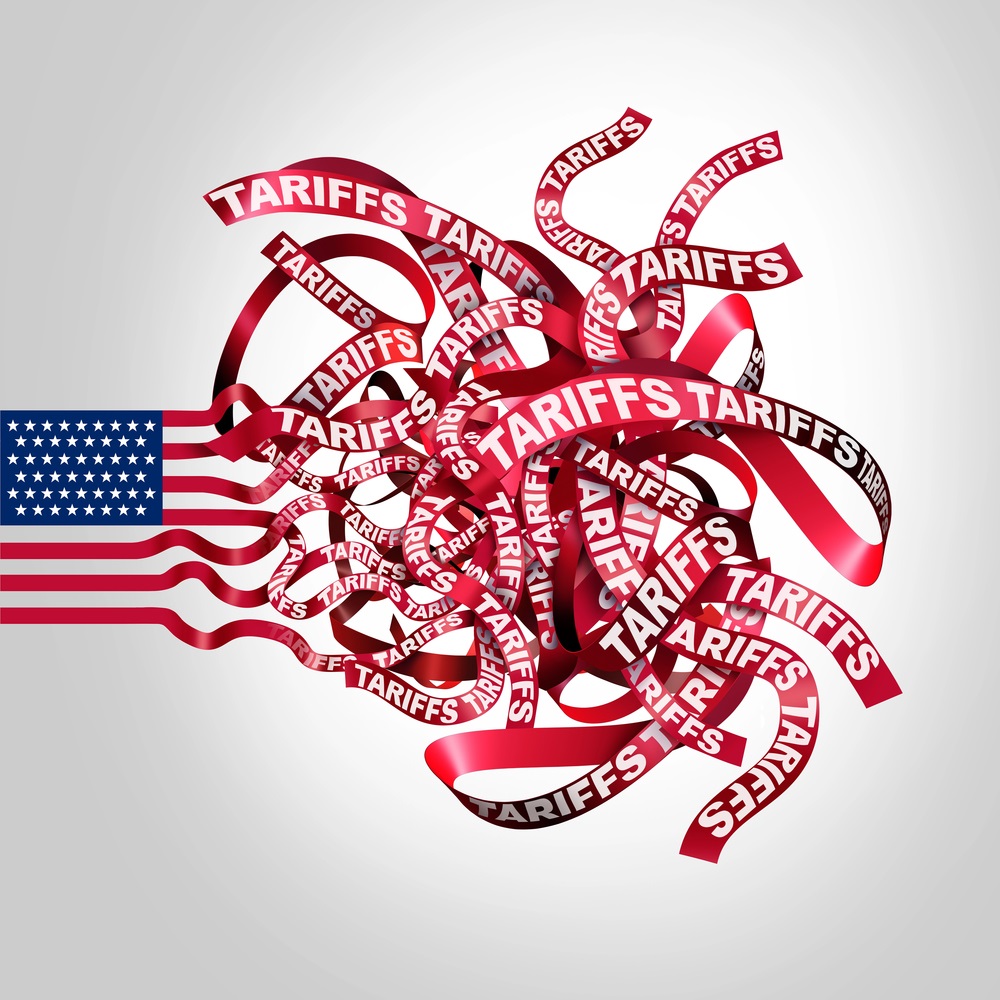
A May 29 article in the IMF’s F&D Magazine makes a case for utilizing U.S. tariffs as an effective policy tool. It opens with a critical examination of the free trade argument, asserting that U.S. and global trade policies have often been guided by theoretical models rather than concrete empirical evidence:
“Tariffs were not tried and found wanting but rejected by current economic models without being tested. Policymakers, wary of confronting the prevailing elite consensus based on these models, inherently limited the array of options and strategies to tackle America’s issues.”
The United States has a rich historical background of employing tariffs strategically, particularly from the late 1800s to the mid-1900s. Notably, Douglas Irwin explores this phenomenon in his insightful 2017 book Clashing Over Commerce, which serves as the primary source for this discussion. During this era, global trade flourished as advancements in technology significantly reduced transportation and communication expenses. Similar to contemporary times, protectionism gained popularity, leading to numerous efforts to “shield” American businesses and workers from foreign competition.
Historically, however, protectionism has consistently faced challenges in the United States. Given the country’s vast size, local and regional interests often overwhelm national consensus in Congress, complicating the passage of protectionist measures. While some protections were enacted, they rarely remained popular and were often abolished swiftly.
In the late 1800s, the notion of reciprocal tariffs became ingrained in the political landscape. Much like current discussions, the rationale was straightforward: American businesses were supposedly being “harmed” by foreign nations acting unfairly. If the U.S. government could leverage tariffs to pressure these countries, they might lower their tariffs on American exports. This led to the passage of the McKinley Tariff Act in 1890, which established varying tariff rates depending on the country. It also empowered the president to act on Congress’s behalf in foreign tariff discussions and to threaten tariff increases should other nations refuse to lower their own. Ultimately, this resulted in ten agreements, mostly with Latin American countries. However, in 1892, the Democrats took control of Congress, repealing the McKinley Tariff Act in favor of uniform tariff rates, effectively nullifying the agreements. This enraged the involved nations, which subsequently raised their tariffs on U.S. goods.
Subsequently, when the Republicans regained power, the Dingley Tariff Act was enacted in 1897. Sections 3 and 4 of this Act once again authorized the president to threaten higher tariffs and to lower tariffs by up to 20% on specific imports if other nations agreed to reduce their tariffs. Despite this authority, all 11 agreements negotiated under this law were ultimately rejected by the Senate.
According to Douglas Irwin, between 1844 and 1909, only three reciprocity treaties were successfully established (Clashing Over Commerce, table 6.4, p. 309). The majority were either blocked by the Senate or dismissed by the other nation after modifications demanded by the Senate were implemented.
In the early 20th century, the general trend leaned towards trade liberalization, a movement temporarily halted by World War I. However, with the onset of the Great Depression in 1930, protectionism resurfaced, leading to the Smoot-Hawley Tariff Act, which triggered a global trade war. Recognizing the detrimental nature of this conflict, nations convened in London in 1933 in an attempt to negotiate a resolution but failed to reach an agreement. In 1934, Congress enacted the Reciprocal Trade Agreements Act (RTAA), which granted the president extensive negotiation powers. Essentially, the president was allowed to raise or lower tariffs by up to 50% from the levels set by the Smoot-Hawley Act in exchange for concessions from other countries. Crucially, the RTAA designated these agreements as executive agreements, requiring only a simple Senate majority for approval, rather than the two-thirds majority typically necessary for treaties. Additionally, any reduction was automatically extended to any nation with which the U.S. held Most Favored Nation status. Under the RTAA and its extensions, 19 agreements were established between 1934 and 1939, culminating in 32 agreements by 1945. Over a mere 11 years, the Roosevelt Administration negotiated more than ten times the number of reciprocal trade deals compared to the century prior.
Eventually, the RTAA was superseded internationally by GATT and domestically by the Trade Expansion Act of 1962 and the Trade Act of 1974. Nonetheless, neither of these legislation pieces matched the RTAA’s success in strategically applying tariffs. Instead, the framework of bilateral agreements proved far more effective in meeting negotiation objectives.
Thus, contrary to the assertions made in F&D, the strategic use of tariffs has a longstanding history marked by a mix of successes and failures. In a recent working paper, I argue that the institutional framework of a government plays a crucial role in determining the efficacy of strategic tariffs. The instances where such tariffs have flourished are when the executive was constrained to reduce tariffs and when only a simple Congressional majority was required for approval. Conversely, negotiations typically faltered in scenarios lacking a credible commitment to reduce tariffs.
In the United States, the use of tariffs is complicated by constitutional stipulations. Tariffs are classified as taxes, which fall under Congressional authority (a point recently underscored in Learning Resources v Trump), thereby necessitating Congressional approval. Additionally, when tariffs form part of treaty negotiations, any agreement requires a two-thirds Senate vote for ratification (U.S. Constitution, Article 2, Section 2). With divisive economic interests dominating Senate decisions, achieving this supermajority is often exceedingly challenging. These high thresholds are intentionally set. The brilliance of the Reciprocal Trade Agreements Act lay in its delegation of just enough authority to the president to serve as a credible negotiator (thus bypassing the two-thirds hurdle) while still ensuring that he adhered to his commitments through legal provisions (resulting in executive agreements that still required Congressional oversight). Other reciprocal trade initiatives have struggled to achieve this delicate balance, either limiting presidential power excessively (e.g., the McKinley and Dingley tariffs) or granting him too much discretionary authority (e.g., the Trade Act of 1974).
Overall, the conditions under which tariffs can be used strategically are exceedingly stringent (see “The Economics of Section 301: A Game-Theoretic Guide” by John McMillan, in Economics and Politics 2(1), 1990). To summarize:
- The nation being threatened must face significant harm if cut off from that market.
- The nation being threatened must not possess substantial retaliatory capabilities.
- The cost of compliance must be minimal for the threatened nation.
- The threatening nation must perceive greater benefits from liberalization than from continuing the threat.
Such conditions are seldom met, and are likely even less attainable in today’s highly globalized world. Moreover, the existing institutional framework significantly complicates the successful employment of strategic tariffs.