In an age where artificial intelligence (AI) dominates conversations, it’s critical to examine the underlying misconceptions about its capabilities. Rob Urie’s perspective sheds light on the myths that surround AI, advocating for a clear understanding of what it truly is and what it is not. This analysis is essential for navigating the complexities of our technological future.
By Rob Urie, author of Zen Economics, artist, and musician who publishes The Journal of Belligerent Pontification on Substack. Originally published at his site
Recent discussions about AI reveal a common struggle among Americans to grasp the implications of linear time—a concept deeply rooted in Western thinking, particularly in the context of clock time that coordinates capitalist work. This confusion not only concerns the temporal sequencing of actions but also raises questions about profit distribution. Notably, all capital equipment used in Western production has been created by workers. Why, then, do financiers claim ownership of the products resulting from this labor?
To illustrate, consider a physical metaphor: suppose I 1) purchase a car, 2) steer it towards a cliff, 3) place a stone on the gas pedal, and 4) shift the transmission into drive. The car then moves forward and plunges over the cliff. The question arises: did my actions cause this event, or did the car drive itself? The answer hinges on where one perceives my actions to end. I initiated a series of events that, if executed competently, would result in the car’s descent; yet the car itself is merely inanimate metal and rubber without human guidance.
Similarly, when I design and execute a three-hundred-step algorithm, is the algorithm the one producing the output, or am I? This distinction raises the difference between intent and process. My intentions shaped the conception and creation of the algorithm, but from that moment onward, its operation occurs within a computing environment driven by the algorithm. Thus, I was the one who produced the output, not the machine.
This dilemma extends to claims of machines “thinking.” In practical terms, AI is a collection of algorithms housed within a substantial computational framework. It didn’t originate independently; AI was first conceptualized at Carnegie Mellon University in the 1970s. It was developed by computer scientists in both academia and industry. Its underlying infrastructure was built by human workers. Hence, AI is entirely a product of human effort.
The foremost question remains: how can it be perceived that AI output signifies more than the human endeavor that created it? What process imbues AI output with qualities that transcend that of mere algorithms? If one argues that something does grant this distinction, they ought to consider sequencing algorithms—codes that organize other codes to follow a structured series of steps to complete tasks. I have developed sequencer models that navigate complex, multi-step procedures from a single command. The output appears as reasoning, and in truth, it is reasoning—my reasoning shaped the coded processes through which the models operate.
If a sequence of actions is conceived, planned, and executed by humans using human-created equipment, at what point do those processes attain a life of their own? In simpler terms, when do algorithms on a computer begin to think or exhibit consciousness? Asserting that any of these traits define AI represents a significant categorical error. It’s akin to suggesting that a rolling rock is moving of its own volition, unfurling from unseen physical forces like gravity. Claims of AI reasoning often stem from ignorance or a fundamental misunderstanding of basic physical processes.
The West has debated since the early nineteenth century whether factory automation produces its own outputs or whether it is the human workers who created the automations that are responsible for the results. Automation creates an illusion of self-generation, while the underlying processes were originally human-designed. With today’s ability to “sequence” production via algorithms, this debate has become even more abstract.
Many newcomers struggle to understand the complexities of sequencing models, which dictate how a model “thinks.” The question arises: how can a model “think” when it merely follows instructions? The answer is straightforward: it doesn’t—it’s simply executing predefined directives. The reasoning perceived by AI users reflects the reasoning embedded in the model’s development by human coders. Instructions are followed; nothing more.
This issue has political ramifications as well, as it affects income distribution in the West. If “capital,” manifested as an automated factory, generates output, do its profits then belong to the capitalist owner? Without workers to construct automated factories, the process of automation couldn’t exist. Historically, the political response has involved minimizing workers’ claims through wages. Workers receive initial payments for their contributions, while capitalists enjoy ongoing profits derived from this labor.
AI reinvigorates this debate conceptually. Regardless of whether AI is viewed as a thinking machine or merely a collection of algorithms, it was built by human labor. It’s crucial to realize that AI was designed to simulate human thought, but the digital domain is a closed system. All information “known” by AI has been filtered through human interpretation. Within this Cartesian framework, AI lacks direct access to the world, resembling the concept of a brain existing in a vat.
One paradox in the discourse surrounding AI is that AI models often define themselves as “word organizers and word sequencers.” Focusing on the term “sequencers,” these processes define and execute a complex set of actions coherently. When engaging AI, a sequence of operations unfolds: words are identified and matched against those in training datasets, with models then generating meanings attached to these words.
It’s essential to note that neither the sequencer nor the overall AI model understands the words it processes. The semantics are human-derived and stored in a retrieval system. Sequencing matches human-defined meanings to words, establishing context for the phrases being analyzed. To clarify, AI “decides” nothing. It operates according to algorithmic commands, devoid of independent choice in either its actions or methods. All of this is pre-written by humans.
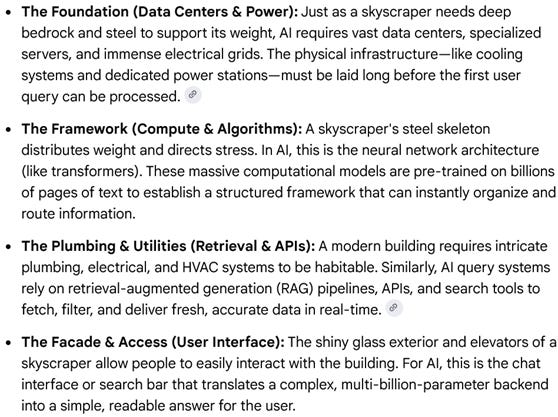
Google AI Chatbot Analogy of AI to a Skyscraper:
End Google AI Chatbot Output——————————————————————
The crux of the matter lies between coding mathematical models to initiate a series of actions, versus treating those models as if they possess autonomous reasoning. Often absent from casual assessments of AI is a comprehension of the intricate and expansive processes involved. Developers have endeavored to create a “thinking machine” since the 1970s, culminating in infrastructure comparable to that of a modern skyscraper. Whether AI justifies its costs remains a pressing question: is it a groundbreaking technology worth the investment, or merely a fascinating novelty whose environmental implications may jeopardize our planet?
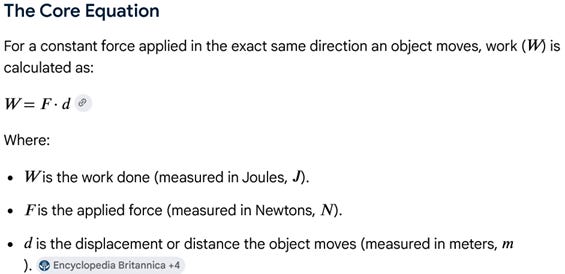
Recent discussions have raised eyebrows about AI’s ability to solve math problems in the absence of thought. Here, it helps to invoke the physics of “work.” Many imagine solitary mathematicians methodically tackling complex puzzles. In contrast, AI leverages brute-force computing power to evaluate every possible solution within seconds. What often goes unnoticed is the substantial infrastructure underpinning these results.
This vast computational prowess does not inherently prove AI’s value. Technology can either confer benefits or simply redefine how tasks are accomplished. Yes, cars facilitate long-distance travel, but they also contribute to time lost in congestion, leaving one to ponder whether they represent a net gain or a loss. Unquestionably, the verdict remains open.


Image: The mechanical intricacies of an automaton from the movie Hugo highlight the assumption that sophistication in machinery equates to human likeness. This perspective provides a critical lens through which to view AI, which is ultimately a digital construct—no more capable of reasoning than a doorstop. Source: dickgeorgecreatives.
When asked if they desire a machine that swiftly transports them, most individuals in the West would likely respond affirmatively. However, when asked if they would like to spend three hours daily stuck in traffic, the answer would probably be a resounding no. This contradiction illustrates how capitalism operates—presenting a benefit one moment, only to unveil its unforeseen burdens shortly thereafter.
Currently, many Americans express concern about AI’s potential to think and thus take their jobs. However, the more pressing worry should be that AI lacks true cognitive capabilities—it represents yet another layer of labor de-skilling. Consider AI-generated “art”; it lacks artistry. AI “thought” essentially aggregates information from institutions like the Pentagon and the American Enterprise Institute. Each query executed by AI contributes to greenhouse gas emissions at critically unsustainable levels, while the proposed solutions often serve merely as distractions that could exacerbate existing issues.
What users perceive as “thought” in producing AI results is essentially the application of computational work. This is akin to translating the horsepower derived from horses into that which an internal combustion engine produces. Imagine a solitary mathematician contemplating a difficult puzzle versus an AI program that can simulate the efforts of 10,000 people laboring for a million years. One might reasonably suspect that such an immense capacity would yield numerous insightful answers.
Google Gemini AI Output
End Google Gemini AI Output———————————————————
If 10,000 individuals could labor for a million years, this would constitute the most extensive collective effort in human history. However, since human lifespans are finite, this remains a hypothetical scenario. Moreover, AI’s methods diverge from those of mathematicians. Rather than identifying an optimal solution based on specific qualities (the mathematician’s approach), AI tends to impose solutions by discarding all other possibilities (optimization).
Additionally, the extensive computational cost associated with AI’s processes rivals that of a lunar expedition. Were 10,000 humans actually to engage with mathematical problems, it would prompt questions of agency and the validity of such a use of societal resources. The ongoing assertion that AI adds value beyond mere profits for select individuals hinges upon obscuring the environmental and social costs it entails.
AI’s extraordinary capability to execute vast permutations almost instantaneously makes it a powerful tool, but how much more beneficial is a world where AI can accomplish such feats than one without it? This question necessitates a societal perspective, informed by a comprehensive understanding of AI’s social implications. It’s insufficient to reference solved math problems as a justification for broad AI investment. The critical inquiry remains: what alternate advancements could have been achieved with the same resources (considering opportunity costs)?
AI solves mathematical challenges through elimination, but this approach is not aligned with traditional mathematical work. Why? Because AI leverages computational methods outside human capacity. Recall the benefit of cars—they can enable faster travel than walking, yet they simultaneously lead to excessive time spent in traffic. AI utilizes raw computing power to tackle specific queries rapidly, but does this truly address relevant issues, or merely serve as a form of collective amusement?
Moreover, AI operationalizes language through a framework that equates human thought with the articulation of syntax married to semantics (form and meaning). However, such operationalization often results in a rigid consolidation of meaning. Take “democracy” as an example; its prevalence in Western discourse spans contexts, including economic democracy. To render it operational, the term must be simplified and solidified.
This isn’t simply an academic nuance. Consider “Christianity”; a recent survey identified 45,000 distinct denominations. Within this context, the operational definition of Christianity becomes reductive, eliminating diverse interpretations and potentially obscuring the nuances of belief. Politically, this oversimplification claims a false unity among disparate views.
Control over language equates to power. In Zen Economics, the term “Household Income” serves as a measure of economic well-being. On the surface, this seems logical, yet defining “household” and “income” and amalgamating them into “Household Income” presents complexities. The semantic dilemma becomes evident: varying definitions lead to misunderstandings, even among those using the same terminology.
When users input a query on “Household Income,” AI references a cache of meanings established by human users. However, as AI supplants traditional search functions, previously understood definitions are increasingly replaced with operationalized terms, leading to the erosion of linguistic diversity. This homogenization effectively diminishes the richness of discourse, as each individual perspective embodies a unique worldview.
It’s essential to recognize that statistical findings can be manipulated by redefining variables. An operationalized version of “Household Income” could simultaneously rise and fall, depending on context and definition. What constitutes a household? Is it a single family, all residents of a home, or a different entity? Such variances in definition directly impact the outcomes derived from analysis.
My exploration of technical definitions throughout history (e.g., the concept of utility in economics) reveals that those claiming to address the same subject often harbor incompatible meanings. For instance, while utility may be modeled mathematically, its actual operationalization often fell short. Consequently, claims of scientific rigor among economists appear exaggerated. Consistently applying incongruent ideas through rigorous logic doesn’t eliminate their contradictions.
In my models, computational logic is explicitly defined within the coding. To clarify, the logic is embedded within the algorithms themselves. For instance, in Error Correction models, assumptions regarding stationary local means and mean-reverting processes are embedded within the structure. The progression of events also emerges through such embedding. Therefore, if a model appears to exhibit reasoning, it’s because the human developers embedded logical reasoning during the coding process.
Ultimately, AI users often perceive advanced outputs without recognizing the meticulous planning and actions that yielded them. When confronted with complex results, users may struggle to accept that a “simple word-counting machine” could produce such outputs. However, the engine powering this procedure is part of a sequence of events largely invisible to AI users. The absence of visibility doesn’t imply a lack of underlying logic.
Here’s the crux: understanding the AI process introduces clarity to what might initially seem mysterious. I have been able to intuitively derive solutions to several significant challenges faced by AI based on relatively straightforward concepts. However, getting this math to perform as intended necessitates sequencing. This sequencing enables the mathematics to function properly. Observing the math in isolation fails to reveal the essential context; without it, the smaller solutions feed into larger ones.
The most straightforward way to grasp the AI process is through the lens of sequencing: 1) AI was created by developers and possesses no autonomy in conception or creation. 2) Consequently, everything that follows from AI is fundamentally a product of human labor. 3) All model reasoning stems from the logic embedded by AI developers. 4) Since AI operates via algorithmic directives, the structure of the model manifests itself through its operation. Users interact with the output, yet remain blind to the algorithmic instructions driving it.
The notions of AI “thinking” or possessing “thought” are easily dismissed. One might ponder the geographical locus of such thought within AI. Lacking a “brain,” AI does not host a cognitive center akin to a human mind. Its outputs arise from the collaborative action of numerous models working together—an inherently procedural phenomenon. While one could arguably equate an entire AI model to a “brain,” its operations and memory are fundamentally mathematical. The output results from sequences, akin to a hypothetical car navigating off a cliff.
However, that car did not drive itself over the cliff; a deliberate series of actions factored into its trajectory. The vehicle did not purchase itself, point towards the cliff, initiate the accelerator, or shift gears. It is understood to be an inert object. Nonetheless, without human intervention, it moves onward towards the cliff’s edge. Most observers would conclude that a chain of events orchestrated by a human propelled the car forward.
Anyone still clinging to the belief that AI possesses reasoning, awareness, or consciousness should examine the model logic behind its operations and pinpoint where, if at any stage, algorithmic instructions evolve into independent thought. Ignorance does not equate to magic, nor should the notion of sophisticated “intelligence” be accepted uncritically. If we deem these phenomena as magical, we must similarly inquire about other instances of supposed enchantment in industrial machinery. Consider the reality of self-driving cars—they are fundamentally unthinking machines, dutifully executing algorithmic instructions. To test this premise, one could simply sever their connection to the algorithms.
This concludes my current exploration of AI. I will soon return to delving into topics of politics and economics.


