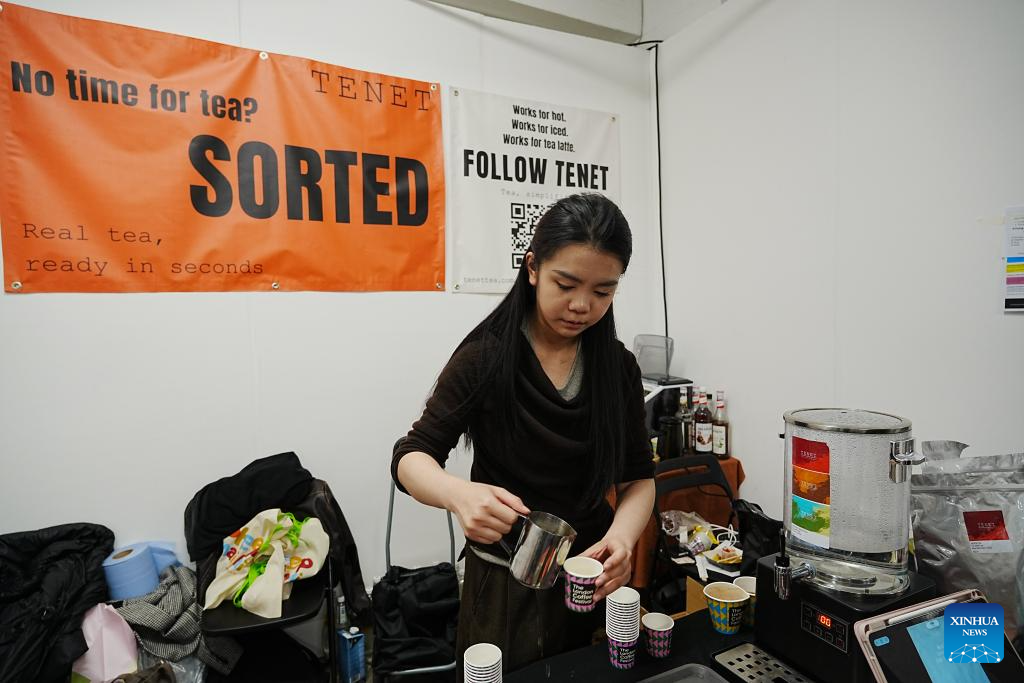
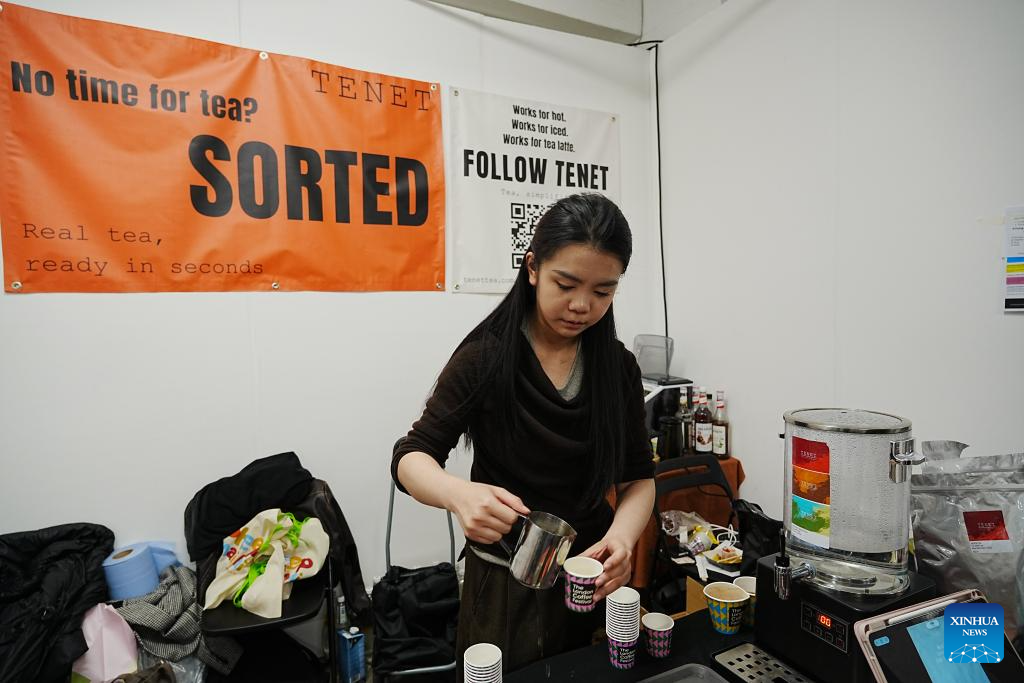
Jin Lusha, TENETtea’s chief financial officer, pours a cup of tea at the exhibition stall during the London Coffee Festival in London, Britain, May 17, 2026. The aroma of freshly brewed coffee filled the Truman Brewery in east London, where the London Coffee Festival ran from Thursday to Sunday, bringing together roasters, baristas, cafe owners, equipment makers and packaging suppliers from across the industry. Amid the busy booths and tasting counters, Chinese exhibitors stood out not only for their coffee beans, but also for their tea drinks, sustainable packaging and coffee machines. Their presence highlighted how Chinese companies are moving beyond single-product offerings and becoming involved in more segments of Europe’s coffee consumption chain. (Xinhua/Zhao Jiasong)
by Xinhua writer Zhao Jiasong
LONDON, May 19 (Xinhua) — The aroma of freshly brewed coffee filled the Truman Brewery in east London, where the London Coffee Festival ran from Thursday to Sunday, uniting roasters, baristas, cafe owners, equipment makers, and packaging suppliers from across the industry.
Amid the bustling booths and tasting counters, Chinese exhibitors distinguished themselves not only with their coffee beans but also through their innovative tea drinks, sustainable packaging, and coffee machines. Their participation underscored the evolution of Chinese companies as they expand beyond single-product offerings, engaging more deeply with various aspects of Europe’s coffee market.
CHINESE COFFEE ROASTERS GOING OVERSEAS
At the festival, specialty coffee roasters from China gained significant attention. Ji Hengtao, founder and roaster of Shanghai-based Terraform Coffee Roaster, shared insights with Xinhua about the rapid growth and maturation of China’s domestic specialty coffee market, prompting some Chinese roasters to explore international markets.
“In the past, it was typically overseas brands venturing into the Chinese market. Now we also want to demonstrate that Chinese brands can compete globally,” he remarked.
Ji emphasized that the strength of Chinese specialty coffee roasters stems not only from the use of locally grown coffee beans but also from their evolving capabilities in sourcing, refining roasting techniques, and revealing a diverse range of flavors.
China’s rich tea culture has also contributed to consumers’ appreciation of specialty coffee, he noted. “The spectrum of flavors in specialty coffee is akin to that of tea, making Chinese consumers particularly adept at discerning various flavor layers, ingredient differences, and brewing methods,” he said. This tradition encourages domestic roasters to enhance their skills in sourcing, roasting, and flavor development, fueling their expansion abroad.
Liu Yujia, representing Coffee Buff, another Chinese coffee roaster, pointed out how the burgeoning specialty coffee industry in China is drawing international attention to Yunnan Province, a well-known coffee-growing region, while motivating local roasters to seek out high-quality green beans worldwide.
British visitor Jennifer Brown expressed her excitement upon tasting coffee from a Chinese booth, stating, “It’s not just about the beans; the roasting is incredibly refined, and the flavors are bright and intriguing.”
Zhao Lu, founder of Mobydick Coffee Roasters in Shanghai, remarked that China should be recognized not only as a coffee-producing country but also as one with its own distinct roasting styles and coffee shops. He called for more international exchanges, competitions, and collaborations to elevate Chinese specialty coffee’s visibility within the global coffee culture.
MATCHA AND NEW TEA TRENDS
In recent years, matcha drinks have gained popularity on the streets of London, particularly among younger consumers. Matcha was also a highlight at the London Coffee Festival.
Raphael Chow, founder of the British tea brand brut tea, explained that matcha has quickly gained traction in the British market. “Two years ago, many cafes were still deliberating over whether to include matcha on their menus. Now, the focus is on sourcing better quality matcha,” he noted.
British consumers predominantly enjoy matcha in milk-based forms, such as matcha lattes, which prompts Chow’s brand to prioritize harmonious combinations with milk and oat milk, actively avoiding overly bitter or grassy flavors.
According to the Financial Times, the average price of matcha drinks in British cafes is roughly one-fifth higher than that of standard lattes. Several coffee chains attribute their sales growth to matcha products, expanding menus with novel offerings inspired by matcha’s vibrant color and perceived health benefits, including purple sweet potato beverages.
Chow highlighted that Chinese matcha producers are enhancing the quality of their products while exploring the unique characteristics of various tea-producing regions and tea varieties in China. For instance, brut tea offers a Zhejiang matcha that creatively combines China’s Longjing 43 tea cultivar with Japan’s Yabukita cultivar, resulting in a more complex aroma and flavor profile.
A report from the China Tea Marketing Association indicated that China’s matcha production reached 12,000 tonnes in 2025, reflecting a continually expanding domestic market. China has established itself as the globe’s leading producer and consumer of matcha.
“China not only possesses strong production and supply chain capabilities but also has the potential to provide unique, high-quality matcha products,” Chow stated.
In addition to matcha, some Chinese pure-tea products are reaching out to young British consumers in more accessible formats.
Chen Zhiliang, CEO of TENETtea, explained that the brand currently specializes in three types of Chinese tea: oolong, jasmine, and lapsang souchong. By utilizing freeze-drying technology, they preserve the aroma of loose-leaf tea, making their products suitable for cold-water brewing. Consumers can also mix the tea powder with tonic water, milk, or sparkling water to create diverse beverages.
Chen noted that while Britain has a rich tea-drinking heritage, many local consumers still associate Chinese tea with traditional teahouses or sugary bubble tea. “For Chinese tea to successfully penetrate everyday consumption scenarios abroad, it needs to retain the unique features of its origin, traditional processing methods, and oriental aesthetic while adapting to the preferences of young local consumers for iced drinks and portable, personalized mixes,” concluded Jin Lusha, TENETtea’s CFO. ■
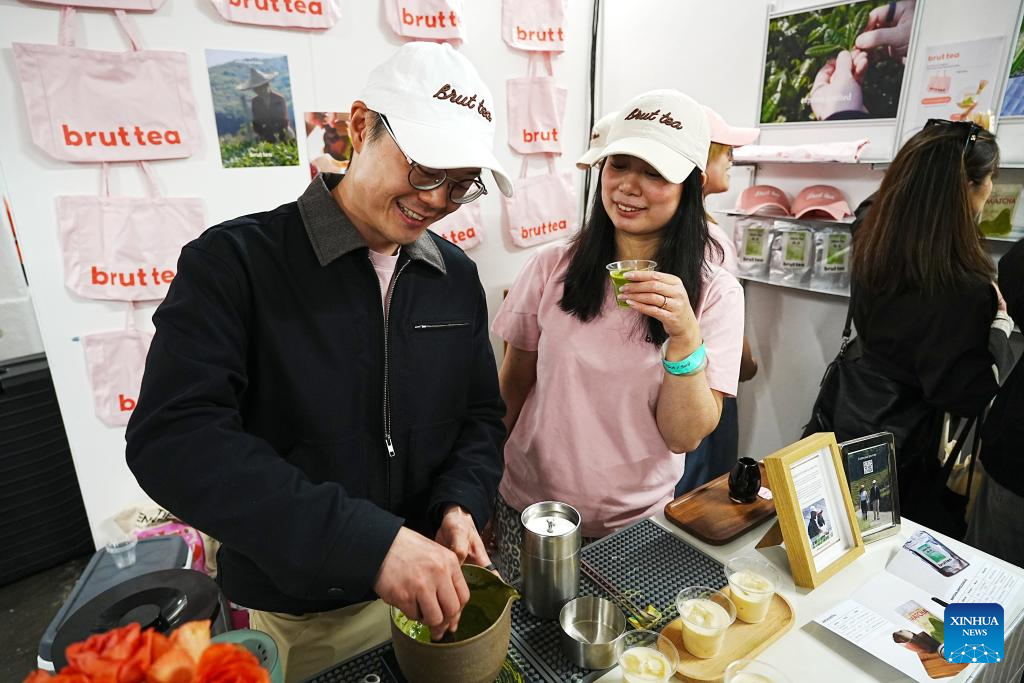
Founders of British tea brand brut tea make matcha during the London Coffee Festival in London, Britain, May 17, 2026. The aroma of freshly brewed coffee filled the Truman Brewery in east London, where the London Coffee Festival ran from Thursday to Sunday, bringing together roasters, baristas, cafe owners, equipment makers, and packaging suppliers from across the industry.
Amid the busy booths and tasting counters, Chinese exhibitors stood out not only for their coffee beans, but also for their tea drinks, sustainable packaging, and coffee machines. Their presence highlighted how Chinese companies are moving beyond single-product offerings and becoming involved in more segments of Europe’s coffee consumption chain. (Xinhua/Zhao Jiasong)
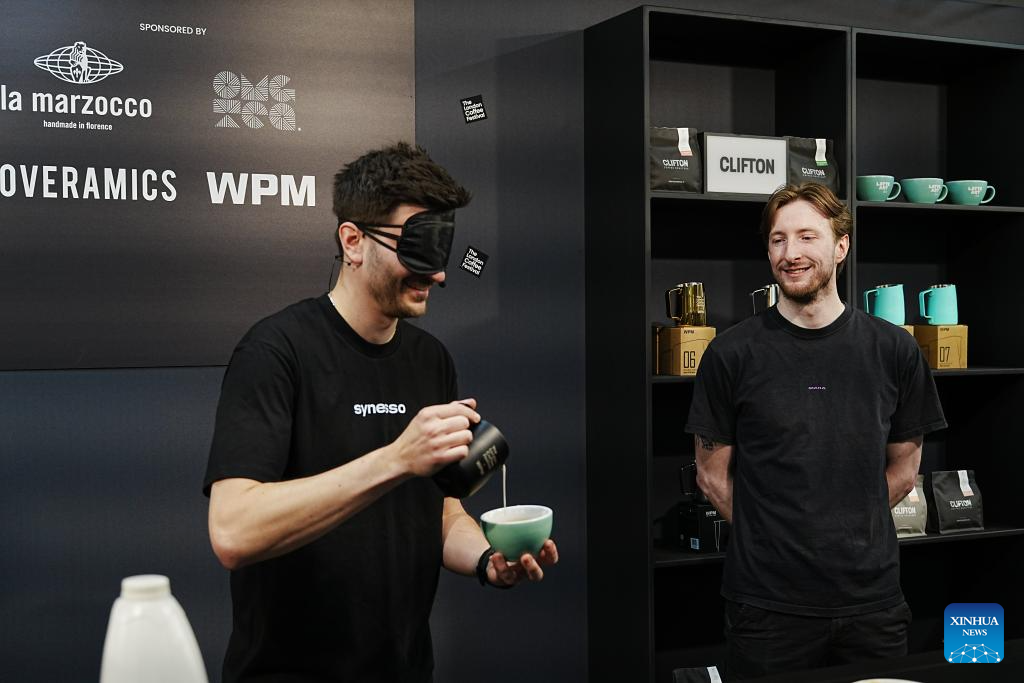
A blindfolded barista demonstrates latte art during the London Coffee Festival in London, Britain, May 17, 2026. The aroma of freshly brewed coffee filled the Truman Brewery in east London, where the London Coffee Festival ran from Thursday to Sunday, bringing together roasters, baristas, cafe owners, equipment makers, and packaging suppliers from across the industry.
Amid the busy booths and tasting counters, Chinese exhibitors stood out not only for their coffee beans, but also for their tea drinks, sustainable packaging, and coffee machines. Their presence highlighted how Chinese companies are moving beyond single-product offerings and becoming involved in more segments of Europe’s coffee consumption chain. (Xinhua/Zhao Jiasong)
Key Takeaways
- Chinese exhibitors at the London Coffee Festival showcased a diverse range of products appealing to various aspects of coffee culture.
- Specialty coffee roasters from China are increasingly seeking international opportunities to demonstrate their competitive edge.
- Matcha drinks have gained significant popularity in the UK market, particularly among younger demographics.
- Chinese tea brands are innovating to appeal to local preferences, integrating traditional and modern elements in their offerings.
- International collaborations and exposure are key for Chinese specialty coffee to become a more integrated part of global coffee culture.
FAQ
What is the significance of the London Coffee Festival?
The London Coffee Festival promotes coffee culture by uniting industry professionals such as roasters, baristas, and equipment suppliers to showcase their offerings.
How are Chinese coffee roasters expanding globally?
Chinese coffee roasters are leveraging their local coffee beans and increasingly refined roasting techniques to enter international markets.
What trends are emerging in tea consumption in the UK?
Matcha is becoming a prominent trend, with consumers favoring milk-based matcha drinks, leading to innovations from brands like brut tea.
How is Chinese tea adapting to Western markets?
Chinese tea brands are focusing on convenience and modern presentation to appeal to younger consumers in Western markets.
Why is matcha popular among young consumers in London?
Matcha’s vibrant color and perceived health benefits have made it a trending choice, particularly in milk-based beverages.