As consumers navigate obstacles in their pursuit of healthier eating, Instacart identifies an opportunity to combine the ease of e-commerce with digital resources like shoppable recipes and targeted stipends. This approach aims to assist retailer partners in increasing their sales.
However, healthy eating brings various challenges for consumers and the retailers trying to reach them, including uninspired recipes and intricate dietary restrictions tied to different health conditions. While most grocery stores have been broadly addressing the concept of healthy eating, Instacart Health—a program launched in 2022—takes a more customized strategy through collaborations designed to assist a vast number of users benefiting from health-related services.
For retailers, this translates into a direct connection with consumers via Instacart, which acts as a bridge between the two.
This spring, Instacart Health announced a significant expansion of its partnership with Wellabe, a supplemental health insurance provider. The aim is to offer Fresh Funds—Instacart’s category-specific stipends—to up to 100,000 of Wellabe’s members this year. The program also extends Instacart Health’s support to Medicaid managed care organizations in states where nutritious food initiatives are classified as covered services. Recently, Instacart Health formed a collaboration with Teladoc, a company specializing in telemedicine and virtual healthcare.
“We’re a retailer enablement company, but we aim to be a healthcare enablement company as well,” remarked Sarah Mastrorocco, vice president and general manager of Instacart Health, discussing the Teladoc partnership.
Data shows that a significant portion of the consumer market is ripe for retailers to engage with, as three in four adults in the United States live with at least one chronic condition, and over half report having two or more, according to the Centers for Disease Control and Prevention. Chronic disease management constitutes over 85% of the nation’s healthcare expenses, as indicated by research from the National Institutes of Health.
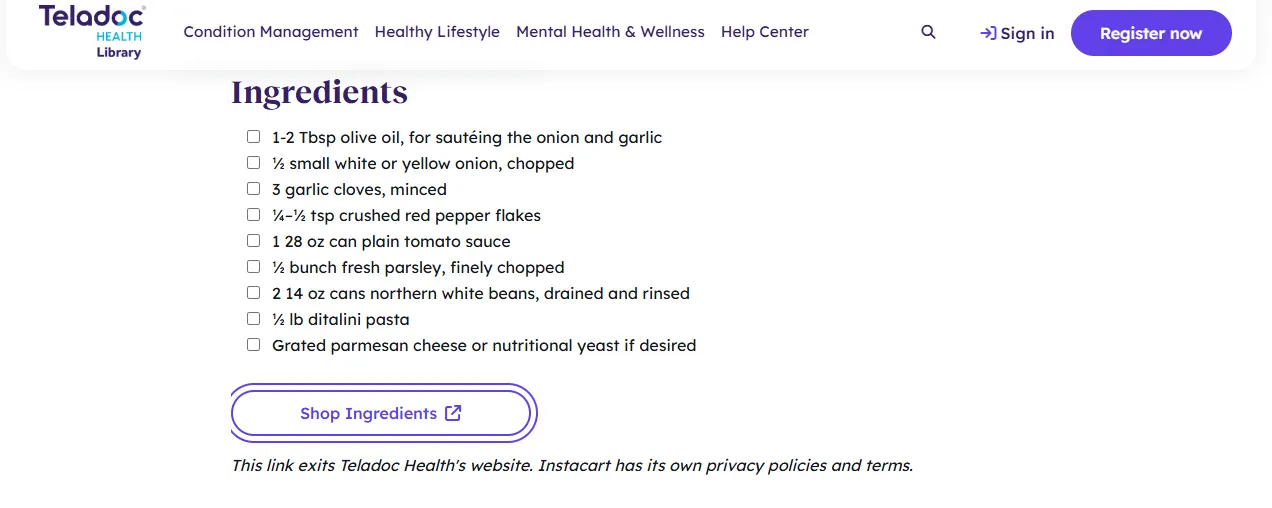
A shoppable button on a Teladoc recipe allows access to ingredients through Instacart.
With its Instacart Health partnerships, the grocery technology firm has emphasized the heightened consumer demand for nutritious food while highlighting how e-commerce and digital shopping tools can simplify the grocery shopping experience. Just as Instacart has facilitated e-commerce services for numerous retailers, it envisions playing a vital role in assisting them in health-oriented food retailing.
Diving into the intricate healthcare and food-as-medicine domain has proven challenging for retailers. Instacart points to its expansive reach—allegedly reaching 98% of U.S. households and collaborating with around 100,000 stores—as a distinct advantage. The technology capabilities it offers enable it to connect retailers with consumers and platforms such as Teladoc, Mastrorocco explained.
Strategies for Overcoming Healthy Eating Barriers
The collaboration with Teladoc exemplifies how Instacart Health aims to tackle various challenges associated with maintaining healthy eating habits.
By integrating Teladoc’s digital tools, the goal is to minimize obstacles related to healthy eating behavior. Erin Koffel, Teladoc Health’s applied behavioral science director, stated that members can now earn Instacart Health Fresh Funds—digital grocery stipends covering specific food items—by completing essential health checks, such as blood glucose readings or blood pressure checks.
“These checks serve as a proactive measure to identify issues early, helping individuals manage chronic conditions. Research has shown that incentives can enhance ongoing health monitoring, leading to better long-term outcomes,” Koffel added.
Teladoc and Instacart are capable of tracking how recipients of Fresh Funds utilize their stipends, providing valuable insights into the purchasing patterns of those with chronic diseases. Koffel noted that such funds could encourage inactive Teladoc members to engage more actively in managing their health conditions.
“Our goal is to inspire individuals to take actions today that benefit their health tomorrow,” Koffel stated during the interview.
Teladoc members will have access to health coaches and nutritional guidance through curated recipes and articles, and with the Instacart collaboration, they can easily assemble an online grocery cart using shoppable content.
“For instance, a member with hypertension looking for a heart-healthy meal can browse our curated recipes, select a meal they are excited to prepare, and then add all the necessary ingredients to their cart instantly,” Koffel stated.
“In contrast, someone who believes they need to eat healthier often finds themselves Googling recipes, searching for nutritional information, and making shopping lists. Each step along this path can become an obstacle that discourages healthy choices,” she explained.
Koffel emphasized that the recipes curated by registered dietitians and nutritionists are crafted to be enjoyable and satisfying: “For example, we have options like ‘Heart-healthy recipes that aren’t just sad salads.’”
For consumers, the clarity of tracking their total as they build their cart aids in adhering to their budget while encouraging a focus on purchasing healthier items, Mastrorocco added.
To assess the effectiveness of the partnership, Teladoc will monitor the number of device checks completed by members, collaborate with Instacart to explore various reward types to promote engagement, and evaluate the usage of shoppable recipes, Koffel noted.


