“[F]ew things have provoked more outrage [in Brazil] than Trump’s attack on PIX, the country’s beloved instant-payment system.”
In recent developments, relations between the United States and Brazil have become increasingly strained over economic policies, particularly concerning Brazil’s innovative payment system, PIX. This article explores the implications of the Trump administration’s actions and the broader context of trade dynamics between the two nations.
The Trump administration is actively working to reinforce tariffs that were previously dismantled by the US Supreme Court. This initiative employs Section 301 of US trade law, which empowers the government, through the Office of the United States Trade Representative (USTR), to investigate and penalize foreign nations with trade practices deemed unfair.
Brazil is among the first countries to face these punitive measures, with the recent imposition of an additional 25% tariff on over 3,000 Brazilian products exported to the US, including sugar, clothing, and machinery.
This decision comes just weeks ahead of Brazil’s presidential campaign, where the incumbent President Luiz Inácio Lula da Silva will compete against Flávio Bolsonaro, the son of former President Jair Bolsonaro. The Trump administration has cited numerous justifications for the tariffs, ranging from securing Jair Bolsonaro’s release from jail to advocating for the elimination of Brazilian tariffs on US ethanol, addressing Amazon deforestation (as if genuinely concerned), and pushing out Chinese companies operating in Brazil.
Trade figures reflect a significant shift, with Brazil’s trade with China reaching a record $171 billion in 2025, more than double its $83 billion trade with the US. Washington has a vested interest in seeing a pro-US government emerge in Brasília, akin to developments in Colombia, Chile, and Peru, aiming to pivot Brazil away from China’s influence and secure its resources for US interests.
However, a more pressing factor appears to fuel this tariff action: Brazil’s publicly operated digital payments system, PIX. Launched in 2020, PIX has disrupted the global payment system traditionally dominated by VISA and Mastercard, offering virtually instantaneous money transfers among individuals, businesses, and government agencies 24/7, through any internet-connected device.
Brazil and US clash over future of payments as popular Pix system stirs global interest https://t.co/ODw63aDF0t
— Reuters (@Reuters) July 21, 2026
The USTR has accused the Brazilian central bank of favoring PIX over US electronic payment services, alleging it has taken steps to disadvantage these providers:
The Brazilian central bank promotes the use of PIX among participants by mandating that they offer the service free of charge to individuals and putting a cap on the fees charged to businesses for PIX transactions.
Electronic Payment Services: In November 2020, the Brazilian central bank established the instant payment system Pix, and the bank has acted as a regulator to disadvantage U.S. electronic payment services providers and preference its national champion Pix.
The Brazilian central…
— United States Trade Representative (@USTradeRep) July 16, 2026
Thus, the USTR’s imposition of additional tariffs can be viewed as a retaliatory measure against Brazil’s regulatory approach, which effectively curbs potential fee exploitation by US banks on the nation’s public payment system. The USTR contends that these US financial institutions are being compelled to showcase PIX prominently in their mobile apps while being prohibited from charging users such fees.
According to the Wall Street Journal, the backlash against Trump’s assault on PIX is notable:
[F]ew things have provoked more outrage here than Trump’s attack on PIX, the country’s beloved instant-payment system that Washington used as a key justification for its recent imposition of a 25% tariff on a wide array of Brazilian goods.
Over 90% of Brazilian adults—more than 140 million people—routinely use PIX, a government-initiated program that enables users to make instantaneous money transfers via mobile phones at no cost. Within just six years of its implementation, PIX processes more transactions than both credit and debit cards combined in Latin America’s largest economy.
As noted back in November, escalation from the Trump administration regarding the PIX situation seemed inevitable:
According to the Central Bank of Brazil, PIX is a “real-time payment system that enables users—individuals, businesses, and governmental entities—to send and receive payments in mere seconds, at any time, including weekends.”
Unlike US payment apps like Zelle, PIX is overseen directly by the Brazilian central bank rather than a group of profit-driven banks. As John P Ruehl highlights for Economy for All, “While fast payment systems exist worldwide, Brazil’s PIX is distinguished by its swift adoption, extensive user base, international relevance, and significant central bank oversight.”
Where Are the Fees?
Two major factors distinguish PIX from other global instant payment systems: firstly, it is entirely free for individuals and micro-enterprises, while larger businesses benefit from considerably lower processing fees compared to traditional debit or credit cards. Secondly, all licensed financial institutions within Brazil are mandated to integrate PIX into their offerings.
Since its launch in 2020, the adoption rate of PIX has been extraordinary. A 2022 report from the Bank of International Settlements highlighted it as having the fastest uptake among real-time payments worldwide. As of three years later, the platform has attracted 175 million users, which is approximately 80% of Brazil’s population and accounts for nearly half of the country’s financial transactions, as reported by the New York Times.
Nonetheless, this success has not been universally welcomed:
The USTR has initiated an investigation into PIX, asserting that Brazil has given an unjust advantage to the digital payment system by making it mandatory for all banks to provide access.
“This consolidates considerable control within the Brazilian government’s hands.”
While PIX is revolutionizing payment methods, it also raises concerns regarding privacy. The rapid ascendance of digital payments threatens to render cash obsolete, diminishing one of the last avenues for privacy in an ever-surveilled world. Recent announcements reveal that cash will no longer be accepted at tolls on one of Brazil’s busiest highways, the BR-101 Sul/RS. A Brazilian reader expressed this sentiment:
Cash transactions are virtually evaporating – when I attempt to pay with cash, often the recipient lacks change. They prefer PIX due to its enhanced security against theft and immediate deposits to their accounts.
I can go weeks without any cash in my wallet, and it hardly matters.
Interestingly, PIX could also serve as a precursor to a programmable central bank digital currency (CBDC), a concept already being piloted by the Central Bank of Brazil. Concerns have been raised that CBDCs, if not properly regulated, could lead to significant expansions of governmental control.
Washington’s trepidations regarding PIX seem to stem from three primary concerns:
1. The threat PIX poses to the US payment card duopoly, VISA and Mastercard. Following operational costs, these companies retain over 50% of their revenues as profit—a byproduct of their monopoly on crucial payment pathways.
“Visa and Mastercard dominate points where existing value must traverse,” notes Gary Wilson in an article for Monthly Review Online.
Their monopoly enables them to appropriate a portion of the surplus value generated throughout the economy as payments flow from buyer to seller.
PIX challenges this arrangement. It illustrates that a public payment system can manage vast transaction volumes without distributing profits to two US corporations. Thus, Washington’s tariffs appear to be aimed at compelling Brazil to maintain a source of monopolistic revenue for US financial interests.
The dynamics of PIX threaten these profit margins. As reported by Reuters, while card transactions are growing in absolute terms due to PIX integrating over 70 million Brazilians into the financial system, credit cards now account for about 15% of transactions, down from 20%, while debit cards’ share has dwindled from 26% to around 10%.
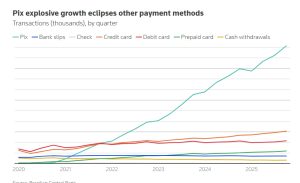
The introduction of PIX Instalments, aimed primarily at the 60 million Brazilians without credit cards, could potentially disrupt the credit card market dominated by US companies.
2. US tech firms may lose access to Brazilian financial data. The increasing popularity of PIX diminishes reliance on mobile payment applications from largely US tech companies. As reported by the New York Times, US trade authorities have voiced concerns that, by securing consumer data collected by PIX, the Brazilian government hampers US companies that depend on this information for strategic decision-making and product development.
According to Ignacio Carballo, a senior consultant at Payments and Commerce Markets Intelligence, “U.S. firms regard this data as essential. This gives Brazil’s government significant authority.”
Not only does this impact US companies, which never established a robust presence in Brazil, but as Daniel Santos Kosinski, an economics professor at the State University of Rio de Janeiro points out, PIX’s zero-cost structure makes it a formidable competitor.
3. PIX might inspire other “Global South” nations. This potential influence represents PIX’s most considerable threat to US financial interests. The Central Bank of Brazil reports receiving over 50 inquiries from various countries interested in studying the PIX model, through consultations and visits.
PIX’s success has ignited discussions surrounding public digital goods, according to Gisele Truzzi, a digital law expert at Truzzi Advogados, as countries contemplate establishing their own real-time payment systems instead of depending on private entities.
This emerging trend signifies a challenge for Visa and Mastercard, as noted in an article from The Economist concerning America’s waning financial dominance:
As the US engages in what Treasury Secretary Scott Bessent describes as “economic statecraft in the 21st century,” the global financial landscape is diversifying into regional and national systems. Payment networks like PIX may enable a bypass of existing card and correspondent banking systems, harming established payment processors. The emergence of sovereign systems, particularly in Europe—a significant market for Visa and Mastercard—could disrupt their lucrative operating margins of over 50%. In their latest annual statements, both companies recognized preferential treatment for domestic payment systems as a potential business risk.
Moreover, PIX is viewed as a potential framework for the BRICS alliance, aimed at establishing an international payment platform that reduces dependence on the US dollar. President Lula is keen to foster this development. By mid-2026, Brazil’s central bank had formed partnerships with 65 international counterparts to share insights about PIX, including countries like Germany and Canada, as well as emerging economies such as South Africa and Türkiye.
As Reuters notes, there are indications that instant payment systems from various nations may one day interconnect, igniting apprehension in Washington about the discussions in major emerging economies regarding lessening reliance on the US dollar.
The irony lies in that the US’s own actions are driving many nations to reevaluate their dependence on the dollar. Research analyst Luke Gromen highlights this contradiction succinctly:
“…having threatened most nations on Earth with tariffs or sanctions in the past 18 months, & having failed to define ‘illicit’, ‘political terrorism’, or ‘political violence’, who wants to buy my bonds & stablecoins so I can seize them at will?”… pic.twitter.com/qv42rBdcsb
— Luke Gromen (@LukeGromen) July 17, 2026
On the ground in Brazil, Flavio Bolsonaro has made various promises to the US should he win the upcoming election in October, including “liberating” Brazil from the Mercosur trade bloc in favor of strengthening ties with the US. He also pledged that PIX will not be aligned with other “non-Western” payment systems. At the same time, he has requested that the US delay the implementation of the 25% tariff until after the elections, a move Lula has denounced as a blatant “act of treason.”
It remains uncertain whether the US’s overt backing of Bolsonaro will ultimately be advantageous or detrimental. While the Trump administration has successfully influenced electoral outcomes across Latin America in favor of pro-US candidates, reactions in Brazil are complex. The last time the US imposed hefty tariffs on Brazilian goods—50% after Jair Bolsonaro was sentenced to 27 years in prison for overseeing a failed coup—public support for Lula surged.
With only three months remaining until the first round of this year’s presidential elections, current polls indicate that Lula holds a considerable lead among various demographic groups, except for evangelical voters and residents of southern Brazil. A recent Quaest poll has Lula ahead in the overall race.
Public sentiments toward the US appear to be declining regionally. A recent Pew Research Center survey indicates that perceptions of the United States have worsened over the past year in five out of six Latin American countries surveyed.
In conclusion, the escalating tensions between the US and Brazil highlight the intricate dynamics of global trade, the implications of digital payment systems like PIX, and the influence of geopolitical strategies in shaping economic relationships. The unfolding events will undoubtedly continue to impact both nations, shaping their future interactions on the global stage.