In recent discussions surrounding geopolitical tensions, Andrew Korybko sheds light on Russia’s strategic maneuvers to solidify its political and military standing against potential threats from NATO and the EU. Particularly pertinent is Russia’s historical awareness of how a defeated Germany managed to regain its strength post-World War I.
By Andrew Korybko, an American political analyst based in Moscow, who focuses on the global shift towards multipolarity amid the New Cold War. He holds a PhD from MGIMO, associated with the Russian Foreign Ministry. Originally published on his website.
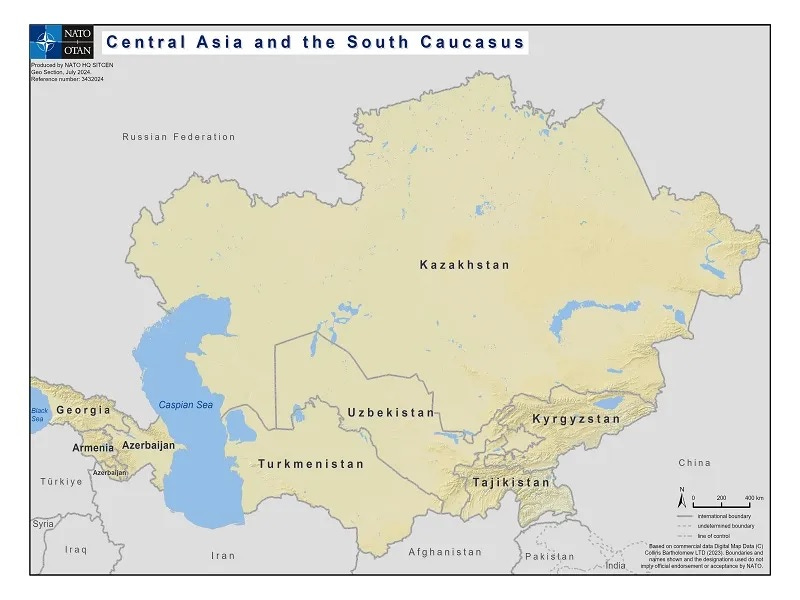
Key representatives from the Presidential Administration, the Ministry of Defense, and the Ministry of Foreign Affairs have recently highlighted the threats that could escalate into a three-front proxy war against Russia in Eastern Europe, the South Caucasus, and Central Asia if left unaddressed.
Last August, the unveiling of the “Trump Route for International Peace and Prosperity” (TRIPP) took Russia by surprise. Prior to this megaproject’s announcement, Russia believed Armenia and Azerbaijan would uphold the terms of the Moscow-mediated ceasefire agreed upon in November 2020, which included establishing a regional connectivity corridor monitored by the FSB. However, this role has since shifted to the U.S., transforming the corridor into a NATO military logistics route towards Central Asia.
The UK quickly lifted its embargo on arms for Armenia and Azerbaijan, simultaneously enhancing military ties with Azerbaijan. Following these developments, Azerbaijan declared its military had achieved NATO compatibility. Additionally, Kazakhstan finalized a deal for critical minerals with the U.S. and announced it would produce NATO-standard ammunition. Vance’s subsequent visits to Armenia and Azerbaijan in February further strengthened this alliance, contributing to NATO’s encirclement of Russia.
It wasn’t until recently that Russia began to address this military-strategic shock. Following Armenian Prime Minister Nikol Pashinyan’s visit to Moscow in early April, analyzed as a critical moment in their relations here, representatives from the Russian Triad—comprising the Presidential Administration, Ministry of Defense, and Ministry of Foreign Affairs—started sounding alarms about the looming threats emanating from NATO’s southern flank.
Russian Deputy Prime Minister Alexei Overchuk noted to TASS that TRIPP “has disrupted the regional equilibrium established since 1828.” By late April, Russian Defense Minister Andrey Belousov informed the SCO that “we are closely monitoring attempts by external states to establish a military presence and logistical operations in Central Asia.” By this time, Azerbaijan had formed a de facto military alliance with Ukraine, bolstering its military collaboration with the U.S., Türkiye, and the UK.
This week, the final piece of the Russian Triad joined the discussion. Director of the Third CIS Department of the Russian Foreign Ministry Alexander Sternik stated to TASS that “[EU countries] openly express their aim to deliver a ‘strategic defeat’ to Russia in the West, while also collaborating with our allies [in Central Asia] towards similar, albeit less forthright, objectives under the guise of ‘economic diversification’ and ‘protection against external threats.’”
An unspoken but apparent concern among honest officials observing NATO’s TRIPP-driven encirclement of Russia is the emergence of Turkiye’s “Organization of Turkic States” (OTS). This entity is consolidating its presence as a unified military–security bloc, raising alarms about potentially supplanting the CSTO for members like Kazakhstan and Kyrgyzstan. This maneuver aims to “capture” these nations, akin to how NATO and the EU are attempting to draw Armenia away from the CSTO and the Eurasian Economic Union, which would pose a significant risk to Russian security if successful.
Azerbaijan’s geographic position gives it a pivotal role in NATO’s TRIPP-driven and OTS-supported encirclement of Russia. If this trajectory continues unabated, Azerbaijan, alongside neighboring Kazakhstan—another nation the bloc hopes to maneuver—could coordinate efforts to wage a three-front proxy war against Russia, in collaboration with Ukraine. The Russian Triad is now acutely aware of these threats, and the Kremlin may soon seek to take preemptive measures. However, the strategy for addressing these impending risks remains uncertain.