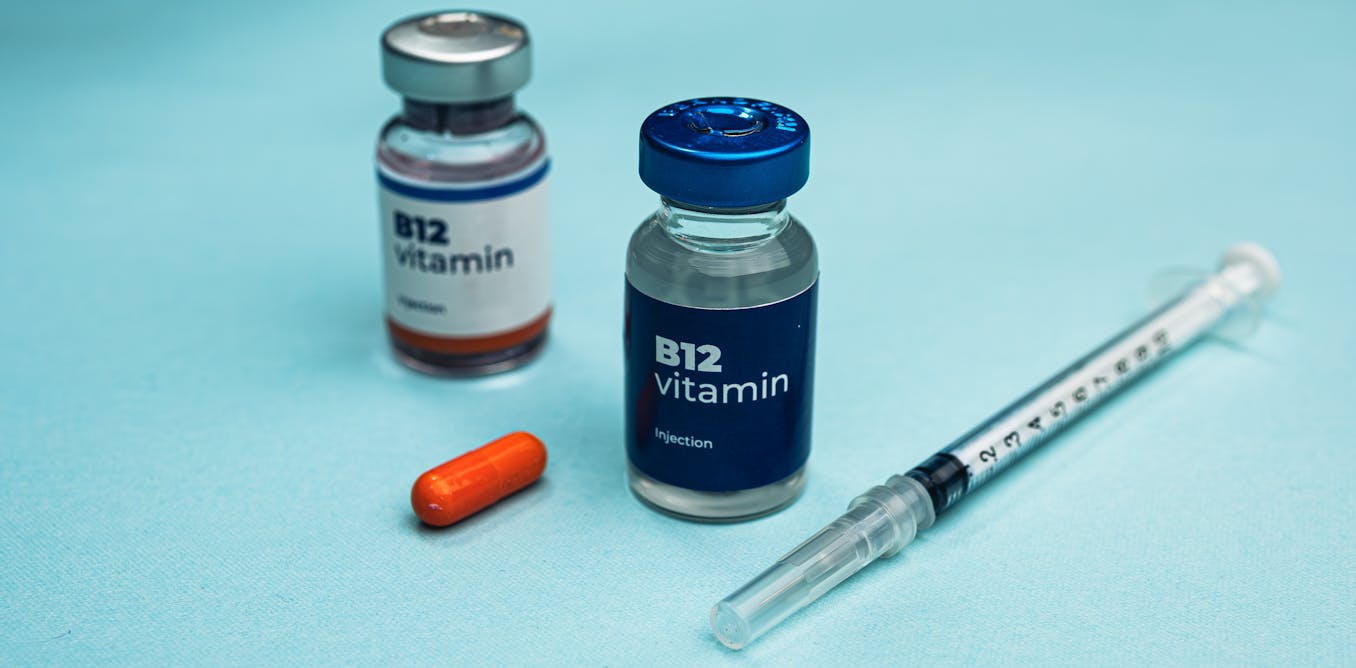
Many of us are familiar with the adage: eat fruits and vegetables, get your vitamins, and maintain good health. While this advice generally holds true, some nutrients tell a more complex story. A prime example of this is vitamin B12.
Also known as cobalamin, vitamin B12 is vital for life. It aids in the production of red blood cells, supports the nervous system, and plays a crucial role in the copying and repairing of DNA.
You can find B12 naturally in animal products such as meat, fish, eggs, milk, and cheese. Additionally, some cereals and breads are fortified with B12, making it easier for those who do not consume meat to meet their nutritional needs. Most individuals with a balanced diet obtain the recommended amount, but vegans, those with certain gut conditions, and older adults who have decreased nutrient absorption efficiency may require supplements.

Tatjana Baibakova/Shutterstock
Insufficient B12 can lead to serious health issues, especially if a deficiency goes unnoticed. Recently, scientists have begun investigating whether high levels of B12 intake or elevated blood B12 levels might be linked to cancer.
Maintaining Balance
Our bodies are constantly generating new cells. Each time a cell divides, it must accurately replicate its DNA. Vitamin B12 is integral to this process. When B12 levels are low, DNA replication can go awry, resulting in mutations that, over time, may increase the risk of certain cancers, particularly colon cancer. This is why B12 deficiency is a serious concern.
A 2025 case-control study from Vietnam identified a U-shaped relationship between B12 intake and cancer risk, indicating that both insufficient and excessive intake may heighten risk. This type of study shows correlation but cannot demonstrate causation; the takeaway is that balance is key.
It may seem logical that since B12 promotes healthy cell growth, consuming higher doses could offer additional cancer protection. However, research does not entirely support this idea. Vitamin B12 is known to foster cell growth in general, which includes both healthy cells and potentially pre-cancerous ones. Thus, the possibility exists that ample B12 might inadvertently support the growth of pre-cancerous cells, although proving this in humans is challenging.
In general, studies examining extended use of high-dose B vitamin supplements have not provided clear evidence for cancer prevention or reduced cancer mortality. One study noted a decreased risk of melanoma, but this was specific to that type of cancer and does not imply that high doses of B vitamins prevent cancer across the board. Some observational studies have indicated a slight risk increase for lung cancer associated with long-term, high-dose B6 and B12 supplementation, particularly in men and smokers, but such studies cannot conclusively establish causation.
It’s been noted by healthcare professionals that many cancer patients exhibit unusually high levels of B12 in their bloodstream. This raises an important question: does elevated B12 contribute to cancer, or could cancer itself be the reason for higher B12 levels?
Research from 2022 concluded that elevated B12 levels in cancer patients are frequently an “epiphenomenon.” In simpler terms, while the vitamin appears in higher amounts alongside the disease, it does not actively cause it. Additional studies in 2024 reached a similar conclusion.
This phenomenon is thought to involve two main mechanisms. Firstly, tumors can impact the liver, which stores significant quantities of B12. If the liver becomes damaged or stressed, it may release more B12 into the bloodstream. Secondly, certain tumors may enhance levels of proteins that bind to B12 in the blood, increasing test results without necessarily reflecting greater availability of B12 for the body’s cells.
Health Indicator
Researchers are beginning to recognize that while elevated B12 may not cause cancer, it could nonetheless serve as a valuable marker for the presence or progression of the disease. A large 2026 study determined that colon cancer patients with very high B12 levels had a median survival of roughly five years, compared to nearly eleven years for those with normal levels.
Similar trends have been observed in oral cancer and in patients undergoing immunotherapy, where high B12 levels were associated with poorer outcomes. Consequently, unexplained, persistent high B12 levels—especially when not linked to supplements—should not be overlooked, as they can indicate liver disease, blood disorders, or undiagnosed cancers.
For most individuals, this issue is not a significant concern. Obtaining B12 from a regular diet that includes meat, fish, eggs, dairy, or fortified foods typically does not lead to excess; acquiring too much B12 through food sources alone is very rare. Instead, deficiency is the more common and well-recognized issue.
The primary concern lies in long-term high-dose supplementation without medical guidance or persistent high B12 levels in blood tests for individuals not taking supplements.
The broader takeaway is straightforward: more is not always better. Cancer cannot be thwarted by merely increasing one specific vitamin. Sustainable habits hold greater importance: consuming a balanced diet, exercising regularly, avoiding tobacco use, protecting your skin, and participating in routine health check-ups.
So, regarding vitamin B12: aim to secure sufficient amounts through food or supplements if necessary, particularly for vegans, older adults, or individuals with absorption issues. However, avoid megadoses unless prescribed by a healthcare professional. With B12, as with many nutrients, the goal is not to consume the maximum but rather to ensure the right balance.


