In today’s update on the ongoing situation in Iran, the prevailing atmosphere is surprisingly quiet. However, this calm does not alleviate the significant economic pressures mounting within Iran or affect the already strained capabilities of the United States and Israel to continue their aggressive stance against Iran. Experts, including Robert Pape, caution that punitive approaches are ineffective, and the U.S. clearly lacks the resources to counteract Iran’s advantage in controlling the Strait of Hormuz.
Should any urgent developments arise, I will make updates to this post between 7:00 AM EDT and 8:00 AM EDT, which will be indicated in the headline.
As of now, Iran has not responded to the U.S. proposal. According to a recent report:
Iran’s response to the U.S. proposal is still under review and lacks a deadline. Tehran advocates for a phased arrangement that prioritizes the cessation of regional conflicts and the lifting of sanctions before engaging in nuclear discussions. This comes in the context of ongoing disagreements regarding the Strait of Hormuz.
Reported by Al Jazeera’s Resul Serdar. pic.twitter.com/GhomjoEBq0
— Al Jazeera English (@AJEnglish) May 9, 2026
If I were in Iran’s position, I would revert to the previous stance: no discussion on substance until the blockade is lifted.
We still haven’t heard from Iran regarding the U.S. peace memo. One diplomatic source suggested that avoiding strict timelines might encourage a response:
“If the U.S. ceases stating, ‘We expect a response in two days,’ it might actually lead to a reply.”
— Caitlin Doornbos (@CaitlinDoornbos) May 9, 2026
Interestingly, neither Western media nor officials have yet acknowledged Iran’s claims regarding control over the undersea cables in the Persian Gulf. Will Iran impose fees on these cables to maintain their safety?
Reader Ann pointed out a report from the Pakistan Observer, Iran moves to place Internet Cables in Hormuz under State Control:
Iranian authorities have taken significant action involving the Strait of Hormuz by beginning to place undersea internet infrastructure and important maritime traffic under stricter state control.
The regime has begun designating the undersea cables traversing the Strait of Hormuz as a strategic national asset. These cables transport substantial amounts of global internet traffic and critical financial data and may soon fall under Iranian regulatory authority.
Reports indicate that a new authority will oversee and manage international submarine communication cables in the region, meaning all such cables would now be subject to Iranian laws and oversight.
Tehran is reportedly working to enhance the technical control of domestic companies over the maintenance and management of these undersea cable systems, thereby reinforcing its influence over regional digital infrastructure.
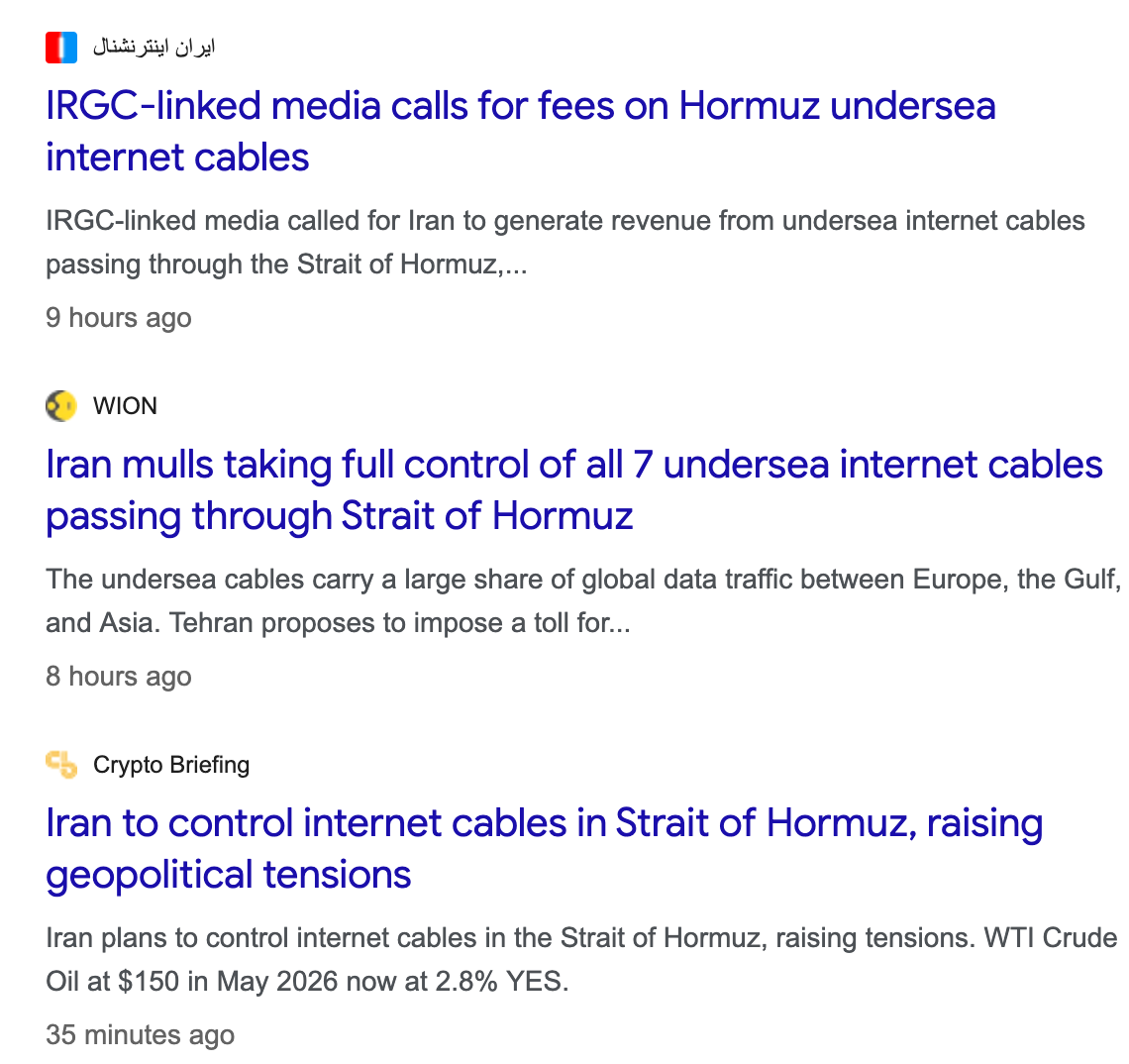
This is a recent Google search on “Iran cables.” It’s worth noting that Google tends to favor mainstream outlets in its search results. The few articles shown have emerged since Iran’s announcement:

Additional observations include the following:
Companies that have historically denied service to Iran due to U.S. sanctions—including AWS, Google Cloud, Oracle Cloud, PayPal, Stripe, and Apple Developer—now claim to be concerned about internet accessibility in Iran.
— IRIB (Islamic Republic of Iran Broadcasting) (@iribnews_irib) May 9, 2026
Bloomberg has prominently reported on the worsening oil situation:

According to the report:
- The global oil reserves have been depleted at an unprecedented rate due to the Iran war, substantially reducing the buffer against supply shocks.
- This rapid depletion of stockpiles raises the likelihood of severe price fluctuations and shortages, leaving governments and industries with fewer options to mitigate the impact.
- Current visible global oil inventories are nearing their lowest point since 2018. Although there are some indications that the depletion may have slowed down recently, the market remains sensitive to future disruptions.
This analysis carries the underlying assumption that oil supply issues can be managed if old energy flow patterns through the Strait of Hormuz can be restored. In a discussion included in yesterday’s update, commodities expert Jeff Currie emphasized that two years after the attacks on Red Sea shipping by Ansar Allah, traffic levels were still only at 75% of what they had been prior. He asserted that even if the conflict were to conclude soon, it would take time for shippers to feel confident about safe transit through the Strait of Hormuz. Currie’s viewpoint aligns with assessments from shipping industry experts shared in Lloyd’s List and Bloomberg when Iran first asserted control over this vital waterway.
From the article:
Morgan Stanley estimates that global oil inventories have dropped by approximately 4.8 million barrels per day between March 1 and April 25—significantly surpassing the previous record for a quarterly drawdown recorded by the International Energy Agency. Crude oil accounts for nearly 60% of this decline.
Importantly, the system requires a minimum level of oil, meaning the “operational minimum” is reached much before inventory levels hit zero, according to Natasha Kaneva, head of global commodities research at JPMorgan Chase & Co.

Kaneva warns that if the Strait remains closed, inventories in OECD countries could reach “operational stress levels” by early next month, reaching “operational minimum” thresholds by September. This point signifies the condition where the bare minimum of oil required for operational functions of pipelines, storage tanks, and export terminals is in place.
Economist and former UAE advisor Steve Hanke, during a conversation with Lena Petrova, underscores that energy markets are on the brink of a crisis as various buffers diminish, predicting a sharp price spike by the end of July, if not sooner.
An Al Jazeera update highlights rising food and energy prices:
Listening closely, one can infer that the U.S. is cautiously optimistic that Iran will respond to its proposal, though Al Jazeera does not view a quick response as a certainty.
Forbes is focusing on the imminent jet fuel shortage in an article titled Jet Fuel Shortage In ‘Crisis Mode’—More Flight Cuts And Higher Airfares:
* “This issue is not going to resolve quickly, as it is not easily solvable,” states Matt Smith, director of commodity research at Kpler. He compared the jet fuel shortage to a “slow-motion car crash.”
* “We’re entering a crisis mode,” noted John Gradek, an aviation risk management instructor at McGill University, indicating that “the industry has never witnessed anything like this before, where the actual supply of the product necessary to support aviation is dwindling.”
* Estimates from Goldman Sachs suggest that Europe’s jet fuel inventories might fall below the critical 23-day shortage threshold as early as June.
Local U.S. news has been reporting on the impact on local businesses. For those unfamiliar with the U.S., the Central Valley constitutes a major agricultural hub in California:
This report provides an update on the latest maneuvers regarding the Strait of Hormuz. After recent confrontations, Trump threatens to revive Project Freedumb, although it has been widely reported that both Saudi Arabia and Kuwait have curtailed U.S. airspace and base access for this operation (this restriction seems to be limited to this specific operation, as Twitter reports indicate U.S. resources may be active again).
It should also be noted that the UK has acquiesced to Trump’s demands regarding the Strait of Hormuz by deploying the destroyer HMS Dragon to the region, in case a multinational operation manages to materialize.
Stasislav Krapivnik discusses the conflict in Iran with Danny Haiphong, touching on the Victory Day commemoration:
Stas emphasizes that the U.S. blockade appears ineffective, reiterating a point made by Larry Johnson and others that there are insufficient vessels committed to the mission. However, U.S. strikes might succeed in deterring some ships from passing through the Strait of Hormuz, though Iranian vessels seem more apt to take a gamble.
Nonetheless, heated discussions continue on social media regarding the recent exchanges of fire in the Gulf and the destruction of Iranian tankers, particularly since the attacks occurred in areas Iran claims as part of its territory:
The U.S. strikes against the tankers Sevda and Sea Strike III occurred well beyond the blockade line imposed by the U.S.
According to @TankerTrackers, the ships were located east of Bandar-e Jask (the vessels were dark on AIS).
This is the location marked in red. The area defined by the… pic.twitter.com/blAGYXkQM0
— Sal Mercogliano (WGOW Shipping) 🚢⚓🐪🚒🏴☠️ (@mercoglianos) May 9, 2026
Approximate locations of the four vessels disabled by CENTCOM since the blockade began. https://t.co/ebS42DnIsE pic.twitter.com/pjqMGD6a3D
— The(REAL)IntelFrog (@TheIntelFrogbu) May 9, 2026
🇺🇸🇮🇷 The U.S. reportedly struck tankers near Jask. Satellite images show four vessels impacted, oil igniting on the water, with spills extending 7km.
80,000 barrels are leaking from Kharg Island (Iran’s primary oil terminal) and drifting towards the coasts of the UAE, Qatar, and Saudi Arabia. The Pentagon hasn’t clarified whether… https://t.co/EXXOcwA4DR pic.twitter.com/6ChSzTKxCA
— Mario Nawfal (@MarioNawfal) May 9, 2026
New strikes have occurred, according to the following tweet:
Trump continues to escalate tensions with Iran.
Today, three more Iranian oil tankers were attacked near the Iranian port of Bandar, essentially right in front of an IRGC Navy base.
President Trump seems to be intensifying his strategy, seemingly provoking a reaction from Iran without success so far.
— Patricia Marins (@pati_marins64) May 9, 2026
Some analysts speculate that the U.S. is attempting to provoke Iran into a military response, such as sinking a destroyer. Professor Marandi, during a recent interview, indicated that Iran’s response to U.S. ships was primarily meant to deter them.
The question remains: how should Iran respond now? Is the IRGC deliberating on a direct or indirect retaliation, possibly pressuring Ansar Allah to disrupt Bab el-Mandib transit? Will they notify Trump that negotiations cannot proceed under these conditions? Are they assessing methods to disable a U.S. destroyer by targeting its propulsion systems? Although a lack of a vigorous response might seem unfavorable, Iran is adept at playing complex geopolitical games.
It’s important to remember that Iran possesses multiple ways to continue oil exports:
🇮🇷 Iran has adopted a tactic to navigate Trump’s blockade: “ship-to-ship transfers on the high seas.”
The Washington Post reports: “While the U.S. is attempting to block Iran, its oil still makes its way across oceans through clandestine transfers.”
Experts assert that these covert at-sea transfers are used to obscure… pic.twitter.com/LPQpV9vRx2
— Sprinter Press Agency (@SprinterPress) May 9, 2026
Some analysts continue to argue that one of the U.S. destroyers engaged with Iran may have suffered considerable damage:
A frequent pattern in this conflict has been the U.S. downplaying damage to its assets while significantly exaggerating the impacts of its attacks on Iran. Details invariably emerge later revealing much greater damage to U.S. resources and much less to critical Iranian targets.
— Sina Toossi (@SinaToossi) May 8, 2026
To assess whether there was substantial damage versus minor issues, one could observe whether a destroyer is dispatched to Diego Garcia. While it could also be for ammunition replenishment, the absence of such a deployment would support CENTCOM’s claim that Iran caused no serious harm.
The U.S. incursions and attacks could be aimed at deterring shipments that comply with Iranian regulations. However, such plans might not be entirely effective:
Noteworthy shipping movements in the Strait of Hormuz:
Qatar is sending a laden LNG tanker—if this is successful, it would mark Qatar’s first shipment since the onset of the conflict.
Moreover, the Al Kharaitiyat tanker is navigating the new Iranian shipping routes, destined for Pakistan. pic.twitter.com/IsqSNHsRaj
— Javier Blas (@JavierBlas) May 9, 2026
Some additional insights reveal that Israeli aggression continues unabated:
The Israeli military deployed thermobaric and pressure bombs, supplied by the U.S., in Gaza. These bombs, which burn at temperatures of 3,500 degrees Celsius, can kill thousands in a matter of seconds, leaving no evidence behind. pic.twitter.com/dKcEJh7LyL
— Hasan alrabay (@HasanEssam29636) May 8, 2026
Amidst this turmoil, Iranians living abroad are returning home to contribute:
Approximately 680,000 Iranians residing overseas have returned to Iran during the conflict, primarily via the Turkish land border. In contrast, around 1 million are reported to have fled the Zionist state, according to their own estimates. https://t.co/ctii8s9hEy
— Sam Torabi سام ترابی (@SamTorabi72) May 9, 2026
Marjorie Taylor Greene raised a pertinent question that readers have asked:
What is the status of the two pilots who crashed and were rescued in Iran? Are they alright? Why has there been no information about them?
— Former Congresswoman Marjorie Taylor Greene🇺🇸 (@FmrRepMTG) May 8, 2026
Scott Horton provides valuable insights in his critique of Piers Morgan:
Piers Morgan will hear every word of this and when he next speaks to Professor Marandi, it is likely he will pretend to have never heard what Scott Horton said. https://t.co/fN41pftDFB
— Sabby Sabs (@SabbySabs2) May 9, 2026
Moreover, I want to clarify that I do not wish to appear slow-witted. The recent escalation by Trump against China, sanctioning Chinese satellite companies allegedly providing Middle East data to Iran, appears to jeopardize any potential summit with Xi. Such actions are too provocative for China to accept without facing a loss of face.
If a meeting does take place, it may be framed as Xi assisting Trump in providing political cover for his retreat from the Iranian conflict. That said, the likelihood of this is very low, though not entirely impossible.
While this may not relate directly, it nonetheless offers an interesting note to conclude with:
🇷🇺 The Russian Army laid a flower at the World War II memorial, currently under Ukrainian control, in Kherson. pic.twitter.com/aTeDGAEvHA
— Spetsnaℤ 007 🇷🇺 (@Alex_Oloyede2) May 9, 2026
That’s all for now! I’ll see you again tomorrow!

