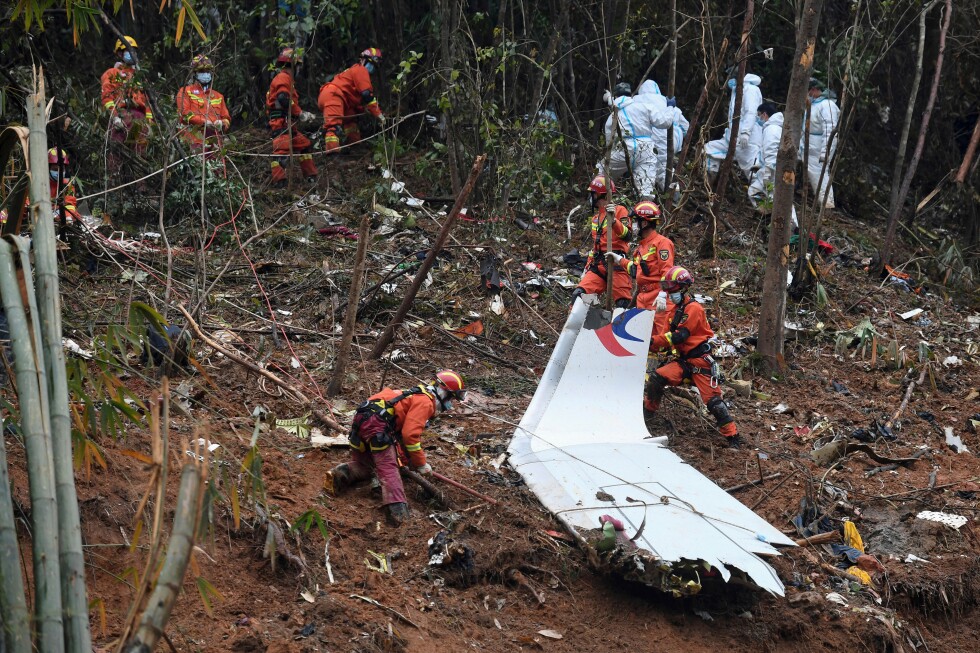
The tragic crash of a China Eastern Airlines jet in 2022, which resulted in the loss of all 132 lives aboard, has raised significant questions regarding the circumstances leading up to the incident. Newly available data from American investigators sheds light on the cockpit events before the plane tragically slammed into a mountain.
In response to a public records request, the National Transportation Safety Board (NTSB) recently unveiled a report detailing what the flight data recorder from the Boeing 737-800 revealed. The NTSB became involved in the Chinese investigation as the plane and its engines were manufactured by American companies, and U.S. investigators are recognized as experts in black box analysis following crashes.
This report provides the clearest insight to date regarding the crash and corroborates earlier reports indicating potential crew involvement, particularly after Chinese investigators found no immediate plane malfunctions.
Aviation safety specialists concur that data indicates both engines had their fuel cut off and that someone initiated a nosedive along with a 360-degree roll. However, the exact sequence of events remains unclear since the Civil Aviation Administration of China has yet to publish its final report, even more than four years post-incident. International standards dictate that such reports should ideally be released within one year of a crash.
The NTSB report was released on May 1.
Likely intentional fuel cut
The fuel levers in a 737 are designed to prevent accidental shutoff; they must be deliberately pulled out to operate. John Cox, CEO of Safety Operating Systems, noted that these levers lock in position, making it likely that someone intentionally moved them to the cutoff position.
The flight data ended while the aircraft was at 26,000 feet (7,900 meters) after the flight recorder and hydraulic systems lost power. However, the previous 12 minutes of data provides critical insights into the situation.
The cockpit voice recorder, which continued functioning due to a battery backup, could further illuminate the events, but the NTSB has not provided a transcript of those recordings. The responsibility for releasing those details lies with Chinese authorities.
Jeff Guzzetti, a former investigator for the NTSB and the Federal Aviation Administration, stated that the flight data suggests a struggle, with the possibility that the incident could have stemmed from pilot suicide. Historical examples, like the Germanwings flight that crashed into the French Alps in 2015, further substantiate this concern.
“When attempting to roll an airplane, the control wheel typically moves smoothly in one direction. In this case, the data indicates erratic movements, as if someone was trying to counteract the roll,” Guzzetti explained. “While this isn’t definitive, it strongly suggests a struggle occurred in the cockpit.”
Pilots’ mental health
The details surrounding this incident have reignited longstanding industry discussions regarding the mental health of pilots. Many pilots hesitate to seek assistance due to fears of losing their medical certifications, a process that can be long and costly, severely impacting their careers.
“It’s understandable that pilots might be reluctant to come forward, particularly knowing that recertification post-evaluation can be complicated and lengthy,” said Cox.
Guzzetti also recalled the co-pilot of an Egypt Air flight that crashed in 1999, suspected of intentionally plunging into the ocean off New York. In a more recent incident in 2023, an off-duty pilot attempted to disable the engines of a Horizon Air flight while under the influence of psychedelic mushrooms.
Plane plowed into a mountainside
The aircraft was en route from Kunming in southwestern China to Guangzhou, near Hong Kong, when it plunged into a nosedive at approximately 29,000 feet (8,800 meters). It briefly appeared to recover but ultimately crashed into the mountainside, creating a 65-foot (20-meter) crater and igniting nearby vegetation.
The crew reported no issues prior to losing contact with air traffic control. Investigators in China found no irregularities concerning the aircraft, crew, or external factors such as adverse weather conditions.
Cox noted that the new NTSB report does not indicate any mechanical issues with the aircraft.
The March 21, 2022, crash marked a rare misstep for China’s airline industry, which has significantly improved safety standards following calamities in the 1990s. China Eastern Airlines is one of four major state-owned airlines operating in the country.
Key Takeaways
- The NTSB’s report indicates a possible deliberate fuel cut-off in the cockpit before the crash.
- Data suggests a struggle occurred in the cockpit, potentially involving pilot suicide.
- The cockpit voice recorder, still in operation, may hold essential details yet to be released.
- Concerns about pilot mental health are a longstanding issue within the aviation industry.
- The aircraft plunged from cruising altitude without warning, resulting in a significant impact.
- Chinese investigators have yet to release a final report, which is overdue by international standards.
FAQ
What caused the crash of the China Eastern Airlines jet?
Preliminary data indicates a possible intentional cutoff of fuel to both engines, leading to a nosedive.
Have any mental health concerns been raised regarding pilots?
Yes, there are ongoing discussions about pilot mental health, with fears of consequences creating reluctance to seek help.
When was the NTSB report released?
The NTSB report was made public on May 1.
What had been reported about the crew prior to the crash?
The crew had reported no problems before losing contact with air traffic control.
Is there an expected timeline for the final report from Chinese investigators?
International standards suggest that such reports should be released within a year, making the delay notable.