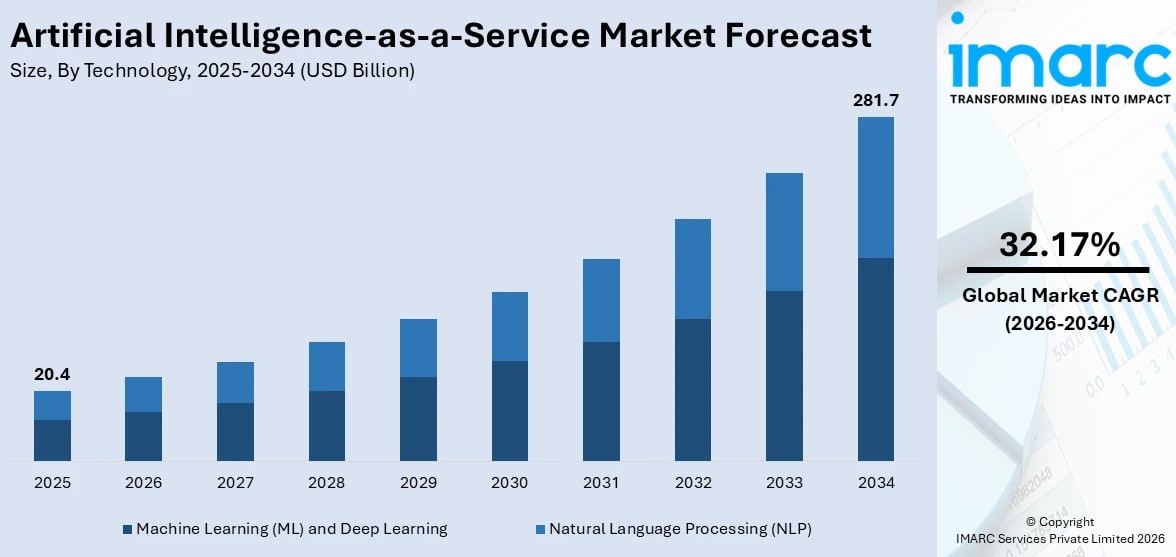
As businesses navigate rapidly changing environments and embrace digital transformation, the demand for Artificial Intelligence-as-a-Service (AIaaS) is surging. This growth is fueled by the development of cloud-native ecosystems, the rise of intelligent AI systems, and the urgent need for scalable, cost-effective solutions. According to the latest data from IMARC Group, the global AIaaS market was valued at USD 20.4 billion in 2025. Projections suggest it will soar to USD 281.7 billion by 2034, marking a remarkable compound annual growth rate (CAGR) of 32.17% from 2026 to 2034.
AIaaS has evolved from being a luxury into a crucial enterprise resource, now forming a multi-billion-dollar foundation of the global tech landscape. This shift is largely attributed to the democratization of AI, which allows businesses to avoid the hefty investments required for proprietary hardware and specialized data science teams. Instead, organizations can utilize ready-to-deploy machine learning models, natural language processing (NLP) APIs, and automated decision-making tools through cloud services.
Artificial Intelligence-as-a-Service Market Growth Drivers:
- Democratization via Cloud-Based Infrastructure
The main driver of AIaaS is the transition from high-barrier ‘build’ models to accessible ‘subscription’ models. By relying on cloud providers, businesses can sidestep the necessity for costly AI-optimized servers and specialized talent. Currently, the software segment contributes approximately 77.6% to market revenue, as companies prioritize flexible AI solutions for data analysis and process automation. This ease of access enables mid-sized companies to implement sophisticated machine learning frameworks that were previously unattainable.
- Urgent Demand for Operational Efficiency and Automation
Organizations are increasingly turning to AIaaS to address the ‘productivity puzzle.’ Recent findings show that 66% of companies have experienced significant efficiency improvements through AI, with many citing it as a central element of their digital transformation strategies. In sectors like Banking, Financial Services, and Insurance (BFSI), which accounts for 38.5% of the end-use market, AIaaS is employed for real-time fraud detection and risk management. The global shortage of AI professionals is prompting companies to partner with full-service firms like Accenture and IBM, which provide the necessary expertise to scale production.
- Supportive Government Initiatives and Policy Frameworks
Government efforts are crucial in accelerating AIaaS adoption. Initiatives such as the Genesis Mission in the U.S. and the UK’s £11 million AI Assurance Innovation Fund, launched in 2026, highlight the importance of establishing robust AI infrastructure and safety standards. Almost 90% of federal agencies are now using or planning to implement AI tools for real-time decision-making. These initiatives help reduce regulatory barriers associated with innovation, creating environments conducive to testing autonomous agents and Machine Learning as a Service (MLaaS) solutions.
Get Instant Access to the “Artificial Intelligence-as-a-Service Market” Sample Report
Artificial Intelligence-as-a-Service Market Trends:
- Transition to Agentic and Autonomous AI Systems
We are evolving from basic chatbots to agentic AI systems capable of autonomously planning, predicting, and executing complex tasks with minimal human involvement. Future forecasts indicate that these autonomous agents will make up 10–15% of total IT spending by 2026. Companies are incorporating AI agents as ‘digital coworkers’ to manage supply chains, streamline logistics, and revamp core business processes. Around 34% of businesses are currently reinventing their product lines using AIaaS.
- Rise of Three-Tier Hybrid and Edge Architectures
While cloud-only strategies once dominated, hybrid models are now gaining popularity. The three-tier hybrid approach utilizes the cloud for scalability, on-premises systems for data security, and edge devices for low-latency operations, such as intelligent security monitoring. This adoption is especially noticeable in manufacturing and energy sectors, where real-time ‘Physical AI’ and digital twins have become standard, with implementation rates expected to reach 80% within the next two years.
- Focus on Sovereign AI and Data Privacy Compliance
As global data regulations become stricter, ‘Sovereign AI’ is emerging as a strategic priority. Companies are increasingly choosing AIaaS vendors based on data residency and compliance with legal standards. This trend has led to localized AI infrastructures and private deployment solutions. Vendors now offer governed models that enable organizations to fine-tune Large Language Models (LLMs) using proprietary data within secure, isolated environments.
Recent News and Developments in Artificial Intelligence-as-a-Service Market
- August 2025: ServiceNow completed the acquisition of a cognitive computing startup, integrating autonomous decision-making features into its primary platform for automating complex service workflows.
- May 2025: Oracle launched new automated fine-tuning modules on its cloud platform, allowing developers to customize large AI models with proprietary data in less than an hour.
- April 2026: Accenture announced a multi-billion dollar expansion of its “MyNav” AI platform to assist clients in scaling AI initiatives from pilot phases to full production.
Note: If you need specific details, data, or insights that are not currently available in this report, we are pleased to assist. Through our customization services, we will gather and provide any additional information you require, tailored to your unique needs. Please provide your specific requests, and we will ensure the report is updated accordingly to meet your expectations.