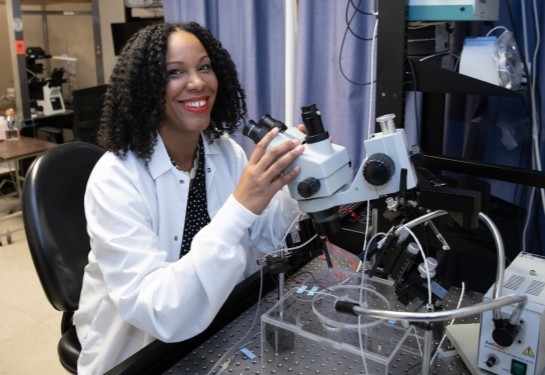
SACRAMENTO – Most people are familiar with the five senses: sight, hearing, smell, taste, and touch. However, few realize they possess another critical sense known as proprioception, which is the ability to perceive the position and movement of their body parts in space. This sense is vital for performing everyday activities, such as walking and reaching for objects, and is crucial for maintaining balance.
Theanne Griffith, a neuroscientist at UC Davis Health, has been awarded a prestigious five-year, $1.6 million National Science Foundation (NSF) CAREER Award to explore the development of this essential sensory system and its role in movement throughout life. The NSF CAREER Award is among the foundation’s most competitive honors for early-career faculty, recognizing outstanding researchers who excel in scientific discovery and education.
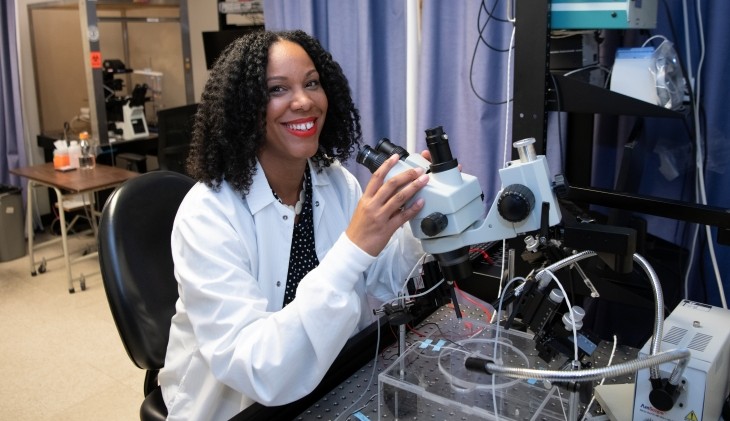
Neuroscientist Theanne Griffith has received a prestigious grant to study proprioception — the nervous system’s internal guide for coordinating movement.
Griffith’s research centers on specialized sensory neurons called proprioceptors, which detect changes in muscle movement and force, relaying this information to the spinal cord. These signals form the nervous system’s internal guide for coordinating movement, aiding in tasks that require speed, accuracy, and precision.
“Proprioception is one of the most important senses that most people have never heard of,” stated Griffith. “Every step we take depends on our brain and body constantly communicating about where we are in space. I’m excited to explore how that communication develops and what it can teach us about movement, neurodevelopment, and neurological disorders.”
Investigating Sodium Channels in Nerve Cells
Her project will focus on sodium channels, specialized proteins in nerve cells that produce electrical signals, examining how they evolve as children develop more complex motor skills. While many sodium channel mutations have been linked to neurodevelopmental disorders, research has traditionally concentrated on their impact on the brain. Griffith’s work investigates whether some movement challenges related to these disorders may also originate from disruptions in proprioception.
Her laboratory will utilize a novel genetic approach that allows for precise study of sodium channels in proprioceptors. By investigating the functionality and evolution of these channels throughout development, the team aims to gain insights into sensory circuit maturation and its contribution to healthy movement.
“Every step we take depends on our brain and body constantly communicating about where we are in space. I’m excited to explore how that communication develops and what it can teach us about movement, neurodevelopment, and neurological disorders.”
— Theanne Griffith, Associate Professor, Department of Physiology and Membrane Biology
Fostering Future Scientists
In addition to advancing the field of neuroscience, Griffith’s award will fund summer research experiences for undergraduate students from California State University campuses through UC Davis programs aimed at increasing access to graduate education and research careers. Griffith’s commitment to developing future scientists aligns with her mentorship efforts and her authorship of The Magnificent Makers, a children’s book series that promotes scientific exploration through curiosity and experimentation.
In recognition of her leadership in research and mentorship, Griffith was named a Freeman Hrabowski Scholar by the Howard Hughes Medical Institute last year. Her new NSF CAREER Award builds on this momentum.
Griffith expressed her enthusiasm for inspiring the next generation of scientists while facilitating discoveries that could illuminate how the nervous system develops its remarkable capacity to sense and control movement.


