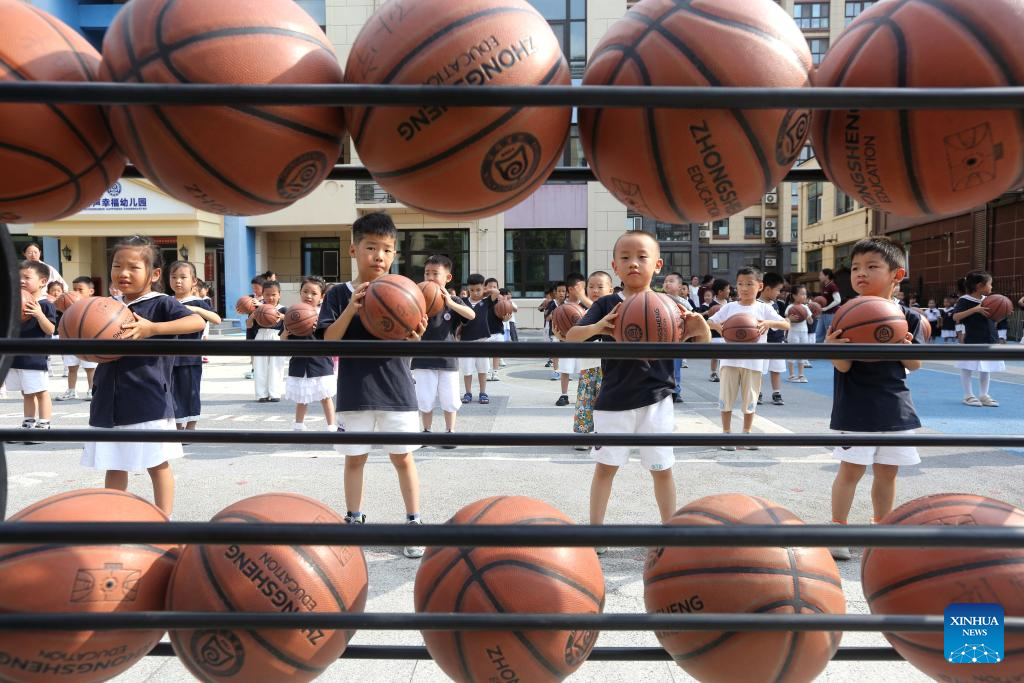
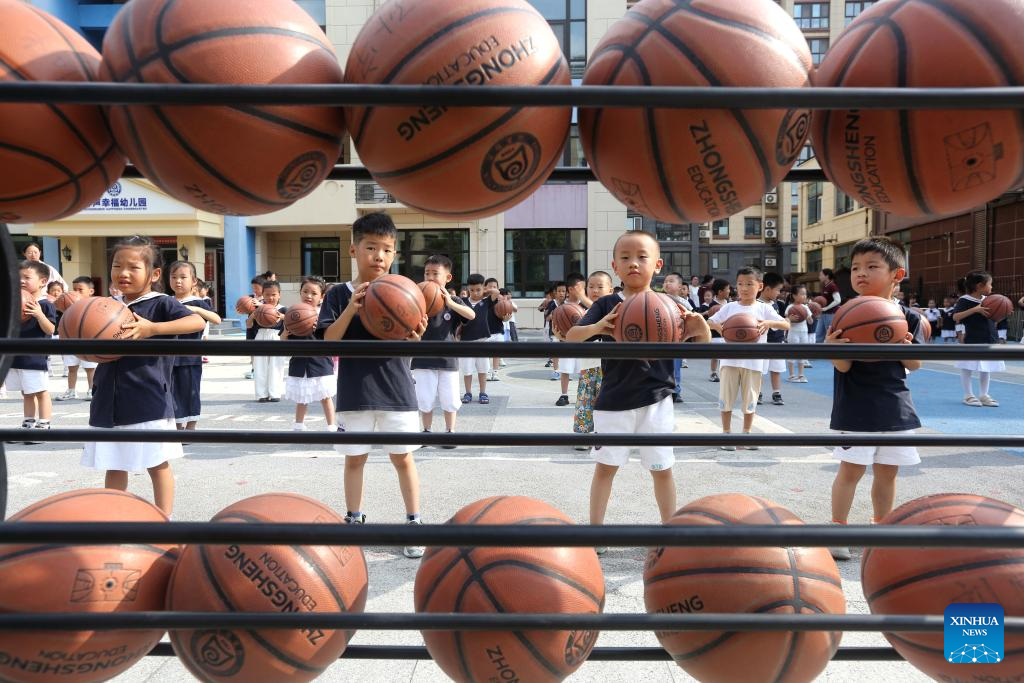
Children practice freestyle basketball at a kindergarten in Lianyungang, Jiangsu Province, China, on August 8, 2025. (Photo by Wang Chun/Xinhua)
Physical fitness and regular exercise play a crucial role in maintaining a healthy lifestyle. In recent years, China has made significant strides in promoting fitness across its vast population. By 2025, 38.5% of the nation’s 1.4 billion people participated in regular physical activities, showcasing a growing commitment to public health and fitness.
The expansion of public sports facilities has been impressive, with the national fitness service reaching deeper into local communities. By 2025, China boasted over 5 million sports venues, offering a total area of 4.37 billion square meters. This equates to 3.11 square meters of venue space per person, enhancing access to recreational activities.
During the 14th Five-Year Plan (2021-2025), more than 1,500 new sports parks were established nationwide, surpassing the initial target of 1,000. This increase significantly contributes to local fitness culture, making it easier for individuals to engage in physical activity without extensive travel.
Accessibility has been a key factor in encouraging fitness. According to surveys, 90.4% of residents aged 19 and up have sports facilities within a convenient 15-minute walk or bike ride from their homes. Compact fitness centers, pocket parks, and multi-use courts are becoming commonplace, allowing residents to incorporate exercise into their daily routines seamlessly.
Bao Mingxiao, a professor at Beijing Sport University, highlights the importance of convenience in meeting public fitness demands. When sports facilities are integrated into communities, individuals are more likely to view exercise as a normal part of their everyday lives.
Not only are facilities becoming more accessible, but the variety of events and services is also expanding. Around National Fitness Day on August 8, 2025, over 22,000 sporting events took place across the country, attracting more than 11 million participants. Additionally, a nationwide online fitness campaign saw participation from over 58.61 million individuals over its four iterations.
Financial investments in sports have also evolved. In 2025, residents aged 19-59 spent an average of 2,428 yuan ($353) on sports activities, while those aged 60 and above spent 1,451 yuan. Notably, nearly 50% of sports-related expenditures were service-based, reflecting a shift in focus toward training, experiences, event participation, and health services rather than just equipment and apparel.
As fitness needs become more diverse, supporting structures are adapting accordingly. By the end of October 2025, China had over 3.9 million social sports instructors—approximately 2.77 for every 1,000 people—and established 375 national physical fitness monitoring stations to help guide fitness initiatives.
Looking ahead, the 15th Five-Year Plan (2026-2030) aims to raise the proportion of the population that exercises regularly to around 40% by its conclusion. This plan emphasizes not only increasing access to fitness services but also enhancing their quality, indicating a shift toward more refined and effective fitness solutions for the populace.
In conclusion, as China continues to invest in public fitness and sports infrastructure, the focus on accessibility and quality will undoubtedly pave the way for healthier lifestyles. By making exercise a convenient and integral part of everyday life, the nation seeks to create a stronger, more active population.