West Africa is recognized for having one of the most mobile populations globally. Since its establishment in 1979, the Economic Community of West African States (Ecowas) has enabled citizens of its member countries to travel freely across borders without requiring visas.
<p>This freedom has bolstered <a href="https://link.springer.com/chapter/10.1007/978-3-030-97322-3_2?utm_source=chatgpt.com">regional trade, labor mobility, and social connections</a>. However, advancements in technology are reshaping border management with significant implications for human rights. </p>
<p>Across West Africa, governments are implementing <a href="https://theconversation.com/biometric-ids-are-being-rolled-out-in-africa-study-reveals-the-risks-and-pitfalls-273510">biometric identification systems</a>, facial recognition technologies, and artificial intelligence tools at airports and land crossings. </p>
<p>As a <a href="https://scholar.google.com/citations?user=P7z_3QkAAAAJ&hl=en">researcher</a> specializing in international law and human rights, I have recently published a <a href="https://www.tandfonline.com/doi/full/10.1080/02589346.2026.2622779">study</a> addressing these trends. I highlight how the rise of AI-driven border surveillance poses risks to migrants' rights, compromises data protection, and challenges the region's longstanding commitment to free movement.</p>
<p>While these systems hold promise for combating terrorism, human trafficking, and irregular migration, they also present serious concerns regarding privacy, discrimination, and the future of regional mobility.</p>
<h2>The Rise of ‘Digital Borders’</h2>
<p>Historically, borders in West Africa have been lightly regulated. Many crossing points lacked advanced technologies, relying instead on trust and travel documents. This landscape is evolving rapidly.</p>
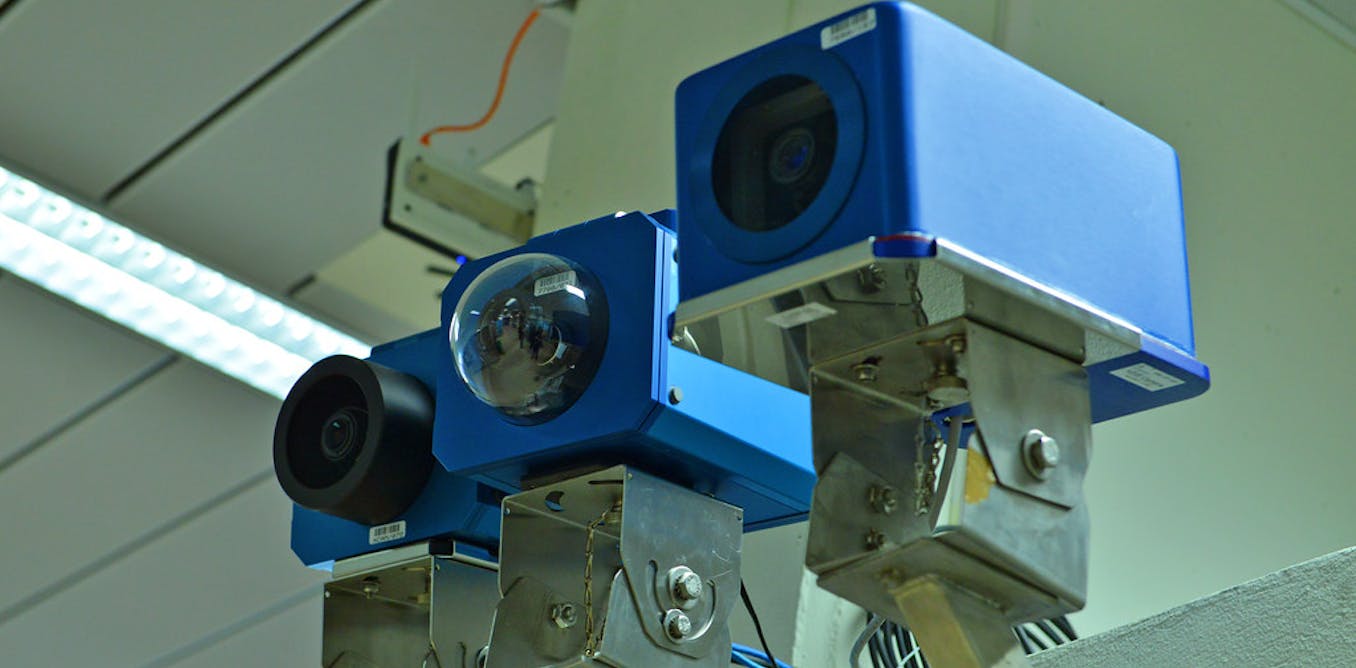
<p>In the past decade, governments have turned to technology to enhance border security and identification processes. This has involved the adoption of surveillance equipment such as cameras and digital systems designed to monitor and record people's movements.</p>
<p>Border posts are being modernized with biometric scanners, centralized databases, and automated management systems. For instance, Nigeria now issues biometric passports and requires residents to register national identification numbers that contain biometric data. Immigration authorities have also implemented biometric screening at major airports and border crossings.</p>
<p>Artificial intelligence is now employed to analyze travel data and identify suspicious patterns, thereby aiding authorities in spotting fraudulent documents or potential security threats. This shift has introduced the concept of “digital borders,” where access to a country hinges not only on physical checkpoints but also on the data stored in digital records.</p>
<h2>Europe’s Influence on African Border Technology</h2>
<p>The development of digital border systems in West Africa occurs within a broader context influenced by European migration policies. Over the past decade, the European Union has sought to control migration before it reaches European soil, a strategy known as “<a href="https://www.europeanpapers.eu/e-journal/externalisation-eu-migration-policies-constitutional-principles-values-introduction#:%7E:text=The%20externalization%20of%20EU%20migration%20policies%20has,*%20**Transferring%20the%20burden%20of%20protection%20responsibilities**">migration externalisation</a>.” This entails financing border control initiatives in countries from which migrants depart or transit.</p>
<pThrough programs like the <a href="https://trust-fund-for-africa.europa.eu/homepage_en?utm_source=chatgpt.com">EU Emergency Trust Fund for Africa</a>, European institutions have supported the establishment of control systems throughout West Africa. While framed as developmental assistance for governance enhancement, these projects also serve to enable European governments to identify and deport migrants reaching their shores by verifying their nationalities through biometric data collected in their home countries. Critics argue that this essentially transfers Europe’s border enforcement responsibilities to Africa.</p>
<h2>Nigeria and Niger Show Two Different Paths</h2>
<p>The effects of these technologies are evident when comparing Nigeria and Niger. This study reveals that Nigeria has gradually integrated biometric and digital tools into its immigration framework. While these advances help to modernize border management, they also raise concerns regarding the collection, storage, and sharing of personal data. Nigeria has enacted data protection <a href="https://ndpc.gov.ng/wp-content/uploads/2025/07/NDP-ACT-GAID-2025-MARCH-20TH.pdf">laws</a>, but their enforcement is inconsistent, leaving migrants with limited avenues to challenge the use of their biometric information.</p>
<p>Niger, on the other hand, illustrates a contrasting scenario. Historically, it has served as a transit hub for migrants trekking through the Sahara toward Europe. Under pressure from the European Union, Niger enacted <a href="https://www.clingendael.org/publication/nigers-repeal-201536-anti-smuggling-law">strict anti-smuggling legislation</a> in 2015 and enhanced surveillance of migration routes. However, in 2023, following a military coup, the new government repealed those laws and distanced itself from European migration policies, effectively reopening migration pathways.</p>
<h2>Risks for Privacy and Migrants' Rights</h2>
<p>While AI technologies can enhance efficiency and improve border management, they also pose significant risks, especially regarding privacy.</p>
<p>Biometric data, encompassing fingerprints and facial scans, is highly sensitive. Once collected, this data can be stored indefinitely and shared across multiple databases. Migrants often lack transparency regarding how their data will be utilized or whether it may be shared with foreign governments.</p>
<p>Another pressing concern is algorithmic discrimination. AI systems used for border control often rely on historical data to identify patterns. If past enforcement disproportionately affected certain nationalities or ethnic groups, these biases may be ingrained in automated decision-making, resulting in some travelers facing additional scrutiny or being denied entry.</p>
<p>Furthermore, digital border systems threaten to erode the Ecowas free movement framework if they are employed to hinder rather than facilitate mobility.</p>
<h2>Why Are Regional Rules Needed?</h2>
<p>West Africa possesses existing legal frameworks that could regulate these emerging technologies effectively.</p>
<p>The <a href="https://au.int/sites/default/files/treaties/36403-treaty-protocol_on_free_movement_of_persons_in_africa_e.pdf">1979 Ecowas Protocol on Free Movement</a> affirms the right of movement for citizens of its member nations. Additionally, the <a href="https://au.int/en/treaties/african-charter-human-and-peoples-rights">African Charter on Human and Peoples’ Rights</a> safeguards freedom of movement and prohibits discrimination. However, these laws were crafted prior to the advent of artificial intelligence and biometric surveillance. Without updated regulations, governments risk adopting powerful surveillance mechanisms with inadequate protections.</p>
<p>Ecowas has the opportunity to establish regional guidelines regarding AI and border governance. This framework could build on existing initiatives, such as the African Union’s <a href="https://au.int/sites/default/files/documents/44004-doc-EN-_Continental_AI_Strategy_July_2024.pdf">Continental Artificial Intelligence Strategy</a> and the <a href="https://oecd.ai/en/wonk/documents/g20-ai-principles">G20 AI Principles</a>. Such guidelines could encompass rules on data protection, transparency in algorithmic decisions, and independent oversight of surveillance practices. Similar safeguards are already being implemented in other regions, including the <a href="https://artificialintelligenceact.eu">European Union’s Artificial Intelligence Act</a>.</p>
<p>As artificial intelligence continues to play an increasingly prominent role in border management globally, the key question is not if West Africa will adopt these technologies, but rather how they will be governed. The region is well-positioned to develop a model centered on the principles of human rights.</p>