Here’s a summary of the information from the article:
Tidal Tomography Unveils Mars’ Interior
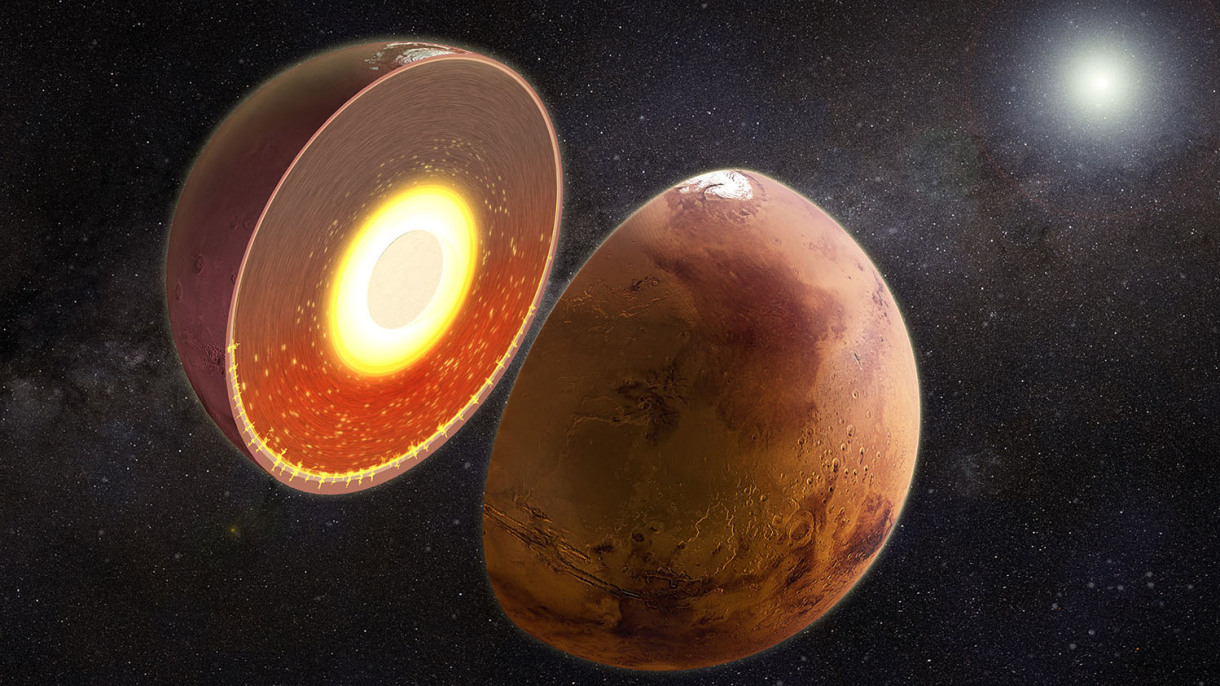
Researchers at Brown University have advanced a technique called tidal tomography, allowing scientists to gain insights into the internal structures of celestial bodies like Mars, using data from existing satellites. A study in the journal Nature highlighted a significant heat anomaly in Mars’ southern hemisphere, suggesting temperatures 200 to 400 degrees Celsius higher than the rest of the planet.
Key Findings:
- Mars exhibits a tidal bulge caused by the Sun’s gravitational pull, which deforms the planet and changes its gravitational pull.
- Data from three spacecraft over 16 years was analyzed to understand this deformation.
- The study revealed that the southern hemisphere’s interior is approximately 20% less rigid than the northern hemisphere, likely due to temperature differences.
Importance of the Research:
Understanding the interior of Mars can provide insights into how it has evolved compared to Earth, a practice known as “comparative planetology.” It raises questions about the planet’s history and why its surface once contained water.
Future Directions:
- The researchers aim to explore whether the temperature differences stem from Mars’ formation or from historical impacts.
- There’s potential to apply tidal tomography to study the Moon’s interior as well.
This summary encapsulates the core findings and implications of the study without losing the essential details.


