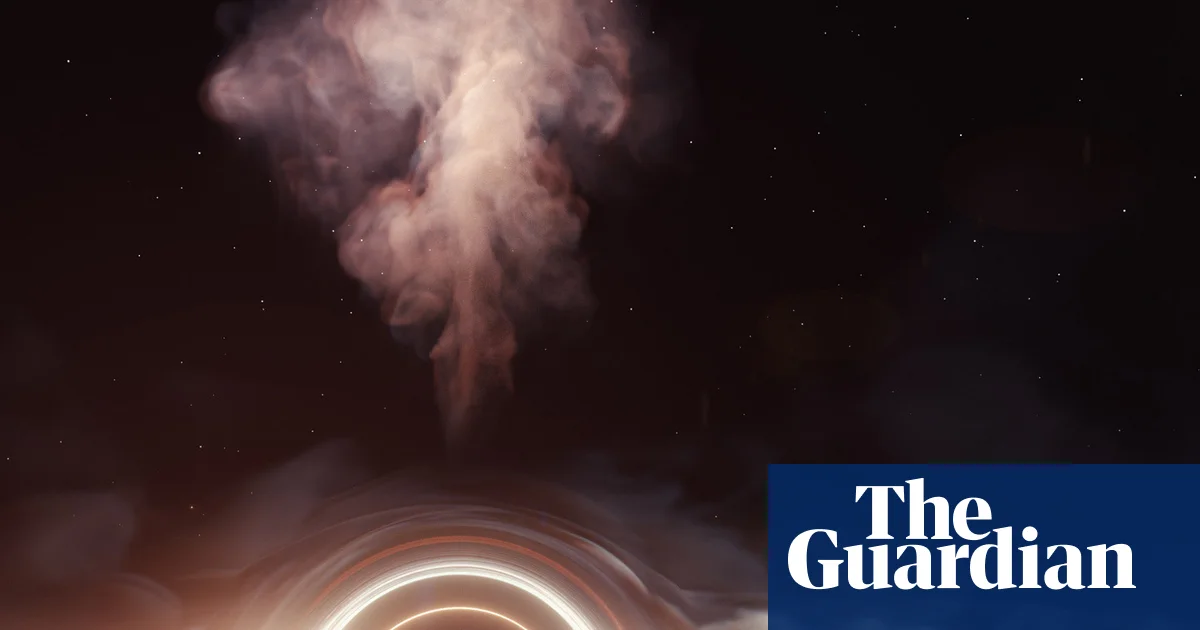
Scientists have uncovered when black holes “burp” — releasing jets after consuming stars and ejecting material into space. Black holes possess such intense gravity that not even light can escape their grasp beyond the event horizon, the point of no return.
Astrophysicist Dr. Adelle Goodwin from Curtin University describes black holes as “messy eaters,” noting that stars can be destroyed outside the event horizon. Despite their notorious reputation, only about half of a star that ventures too close is absorbed by the black hole; the remainder is expelled as powerful jets that can affect galaxy evolution.
Previously, the timing of these “burps” was unclear, happening unpredictably from one to several years after a star’s destruction. Recent research published in Nature Astronomy has addressed this mystery by analyzing 20 tidal disruption events of stars by supermassive black holes using radio telescopes, which are ideal for observing jets in action.
They discovered that these giants, ranging from hundreds of thousands to billions of solar masses, emit jets in two distinct phases: first during rapid feeding, and again hundreds to thousands of days later, once the feeding rate decreases significantly. This threshold also triggers jets in smaller stellar-mass black holes.
The consistency across different black hole sizes provides a basis for predicting jet emissions, which could optimize telescope observations and deepen our understanding of these mysterious cosmic entities.
Dr. Sara Webb from Swinburne University remarked on the predictability of supermassive black holes’ behavior at different evolutionary stages, underscoring the ongoing quest to unravel the properties of these extreme astronomical phenomena.


