The Helix Nebula: A Cosmic Recycling Process
Overview:
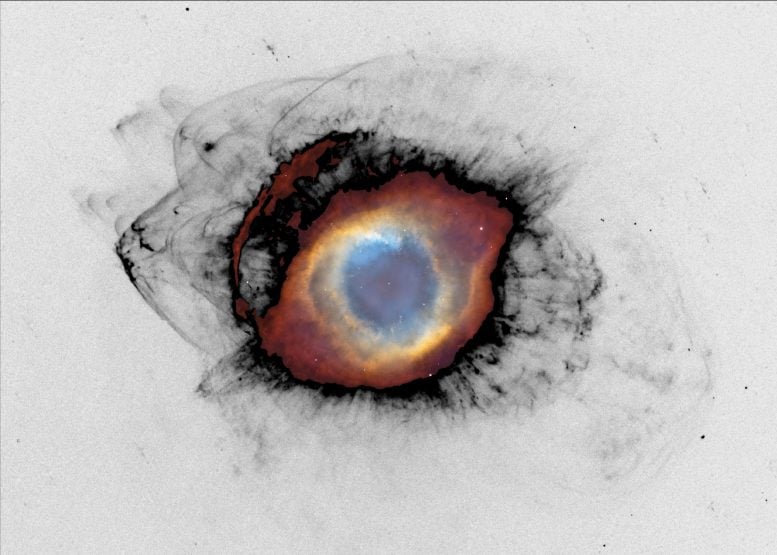
The Helix Nebula, located roughly 650 light-years from Earth in the constellation Aquarius, provides a detailed view of how dying stars return material to the galaxy. New observations reveal that fragments of material expelled by the dying star collide with surrounding gas, breaking apart and beginning their journey back into interstellar space.
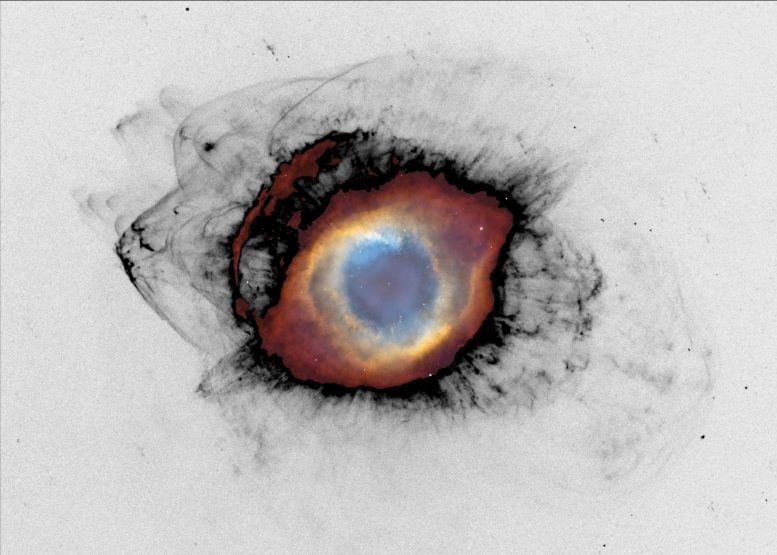
Credit: NASA, ESA, C. R. O’Dell (Vanderbilt University), M. Meixner, P. McCullough, G. Bacon (Space Telescope Science Institute)
Key Findings:
- Stellar Material Recycling: As the Helix Nebula’s central white dwarf expels material, it creates bow shocks—structures formed when stellar debris collides with interstellar gas.
- Recycling Cycle: Material from dying stars could eventually be incorporated into new stars, clouds, and planets.
- Observational Breakthrough: The recent study captures a phase of this recycling process that has been difficult for astronomers to observe, offering insights into the distant future of our Sun as it approaches a similar fate.
Research Context:
The study, published in Nature, highlights ongoing efforts to understand stellar evolution and is led by Pieter van Dokkum and an international team including Northwestern University astrophysicists. The researchers initially aimed to test a new telescope, MOTHRA, using the Helix Nebula as a calibration target. Surprisingly, they uncovered a network of bow-shaped structures, revealing details previously unexplored.
Structure and Observations
- Bow Shocks: Researchers identified 22 arc-shaped shock waves, resembling ripples created by a boat in water, which indicate where stellar debris interacts with surrounding gas.
- Fragmentation Process: Clumps of stellar material remain largely intact for around 10,000 years before being broken apart and dispersed into space.
The Future of Observational Astronomy
The MOTHRA (Modular Optical Telephoto Hyperspectral Robotic Array) system, once completed, will use advanced lenses and filters to detect faint gas emissions over broad areas—potentially revealing even more about cosmic phenomena like the Helix Nebula.
Further Reading:
For a deeper dive into the findings, check the full study in Nature here.
Conclusion
This research not only enhances our understanding of stellar evolution but also underscores the role of dying stars in the cosmic recycling process, illustrating how materials are continuously remixed in the galaxy.


