Study Reveals Hidden Disorder in Twisted Two-Dimensional Semiconductors
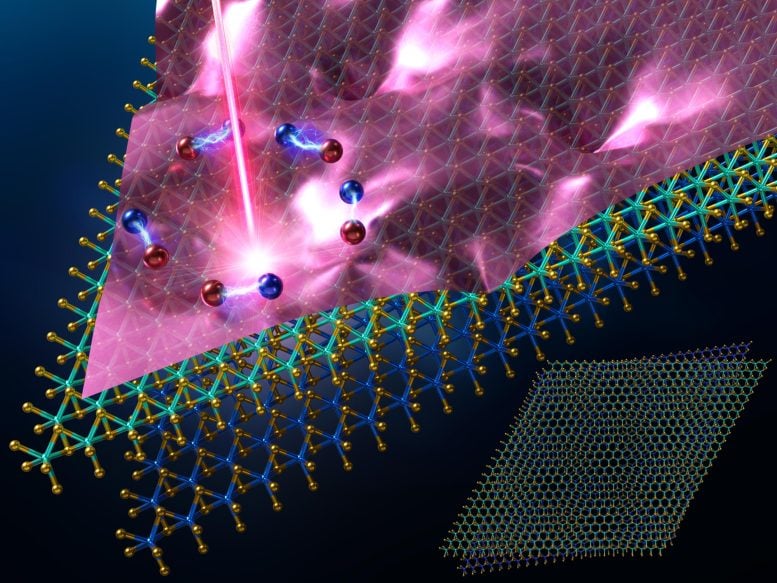
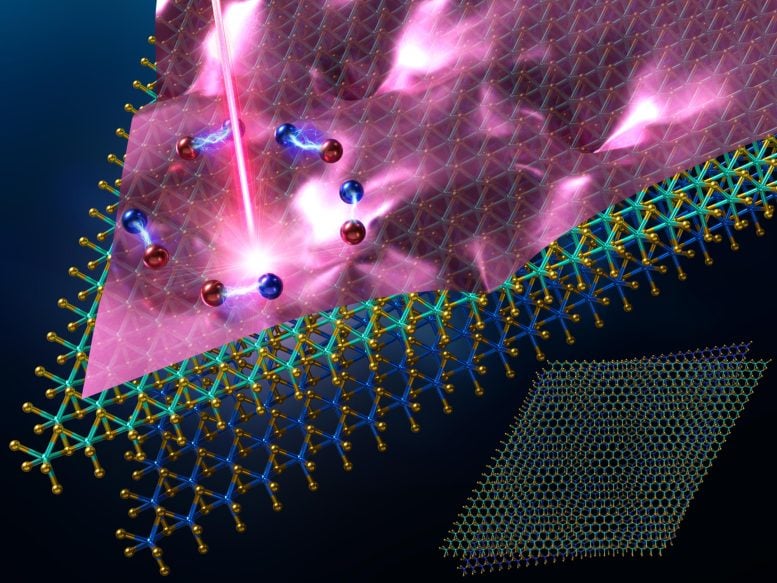
In a twisted MoSe2/WSe2 moiré heterostructure, photoluminescence varies from point to point as excitons respond to both smooth disorder and local trap-like sites. Credit: Research Center for Materials Nanoarchitectonics (MANA), NIMS, and Issey Takahashi.
Overview
A recent study led by Katsunori Wakabayashi at the Research Center for Materials Nanoarchitectonics (MANA) has unveiled two distinct forms of hidden disorder in ultrathin semiconductors. This research has significant implications for the development of advanced optical and quantum devices.
Key Findings
- Types of Disorder:
- Extended Background Disorder: Smooth variations across large areas of the material.
- Localized Defect Disorder: Concentrated around small defects, affecting light emission at precise points.
Challenges with Twisted Semiconductor Layers
- Moiré heterostructures, formed by stacking two thin semiconductor layers with slight twists, create complexities in light emission, resulting in numerous overlapping peaks in photoluminescence spectra.
- Traditional methods focusing on identifying individual spectral peaks are hindered due to the dense nature of these signals.
New Analytical Approach
- Framework Development: Wakabayashi’s new mathematical framework analyzes spectral properties like peak energy and average emission energy across the surface of the material.
- Disorder Inference: By examining spatial variations in spectral measurements, this method reveals underlying disorder characteristics without needing to assign every peak to a specific origin.
Implications for Material Quality
This innovative approach could enhance the quality and consistency of semiconductor manufacturing, aiding in the development of materials for light-emitting devices, optical sensors, and quantum technologies.
Reference
Hierarchical disorder in moiré exciton photoluminescence probed by spectral-descriptor correlations
Katsunori Wakabayashi, Physical Review Research, August 7, 2026.
DOI: 10.1103/jt25-c8fp
For ongoing updates in the field, consider joining the SciTechDaily newsletter and following us on Google News.


