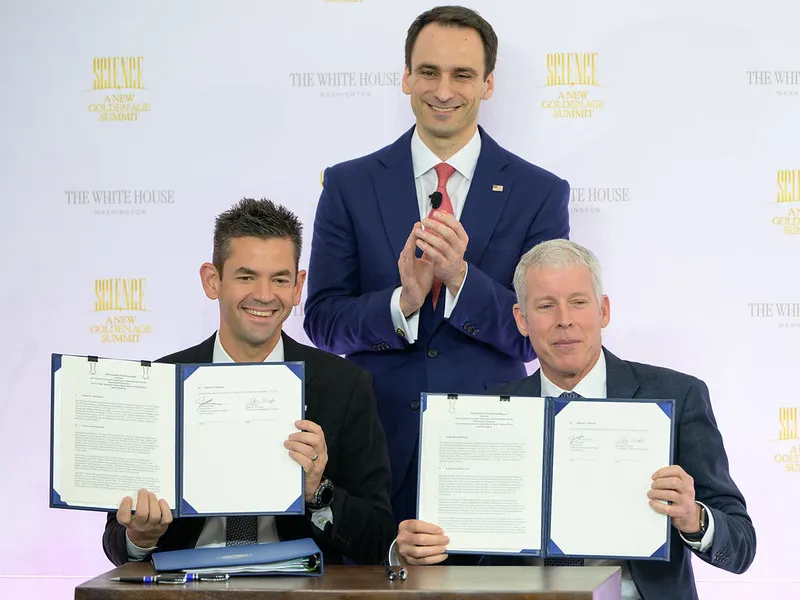
On Thursday, the White House Office of Science and Technology Policy (OSTP) organized the “Science: A New Golden Age Summit” to follow up on the July report highlighting the U.S. scientific revival.
A significant announcement during the summit was the partnership between NASA Administrator Jared Isaacman and Energy Secretary Chris Wright to enhance collaboration on space nuclear power and propulsion. This initiative is integral to NASA’s lunar base plans, which Isaacman provided updates on.
This agreement is part of a larger $6B federal science initiative, which includes funding for 10 NASA Genesis Mission Fellows—PhD students specializing in AI, science, or engineering.
Isaacman drew a parallel between past and present, stating that just as Adm. Hyman Rickover envisioned nuclear power revolutionizing naval capabilities, NASA and the DOE are positioned to do the same for space exploration. The upcoming SR-1 Freedom spacecraft, set to launch in 2028, will be pivotal in this undertaking.
The fine details reveal that the agreement outlines collaborative efforts between NASA and DOE in designing and deploying nuclear systems, reinforcing commitments outlined in President Trump’s 2025 space superiority executive order. Key projects include:
- Space Reactor-1 Freedom: Scheduled to demonstrate nuclear electric propulsion on a Mars mission by 2028.
- Lunar Reactor-1: A fission-powered reactor to support lunar operations, expected to be ready for launch by 2030.
- Radioisotope Power: Systems for upcoming missions such as Titan rotorcraft Dragonfly and ESA’s Rosalind Franklin Mars rover.
Isaacman presented SR-1 as the inaugural step toward an “Apollo-like endeavor,” aimed at developing enhanced materials and technologies for future Mars missions.
This memorandum of understanding solidifies previously established plans rather than introduce new initiatives. Observers note that while no additional funding figures were announced, the framework is essential for executing nuclear projects.
Industry perspectives highlight the memorandum’s importance in transitioning from theoretical designs to concrete, operational space reactors by 2028.
Additionally, Isaacman informed OSTP Director Michael Kratsios that NASA aims to exceed the national space policy objective of establishing the first Moon Base components by 2030, with the first element expected to launch in December, followed by regular uncrewed robotic missions from early 2027. As astronauts arrive, rovers and equipment will be prepared and operational, with a commitment to transparency reflected through a public-facing website that will document the Moon Base’s construction.


