Overview of Fast Radio Bursts (FRBs)
First discovered in 2007, fast radio bursts (FRBs) are brief pulses of radio emission from distant regions of the universe. Their origins remain largely mysterious, as most are transient events that are observed only once. Recent advancements with NASA’s James Webb Space Telescope have allowed astronomers to identify the host galaxy of the most distant FRB recorded, providing crucial insights into the processes that may generate these bursts.
Key Findings
-
Detection of FRB 20240304B:
- The MeerTRAP team identified this burst using the MeerKAT telescope on March 4, 2024.
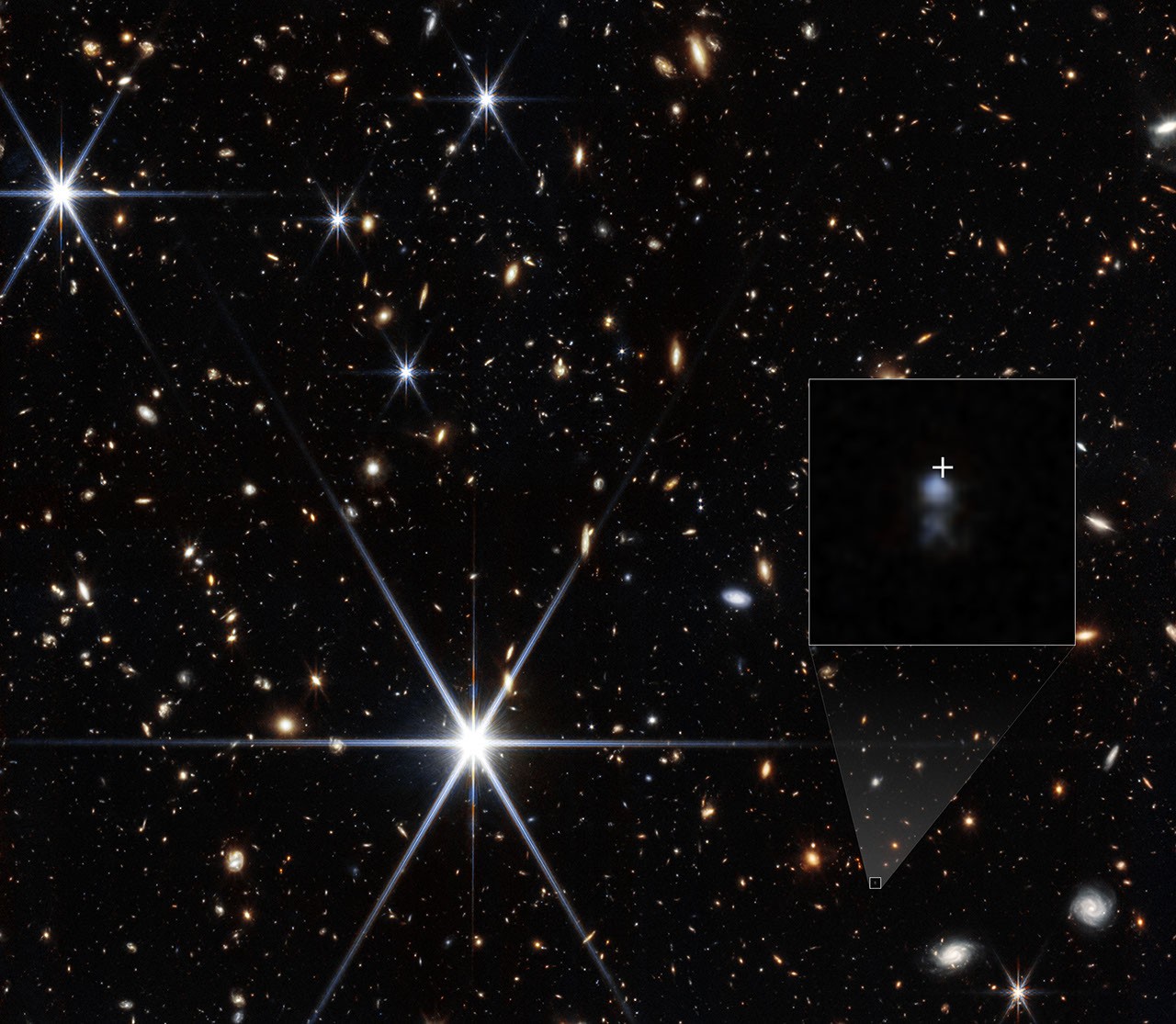
- Its extreme distance needed confirmation from a host galaxy, which could not be located using ground-based telescopes, prompting the use of the Webb telescope.
-
Host Galaxy Characteristics:
- Webb’s NIRCam detected a small dwarf galaxy at a redshift of 2.148, indicating it existed roughly 3 billion years after the Big Bang.
- This galaxy is significantly less massive than typical FRB host galaxies, which are usually larger, star-forming galaxies.
-
Implications for FRB Origins:
-
The findings challenge the predominant theories for FRB origins:
- Neutron Star Mergers: Expected to occur in older galaxies due to the billions of years required for merging.
- Magnetars: Young, highly magnetic neutron stars that can produce FRBs soon after supernova explosions, supporting the case for younger galaxies like the observed dwarf galaxy.
-
The discovery suggests that FRB 20240304B was likely not produced by a neutron star merger, providing evidence against this theory.
-
Cosmic Significance
The team’s discoveries not only enhance our understanding of FRBs but also contribute valuable data regarding the “cosmic web,” revealing structures and matter otherwise invisible in the vastness of space. They identified imprints from two cosmic structures on the burst’s signal, highlighting its utility as a cosmic diagnostic tool.
Future Prospects
As telescope technology advances, the team anticipates the detection of more distant FRBs, potentially observing several events per year at redshifts greater than 1.0. The James Webb Space Telescope will continue to play a vital role in characterizing these far-off galaxies and unlocking more secrets of the universe.
More Information
To dive deeper into Webb’s explorations and findings, visit: NASA Webb.


