China’s Ambitious Lunar Mission: Aiming for 2030
China is intensifying its efforts to land astronauts on the moon by 2030, transitioning from long-term plans to active preparations. The China Manned Space Agency (CMSA) reports fast-paced construction at the Wenchang Space Launch Center, including vital ground support systems and infrastructure for lunar missions.
Key components of the mission involve developing the Long March 10 rocket, Mengzhou crew spacecraft, and the Lanyue lunar lander. Each vehicle is undergoing critical tests to ensure reliability, with tests including pad abort and dynamic pressure escape flights.
Additionally, astronaut training is ongoing to equip them for the lunar environment, where they will utilize the Tansuo rover for scientific tasks and sample collection.
If successful, China will become the second nation to land astronauts on the moon, enhancing its position in global space exploration.
Orbital Station Developments
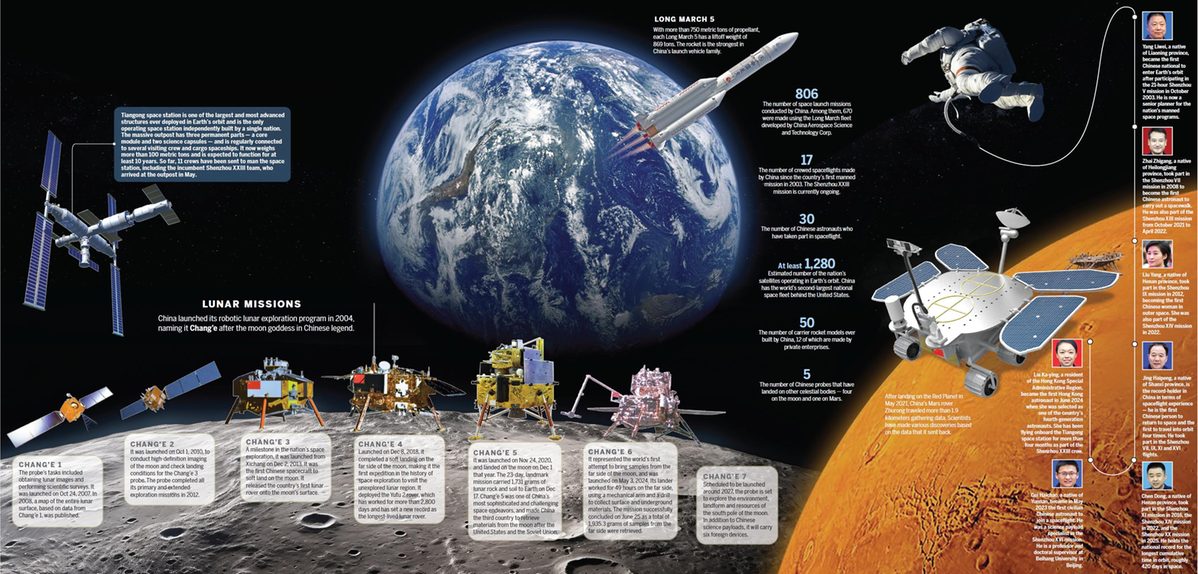
China’s confidence stems from its achievements in human spaceflight and robotic lunar exploration. The Tiangong space station, operating in low-Earth orbit since 2021, exemplifies the country’s manned space capabilities. The station supports scientific experimentation in various fields, having hosted 265 projects by the end of 2025.
The establishment of the Tiangong station marks the culmination of nearly three decades of planning and systematic approach to crewed space missions, culminating in the successful launch of key modules.
Deep-Space Exploration
China’s lunar program has evolved rapidly through successful robotic missions. Notably, the Chang’e missions have achieved significant milestones, including sample retrieval from both the near and far sides of the moon. The upcoming Chang’e 7 aims to explore the lunar south pole, seeking resources like water.
China has also made strides beyond the moon with the Tianwen 1 mission to Mars, deploying the Zhurong rover and collecting valuable scientific data. Following this, China is planning the Tianwen 2 asteroid sampling mission and future efforts to bring Martian samples back to Earth.
Private Sector Contributions
Besides state-funded missions, private companies like i-Space and LandSpace are emerging as key players in China’s space industry. These firms have successfully launched multiple rockets, developing significant technologies, including reusable rockets.
Overall, China’s rapidly evolving space program showcases its ambitions to be a leader in space exploration, with both government and private sectors making significant contributions.


