In recent discussions about diet, food processing and health, the focus on ultra-processed foods (UPFs) has intensified. On September 29, 2026, McGill University and the McGill Office of Science and Society hosted their annual Trottier Public Science Symposium titled Ultra-Processed Foods: Processing the Facts (video). Anticipating this event for months, I found it largely fulfilling, albeit with one notable exception addressed towards the end. The symposium began with Ashley Gearhardt presenting on “Can Ultra-Processed Foods Be Addictive? A Review of the Science.” This was followed by Kevin D. Hall discussing “Ultra-Processed Foods and Body Weight.”
The dialogue surrounding dietary guidelines dates back centuries. Hippocrates, known for the Hippocratic Oath, famously stated, “Let thy food be thy medicine.” Similarly, Luigi Cornaro (1456-1566) recommended a modest diet of just 350 grams of food and half a bottle of wine daily. This may have been one of the earliest caloric restriction diets. Sylvester Graham (1794-1851) encouraged a vegetarian diet rich in whole grains—a notion endorsed by Michael Pollan. Meanwhile, William Banting (1796-1878) advocated for a meat-heavy diet devoid of sugar and starch, setting the stage for contemporary diets like Atkins and Paleo. More recently, cardiologist Steven Gundry has controversially claimed that certain lectins—if not ingested properly—are detrimental. However, while willful ignorance of risk is unwise, many beans consumed in normal diets will not pose a threat. RFK Jr. also suggests substituting seed oils with beef tallow as a path to better health. While animal fat is not as villainized as once thought, nor are seed oils inherently harmful, they often serve as key components in UPFs. Today’s health influencers range from legitimate experts to questionable figures.
As the medical community strives to enhance nutrition education, various diets and dietary guidelines have been analyzed. Recently, the health implications of UPFs have become a focal point. Chris van Tulleken’s book, Ultra-Processed People: The Science Behind Food That Isn’t Food (2023), serves as a vital source for those analyzing this issue. UPFs are essentially food-like products made from commodity crops with additives to enhance flavor and texture. Dr. Gearhardt illustrates this by categorizing corn (maize) into three types:
- Unprocessed: Fresh or blanched corn—like freshly picked Silver Queen—is an example of real food.
- Minimally processed: Canned corn with added salt has a long shelf life and remains healthy and tasty, especially with real butter.
- Ultra-processed: Products like Nacho Cheese Doritos exemplify UPFs—hyper-palatable and indulgent, yet far from wholesome.
It becomes apparent which options constitute genuine food and which embody industrial production. There is no recipe for a Dorito. The same classification applies to UPFs dominated by soy and wheat, which along with corn, represent the Big Three inputs for these products. Concerns over their potential addictive qualities draw interesting parallels to Big Tobacco—also notorious for ultra-processing. Notably, many UPF producers were historically linked to tobacco corporations, highlighting a deeply interconnected narrative.
Among the speakers at the Trottier Symposium, Dr. Ashley Gearhardt from the University of Michigan proved to be more compelling. As an addiction psychologist, her focus on UPFs’ addictive potential is rooted in the language of those who struggle with them. Many describe overwhelming cravings and behaviors they recognize as harmful. Are such individuals correct in perceiving UPFs as addictive? While a definitive answer eludes us, Professor Gearhardt’s research, rooted in real-life experiences, is persuasive:
“I do it all the time, but one example is I went to [name of mall], which is 30 or 40 minutes away from my house just to get a Cinnabon [chuckle]; I got extra sauce on it… If I have other foods in the house… I might have my fruits and vegetables in there but I’ll still go to the store and get Reese’s peanut butter cups and then Doritos and two or three pops” (participant with severe food addiction and low food security).
This individual’s testimony resonates with the language of addiction, revealing a loss of control that some may interpret as irrational. Lacking universal biomarkers for addiction necessitates a psychological framework to understand the effects of UPFs on individuals. Yet, evidence suggests that the “dopamine rush” linked to reward and desire is very real, influenced by social interactions, much like the “likes” we chase on social media. The Yale Food Addiction Scale (YFAS), developed by her and her team, offers criteria for diagnosing food addiction, encapsulating factors such as loss of control, cravings, and the ability to resist temptation despite negative repercussions.
The creation of these so-called “addictive” products by major food corporations predates the UPF definition introduced by Carlos Monteiro and his associates in Brazil. In 2013, Michael Moss published Salt Sugar Fat: How the Food Giants Hooked Us. The concept of bliss point—finding the optimal combination of sugar, salt, and fat to achieve maximum palatability in food products—has its roots in research by Howard Moskowitz. The results are telling: over 90% of food items achieving their bliss point fall into the UPF category. This shows a clear intention; UPFs are designed, at minimum, to be habit-forming. Professor Gearhardt substantiates the stance that UPFs may be purposefully engineered to be addictive. If so, their consumption transcends the notion of free choice, contrasting with the claims of the Merchants of Doubt, who will likely advocate for their views despite evidence to the contrary.
What steps should be taken, then? Although Professor Gearhardt didn’t explicitly mention the Farm Bill in her presentation, its implications are clear. She rightly promotes the consumption of whole foods—though this shift hinges on government subsidies favoring healthy food production over the commodity crops that underpin animal feed and UPF creation. Only then can “healthy eating gain traction in grocery stores.”
A key takeaway from her talk is the pressing nature of these changes. The considerable evidence indicating that UPFs negatively impact health compels us to act now rather than wait for an elusive “scientific proof” that could never arrive. The public, too, appears receptive to reform, as illustrated by a 2025 poll from one of her laboratory’s studies published in the American Journal of Public Health in July 2026 (as referenced during her talk):
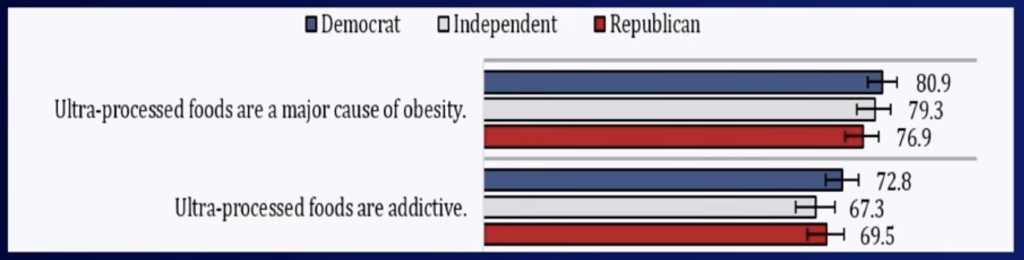
Approximately 80% of Americans across all political affiliations agree that “Ultra-Processed Foods are a major cause of obesity.” Moreover, around 70% of Americans concur that “Ultra-Processed Foods are addictive.” These statistics portray a profound consensus. What other topics see such widespread agreement? The shared experience is palpable: it’s nearly impossible to eat just one Nacho Cheese Dorito; this isn’t an accident of production but an intentional aspect of the product. Long before Dr. Luther Terry published the Surgeon General’s Study on Smoking and Health in 1964, cigarettes—arguably the first ultra-processed addictive commodity—were already viewed as “coffin nails.” Society recognized this harm and eventually took action. Addressing UPFs isn’t just a public health matter; it’s a political issue too, particularly in a system influenced by Big Agriculture and Big Food, especially in the context of the Citizens United Era.
In the second presentation, Dr. Kevin D. Hall, formerly of the National Institutes of Health, addressed “Ultra-Processed Foods and Body Weight.” He insightfully noted that being overweight shouldn’t be reduced to a moral failing, as biological aspects play a critical role in weight regulation, a concept recognized since the works of physiologists like Walter B. Cannon, who penned The Wisdom of the Body (1932), which still holds relevance today in discussions of physiological homeostasis.
Critics who assert that weight loss is achievable solely through calorie control miss the nuances of human biology. A person shedding pounds may experience an uptick in appetite that can overpower personal resolve. Furthermore, dietary composition significantly influences weight management, underscoring the intricate nature of metabolism and its interconnections to UPFs.
Dr. Hall presented groundbreaking findings revealing that individuals consuming high-UPF diets—compared to those on whole-foods diets—ingested 500 more calories daily, leading to weight gain (previously discussed here). Later studies imply that the appeal of UPFs might extend beyond mere dopamine responses, suggesting additional factors are at play. This understanding was partly why Hall decided to leave the National Institutes of Health, having faced restrictions on discussing findings contradicting prevailing narratives.
Current research from Hall’s group explores the mediators that contribute to the allure of UPFs, zeroing in on energy density and hyper-palatability. This is illustrated in a trial (currently unpublished) that utilized four varied diets, depicted below:
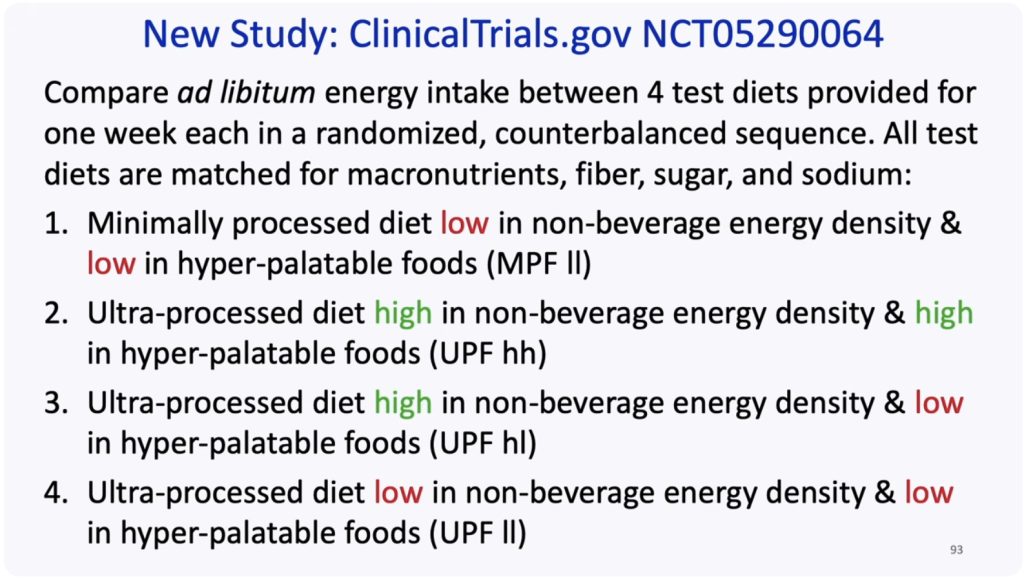
In simpler terms, the first diet resembles the typical whole-food diet that an average American might struggle to adopt. The second consists of UPFs engineered for high energy density and optimized for maximum tastiness. The third includes UPFs high in energy but lacking in taste, while the fourth features a low-energy density UPF diet that tastes poorly and lacks pleasing texture—counterproductive to the concept of UPFs.
The results reiterated previous findings: those on UPF diets consumed more calories and consequently gained weight:
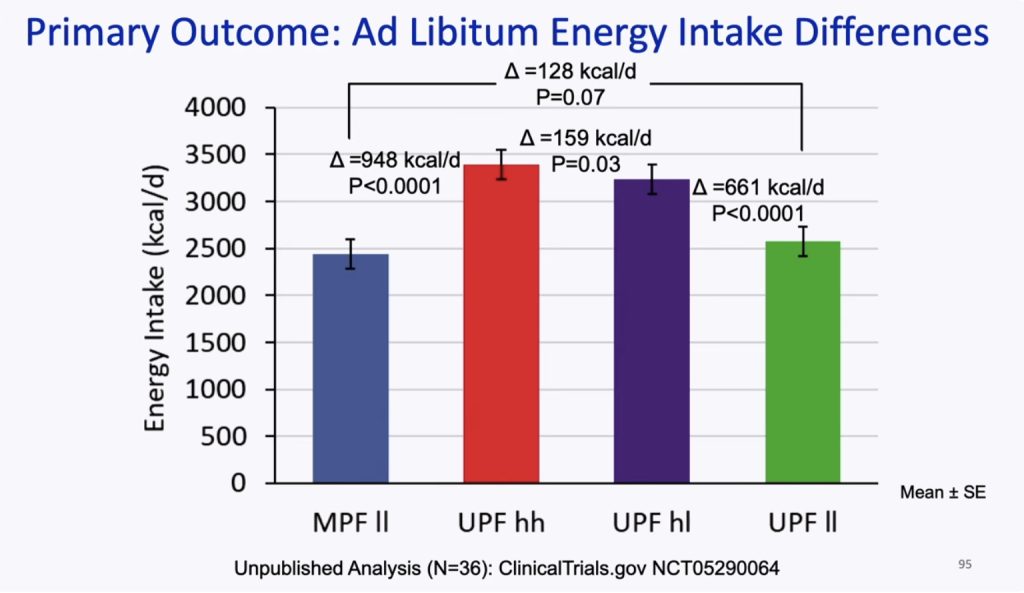
The minimally processed “whole food” diet (blue) resulted in the lowest energy intake, whereas the turbocharged UPF diet (red) resulted in the highest calorie consumption. The high-energy density but low-taste UPF diet (purple) was only marginally different from the standard UPF diet. Conversely, the “unpalatable” UPF diet (green) recorded calorie intake comparable to the whole food diet. These outcomes affirm that the food industry’s focus on marketing energy-dense, hyper-palatable products will lead to increased consumption, prioritizing corporate profit without accountability for health outcomes.
The resulting weight changes were consistent with expectations. Participants on the ultra-processed diet (red) experienced the most significant weight gain, while those on the whole-food diet (blue) lost weight:
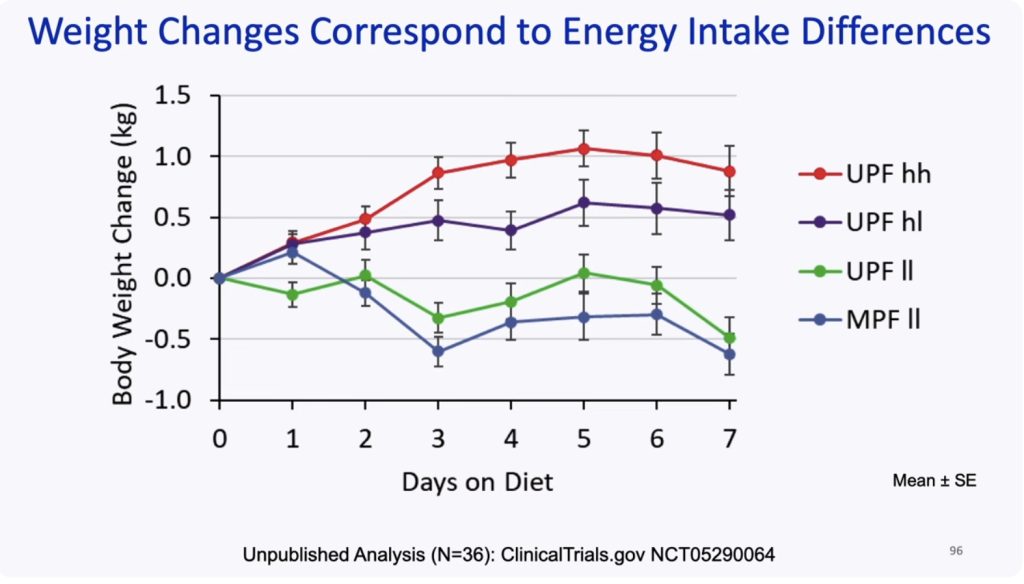
The trial’s findings provide solid backing for these claims. Yet, the overarching message remains complex, necessitating continued research. Dr. Hall did address issues within the American food system, pointing out the excessive production of “food,” largely comprising corn, soy, and wheat. This amounts to an astounding 15,000 calories available per person daily, much of which serves as animal feed in Concentrated Animal Feeding Operations (CAFOs), which emphasize profit at the expense of ethics and animal well-being, or is diverted into biofuels—a political maneuver benefiting regional interests rather than public health. Despite this production, data shows that merely one-third of these products are consumed.
This presents a significant environmental challenge. So, what actions can be taken? Dr. Ashley Gearhardt advocates for a revitalization of our food system, aimed at cultivating nutritious food while tackling the detrimental impacts of UPFs. Having been raised on a farm that did not grow actual food, she is acutely aware of these discrepancies. Both speakers align on the notion that UPFs are intricately tied to the ongoing obesity epidemic over the last fifty years. Gary Taubes and others have attributed this crisis to processed sugars that replaced fat calories in a demonized traditional American diet that pre-dated the 1970s. Even as we identify which elements are most harmful, the essential shift must be toward eating real food. Our health can improve if we adhere to the principle of consuming “real food, not too much, mostly plants,” as Michael Pollan advises. Additionally, ethically sourced non-industrial meat should have a place in a balanced whole-food diet. A thoughtfully crafted Farm Bill could facilitate this transition.
However, Dr. Kevin Hall’s conclusion was unexpected. Rather than championing a return to wholesome food production through federal support, he abruptly transitioned to promoting a pharmacological approach to obesity through tirzepatide, also known as Mounjaro and Zepbound. While these GLP-1 receptor agonists do influence weight by altering physiological balance, they represent a workaround rather than a solution to a deeper-rooted issue driven by politics. Is this approach sustainable within the framework of the American food system? Or does it simply sidestep the problem?
Ultimately, Dr. Ashley Gearhardt of the University of Michigan, who approached the issue with minimal industry ties, provided a more compelling case than Dr. Kevin D. Hall, currently involved with AstraZeneca Pharmaceuticals and serving as the Eddie Goldenberg Research Chair of Canada in Nutrition and Metabolic Health at the University of Ottawa.
His dual roles raise an important contradiction. My first post at Naked Capitalism examined The Illusion of Evidence-Based Medicine: Exposing the Crisis of Credibility in Clinical Research, reminding us that assessing evidence-based medicine (EBM) necessitates asking, “Whose evidence, for what purpose?” Understanding the funding sources of scientific inquiries can be instrumental in discerning authenticity.
As a final thought, it’s advisable to avoid the center aisles of grocery stores whenever possible, as endorsed by Marion Nestle in her work What to Eat Now. Enjoy your meals!
Note
[1] Efforts to include essential literature like this in the mandatory reading list for medical students have yet to bear fruit, but I remain hopeful it will gain recognition eventually. The science of nutrition and the associated politics of large-scale agriculture are fundamental drivers that we cannot afford to overlook.